
Lieferung heute & morgen

Qualitätsgarantie

Willkommens-Angebote freischalten: KOSTENLOSE Lieferung | Bis zu 80 % RABATT | Kostenlose 30-Tage-JoyPlus-Testphase
App herunterladen
An electric air pump can be useful in the boot, garage or when camping. However, models vary considerably in terms of power supply, airflow, battery life and operation. If you only look at a high PSI rating or a compact casing, you may end up buying a portable air pump that is not powerful enough for the intended use.
This buying guide explains which technical specifications matter, which marketing claims should be treated with caution and which product profile is best suited to different everyday needs.
Ratings such as 150 PSI, or even higher maximum values, describe the theoretical pressure the pump can reach. The tyre pressure recommended by the vehicle manufacturer is usually considerably lower. Actual inflation speed also depends on airflow, motor power, hose connection and operating time.
A 150 PSI tyre inflator may therefore be suitable for bicycle tyres or balls without being particularly quick at inflating a flat car tyre. As well as checking the maximum pressure, look at the airflow and inflation-time specifications.
A rechargeable air pump can be used flexibly, but it needs to be charged regularly. When inflating several car tyres, the battery life may be limited. Cold temperatures, battery age and repeated use can also affect the available power.
A corded car tyre inflator with a 12-volt connection is less independent, but can be used in the vehicle without being charged beforehand. A sufficient cable length and a suitable power source are important.
A digital tyre inflator with an LCD display and automatic shut-off makes operation easier. However, it cannot prevent you from setting the wrong target value. The correct pressure is specified on the vehicle, in the owner’s manual or on the sticker inside the door frame. The maximum pressure shown on the tyre sidewall is not automatically the recommended driving pressure.
Compact models are often sufficient for bicycles, balls and smaller inflatable items. For car tyres, an electric air pump should provide sufficient pressure and a clearly stated inflation performance. The specification in L/min describes the airflow; inflation time also depends on tyre size, starting pressure and target pressure.
A portable compressor with 26 L/min and 150 PSI, such as the Porbi Portable Air Pump Q16, should therefore be assessed differently from a model with a higher airflow but lower pressure intended for air mattresses. Do not compare products based on just one specification.
With corded models, the connection should be compatible with the vehicle. A 12-volt model is typically powered through the vehicle’s socket. During use, it may be advisable to run the engine in accordance with the manufacturer’s instructions, so that the vehicle battery is not unnecessarily strained.
For cordless models, battery capacity, charging time and operating time are key considerations. According to the product specifications, the Baseus GoTrip VA1 Super Mini Wireless Inflator has two 2,500 mAh battery cells. The Porbi Q16 specifies 4,000 mAh, a charging time of around 3.5 hours and an operating time of up to 25 minutes. Such figures should always be understood as manufacturer specifications rather than guaranteed real-world results.
Different valve connections are relevant for cars, motorbikes and bicycles. Check whether a Schrader connection, a Presta adapter and a ball needle are included. Air mattresses and other leisure products usually require additional nozzles.
Preset modes for cars, motorbikes, bicycles and balls are useful. Automatic shut-off can help prevent over-inflation, but does not replace checking the pressure reading. For longer operating cycles, it is also important to observe the cooling break specified by the manufacturer.
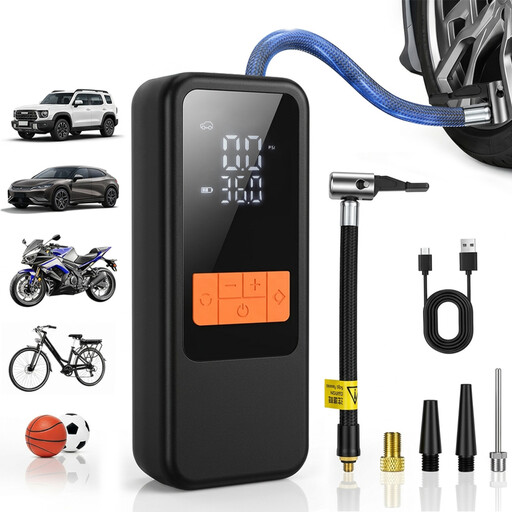
Why this product suits this profile: The Q16 combines battery operation, five preset modes and a compact design for occasional top-ups of car, motorbike and bicycle tyres.
The product specifications state not only 150 PSI, but also 26 L/min, an operating time of around 25 minutes and a charging time of approximately 3.5 hours.
Five modes, a Type-C connection, power-bank output, and an LED light with continuous and SOS modes.
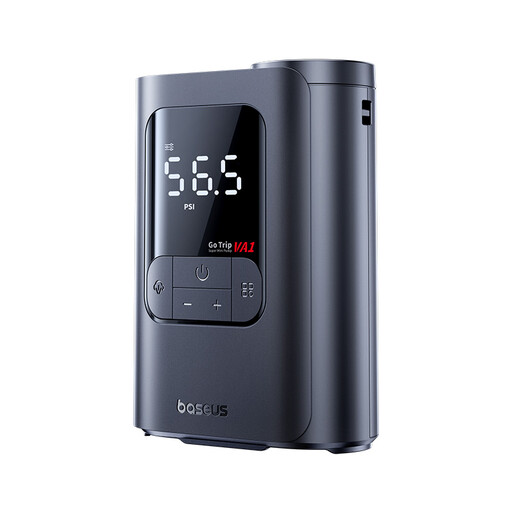
Why this product suits this profile: This cordless air pump is ideal for users who value compact dimensions, multiple modes and a stated level of pressure accuracy.
As well as its compact design, the product is specified with a pressure accuracy of ±0.05 bar and five inflation modes.
Two 2,500 mAh battery cells, USB-C charging, three nozzles and a weight of around 459 g according to the product description.
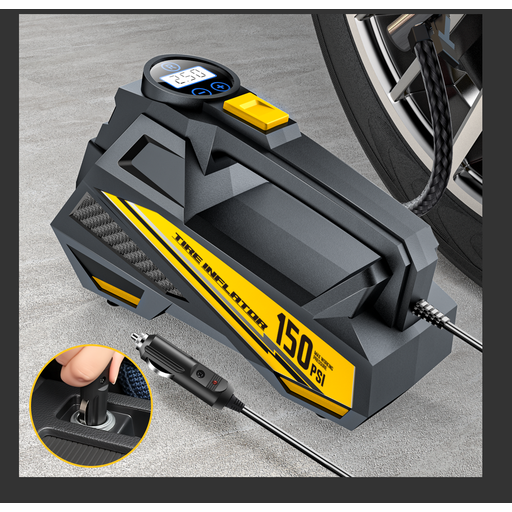
Why this product suits this profile: This corded air compressor for cars, motorbikes and bicycles is designed for use in a vehicle and does not require a charged internal battery.
The 12-volt power supply avoids reliance on a charged battery. Nevertheless, the specified cooling break after prolonged use should be observed.
Digital LCD display, four pressure units, preset modes, LED light and 150 PSI maximum pressure according to the product specifications.
We have put together a complete, regularly updated list of products that fully meet these strict selection criteria and the safety regulations applicable in the EU.
The key factor is not the maximum advertised figure, but your vehicle’s recommended tyre pressure. Many 150 PSI models cover the usual range for passenger-car tyres. Vans, motorhomes and heavy vehicles may, however, require specialist models with a higher airflow.
This depends on battery capacity, tyre size, starting pressure and target pressure. The Porbi Q16 and Q19 are specified with an operating time of around 25 minutes. According to the product data, this is approximately enough for two flat tyres of size 195, although actual battery life may vary. For regular, longer periods of use, a corded portable compressor may be a suitable alternative.
With battery-powered models, electricity consumption is limited to charging the battery. With 12-volt models, the load depends on motor power and operating time. For occasional pressure adjustments, energy consumption is generally manageable. It is important not to run the pump for longer than intended and not to drain the vehicle battery unnecessarily.