
Lieferung heute & morgen

Qualitätsgarantie

Willkommens-Angebote freischalten: KOSTENLOSE Lieferung | Bis zu 80 % RABATT | Kostenlose 30-Tage-JoyPlus-Testphase
App herunterladen
An electric air pump can be useful in the glove compartment, bike bag or camping gear. However, not every model is suitable for every application. A small rechargeable air pump for bicycle tyres is designed for different requirements than an electric pump for air mattresses. When inflating car tyres, it is not just the advertised PSI rating that matters, but also pressure measurement, power supply, accessories and everyday durability.
Specifications such as 150 PSI air pump primarily describe the maximum pressure that can be achieved under certain conditions. They say little about how quickly a flat car tyre can be inflated. A bicycle tyre usually requires only a small volume of air, whereas a car tyre needs considerably more time and motor power.
You should therefore also consider:
A very high maximum pressure is not automatically an advantage if the pump delivers too little air volume for larger tyres.
A cordless air pump can be used flexibly, but it needs a charged battery. Cold temperatures, frequent top-ups or inflating several tyres can reduce the available run time. Battery capacity should therefore be considered alongside charging time and maximum operating duration.
For occasional adjustments to bicycle or motorbike tyres, a compact rechargeable air pump may be sufficient. If you regularly want to inflate several car tyres, look for higher motor power, sufficient battery capacity or, alternatively, a 12-volt or mains connection.
A device can be technically suitable yet still be impractical if the right adapter is missing. Schrader valves on cars, Presta valves on bicycles, balls and air mattresses require different attachments. A short air hose or permanently integrated connection can also make the pump less convenient to use.
Before buying, check whether the hose, ball needle, bicycle adapter and nozzles for inflatable items are included.
A tyre inflator with a pressure display shows the current or selected pressure. Automatic shut-off is particularly useful, stopping the pump once the target pressure has been reached. This means you do not need to monitor the process as closely. The pressure unit should be switchable between PSI, BAR and kPa, as vehicle manufacturers in Germany often specify tyre pressure in BAR.
The target value shown on the pump does not replace the vehicle manufacturer's specification. For car tyres, the recommended pressure stated on the vehicle, in the handbook or on the fuel filler flap is the one that matters. For the most comparable measurement, tyres should generally be checked when cold.
The air flow rate affects how quickly an item can be inflated or deflated. A compact electric bicycle pump may be sufficient for individual top-ups. An electric pump for air mattresses, on the other hand, often needs to move considerably more air, as volume is just as important as pressure in this application.
For air mattresses, inflatable boats or large camping items, the model should explicitly be suitable for inflation and, where applicable, deflation. A mini tyre compressor is not automatically designed for large-volume leisure products.
A portable air pump should be suitable for the way you intend to carry it. Models weighing between 130 and 500 grams are more suitable for bicycles, rucksacks or glove compartments. Mains-powered pumps are better suited to indoor use and campsites with access to a socket.
An air pump with an LED light can be helpful in the event of a breakdown or when working in a dark cellar. However, the light is an additional feature, not a substitute for a high-visibility vest, torch or a secured breakdown location. Power bank, SOS or charging functions should also be regarded as useful extras.
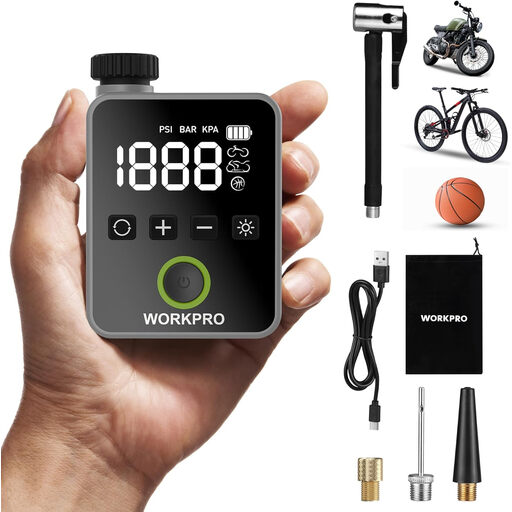
Why this product suits this profile: According to the product specifications, this compact cordless model weighs 270 g and can be stored in the glove compartment or rucksack with its case. It is intended for bicycles, motorbikes, balls and selected tyre pressure adjustments.
The four operating modes, digital display and automatic shut-off make the intended use clearer than a maximum-pressure rating alone.
Pressure range from 3 to 140 PSI, PSI, BAR and kPa units, plus four included nozzles.
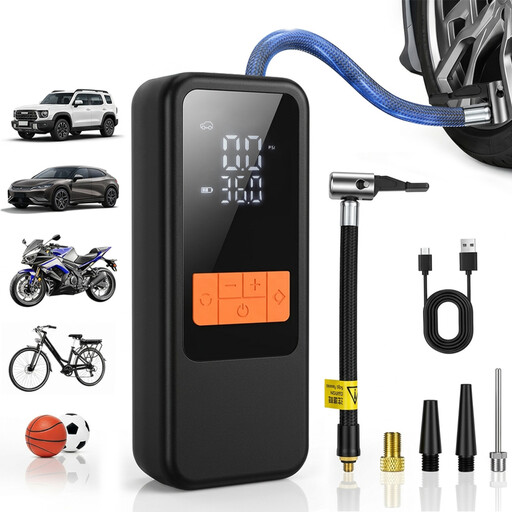
Why this product suits this profile: This rechargeable air pump is aimed at users who want to inflate car, motorbike and bicycle tyres as well as balls with one device, while setting specific pressure values.
The product specifications state both the 4000 mAh battery capacity and the run time of up to 25 minutes, making its limitations easier to assess.
150 PSI maximum pressure, five preset modes, Type-C connection and LED light with continuous and SOS modes.
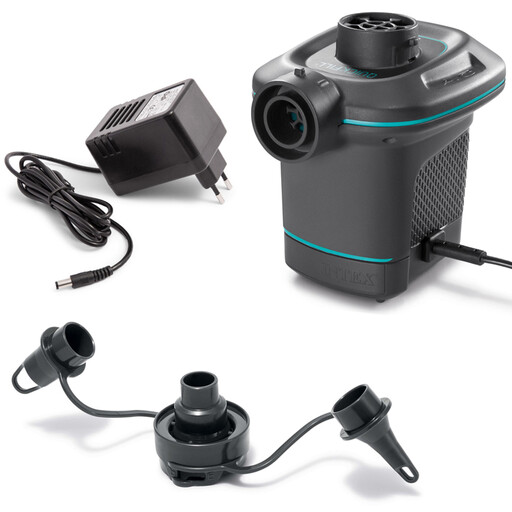
Why this product suits this profile: This mains-powered pump is suitable for indoor use, campsites with access to electricity and large-volume items such as air mattresses, where a high air flow rate is important.
The 220–240 V power supply and stated air flow rate of 1100 l/min clearly show that this is not a mobile tyre inflator.
Inflation and deflation, three connection nozzles, hose, carry handle and integrated overheating protection.
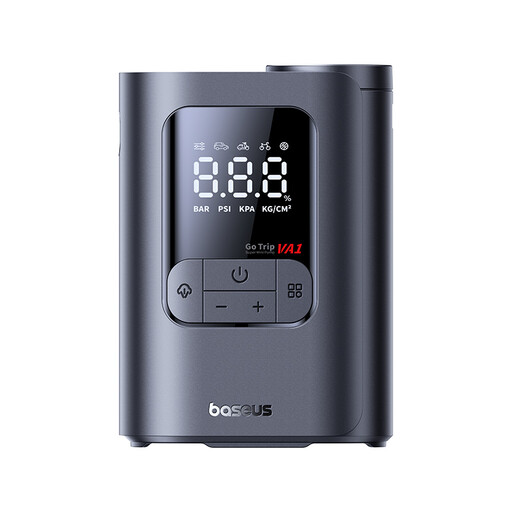
Why this product suits this profile: This corded model connects directly to the vehicle's power supply. It is designed for drivers who do not want to worry about charging a battery in advance.
The power supply is clearly specified. This removes the usual uncertainty of having a flat rechargeable air pump when you need to adjust tyre pressure unexpectedly.
Five preset modes, an adjustable range from 3 to 150 PSI and three LED light modes according to the product description.
We have compiled a complete, regularly updated list of products that fully meet these strict selection criteria and the safety regulations applicable in the EU.
For car tyres, a suitable pressure range, an easy-to-read pressure display, automatic shut-off and a compatible valve connection are essential. A cordless air pump offers flexibility, while a corded model does not depend on the battery's charge level. Lorry or trailer tyres have different requirements; several of the compact models mentioned are not designed for them.
Run time depends on battery capacity, tyre pressure, temperature, tyre size and the number of inflation cycles. Product specifications such as “25 minutes of use” should therefore be understood as the manufacturer's figure under certain conditions. If you want to inflate several tyres one after another, you should also take charging time and possible breaks into account.
With rechargeable models, the main cost is the small amount of electricity needed to charge the battery. For a mains-powered pump, consumption depends on motor power and operating time. For occasional top-ups, energy usage is usually manageable. An electric pump for air mattresses or other large items may consume more because it needs to run for longer. It is therefore important to operate the pump only for as long as necessary and use the correct attachment.