
Lieferung heute & morgen

Qualitätsgarantie

Willkommens-Angebote freischalten: KOSTENLOSE Lieferung | Bis zu 80 % RABATT | Kostenlose 30-Tage-JoyPlus-Testphase
App herunterladen
An electric air pump for car tyres can save time on the road and provide a practical solution if your tyre pressure drops slowly. But not every compact device is suitable for every vehicle or purpose. Before buying, car drivers, EV owners, motorcyclists and cyclists should check the power supply, pressure range and operating time in particular.
A figure such as 150 PSI may sound impressive at first. However, it usually describes the maximum pressure achievable under certain conditions, not necessarily how quickly the pump will inflate a car tyre. The recommended pressure for car tyres is often much lower. Airflow, motor power and the manufacturer’s stated inflation time are also important.
A cordless tyre pump is convenient to use, but it needs a charged battery. The available operating time may be limited when inflating several tyres, in low temperatures or with large SUV tyres. A portable tyre inflator with a USB-C port is handy, but it’s still important to check the battery capacity, charging time and maximum operating time.
Automatic shut-off stops the pump once it reaches the pre-set pressure. This is convenient, but it relies on the correct unit being selected and a secure connection. A digital tyre pressure gauge can make checking easier, but it shouldn’t replace regular checks with a separate, suitable gauge at a petrol station or garage.
A battery-powered air pump is useful for quick jobs when there’s no power socket available, such as at the roadside, on a motorbike or in a car park. For longer jobs, battery capacity matters more than the simple claim that a pump is “cordless”. Check whether a charger or just a USB cable is included, and how long charging takes.
A 12V compressor runs from your vehicle’s power socket. It can draw power from the vehicle for longer, but you’ll need a cable that’s long enough. In vehicles with combustion engines, the engine should be running while you use the pump, in line with the manufacturer’s instructions, to avoid putting unnecessary strain on the starter battery. For EVs, check whether there’s a usable 12V socket and how it’s powered by the vehicle.
Check the stated pressure range in PSI, BAR, kPa or kg/cm². For a car, a finely adjustable display within the usual range is more relevant than an especially high maximum pressure. A rating of “150 PSI” or “160 PSI” on its own doesn’t allow you to compare inflation speeds directly.
According to the product specifications, the Baseus GoTrip VA1 Wireless Inflator supports a range of 3 to 150 PSI and pressure adjustment in 0.5-PSI increments. The Baseus model is also stated to have a pressure accuracy of ±0.05 BAR. These figures are useful, but should always be considered in the context of how you’ll use the pump and the tyre pressure recommended by your vehicle manufacturer.
A higher airflow rate can speed up inflation. Small mini pumps are mainly designed for topping up bicycle tyres, balls and individual car tyres. Inflation can take considerably longer if car tyres are completely flat.
According to the product specifications, the Porbi Q19 has a 4,000 mAh battery capacity, an airflow rate of 26 l/min and a stated operating time of up to 25 minutes. The supplier also recommends a cooling break after extended use. Take this advice seriously: an electric air pump for car tyres isn’t designed for unlimited continuous use unless the manufacturer says it is.
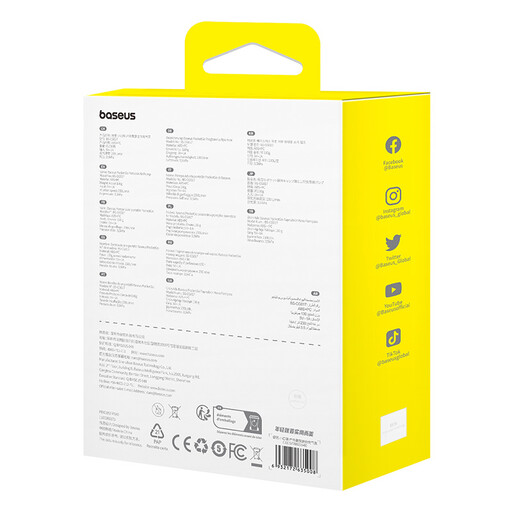
Why this product suits this user: At around 130 g according to the stated weight, this model is designed to be especially portable. It’s suitable for small top-ups on bicycles and motorbikes, as well as for other inflatables.
Its low weight makes its limitations clear: it’s intended more for portable top-ups than for repeatedly inflating completely flat car tyres.
According to the product specifications: 5V-1A input and a compact design for use on the go.

Why this product suits this user: Its cordless design, USB-C input and five inflation modes make it a versatile choice for anyone looking for one device for their car, motorbike, bicycle and balls.
The stated 2,500 mAh battery capacity and 5V/2.4A charging requirement make the power supply clearer than a vague claim that a product is “cordless”.
According to the product specifications: ±0.05 BAR pressure accuracy, five modes and automatic shut-off when the target pressure is reached.
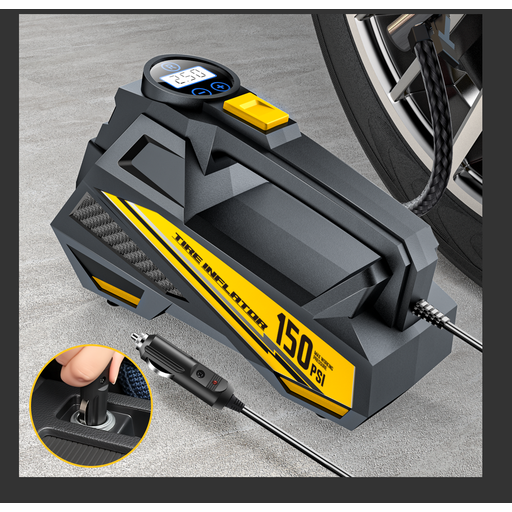
Why this product suits this user: Its corded design is aimed at drivers who regularly top up their tyres and prefer to use their vehicle’s 12V power socket.
There’s no need to charge a battery beforehand. The long cable also reduces the risk of it not reaching the tyres furthest from the socket.
According to the product specifications: 12V DC power supply, maximum 150 PSI, LCD display, LED light and several nozzle attachments.
We’ve put together a complete, regularly updated list of products that meet these strict selection criteria and the safety requirements in force in the EU.
For standard car tyres, an adjustable range that covers the pressure recommended by the vehicle manufacturer is sufficient. A maximum pressure of 150 PSI isn’t automatically necessary. A clear display, suitable units and reliable pressure pre-setting are more important.
A battery-powered air pump is more flexible and doesn’t rely on a vehicle power socket. A 12V compressor, on the other hand, is suitable for longer jobs, as long as your vehicle has a compatible socket. Commuters may benefit from a battery-powered model; if you regularly top up several car tyres, compare the operating time, cable reach and cooling breaks required by a 12V device.
Its lifespan depends on the quality of the battery, the motor, how it’s stored and how often it’s used. Frequent overheating, damp conditions and use beyond the stated duty cycle can affect its durability. Store the device in a dry place, charge the battery according to the manufacturer’s instructions, and use it only within its intended pressure and operating limits.