
Lieferung heute & morgen

Qualitätsgarantie

Willkommens-Angebote freischalten: KOSTENLOSE Lieferung | Bis zu 80 % RABATT | Kostenlose 30-Tage-JoyPlus-Testphase
App herunterladen
An electric air pump for car tyres can be a handy addition to your vehicle kit when tyre pressure drops, you're on a camping trip, or you're out and about. But not every compact device is equally suited to a car, an electric vehicle, a motorbike or a bicycle.
On product pages, specs like "150 PSI", "fast inflation" or "large battery capacity" can seem straightforward at first glance. In practice, though, several details really matter. If you only focus on maximum pressure, you can easily overlook the actual airflow, running time or connection options.
A 150 PSI air compressor can theoretically generate high pressure. For car tyres, however, the volume of air per minute and the motor's durability are more important. A car tyre needs significantly more air volume than a bicycle tyre or a ball. That's why you should also look at specs like airflow rate, fill time and recommended vehicle types.
A battery-powered compressor with a high mAh rating won't necessarily be able to fully inflate several car tyres. Motor power, cylinder size, ambient temperature and output pressure all affect energy consumption. What matters are concrete manufacturer figures for continuous operating time or the number of possible refills.
An automatic shut-off stops the process when the preset pressure is reached. However, it only works reliably if the hose is correctly attached to the valve and the target values have been entered properly. Before driving, you should still cross-check the tyre pressure against your vehicle handbook, the sticker on the driver's door or the fuel filler flap.
Cars, SUVs, motorbikes and bicycles all require different pressure and air volume levels. A device with 150 PSI isn't automatically suitable for large van, motorhome or lorry tyres. So check:
A motorbike tyre pump or electric bicycle pump may be sufficient for smaller volumes, while a car air pump with battery model needs more motor power.
An integrated digital tyre pressure gauge should clearly show both the current and preset pressure. Multiple units, such as PSI, bar and kPa, are handy. However, the displayed accuracy should always be considered in relation to the manufacturer's specifications. A reading doesn't replace regular checks with a separate, suitable testing device.
For a cordless tyre pump, the battery type, charging time and charging port are all relevant. USB-C makes everyday recharging easier, while a 12-volt cable can be useful when the battery is flat. Models with a power bank function or LED emergency light can offer extra uses in a breakdown situation. The LED light improves visibility of the valve, but doesn't replace a hi-vis vest, warning triangle or proper scene safety measures.
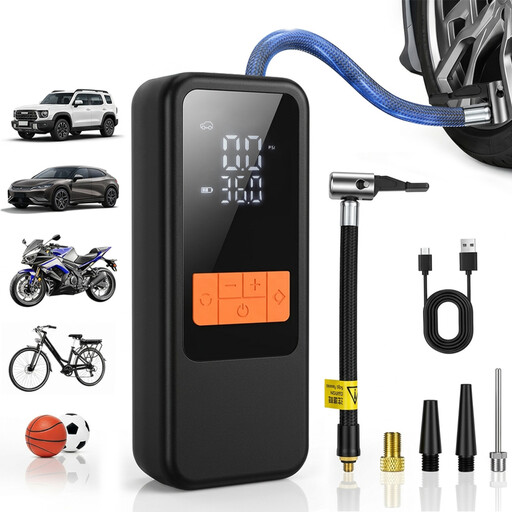
Why this product fits the profile: This model combines five preset modes with a compact design and is suitable for occasional top-ups on cars, bicycles, motorbikes and balls.
The product specs state 26 L/min, up to 150 PSI, automatic pressure detection and around 25 minutes of use.
4000 mAh battery, Type-C port, power bank function and LED light with constant and SOS modes.
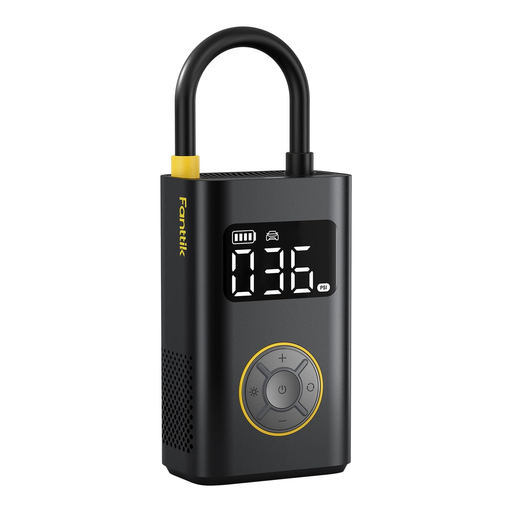
Why this product fits the profile: For users who prefer clear operation and several distinctly separated modes for car, SUV, motorbike, bicycle and ball.
The integrated hose, accessory storage and easy-to-read display reduce loose parts and operating errors.
According to the product specs, the device reaches up to 150 PSI, runs for up to 23 minutes and switches off automatically at the target value.

Why this product fits the profile: The combination of a larger battery, 35 L/min airflow and power bank function is aimed at users who need to top up tyres more frequently.
The stated runtime of up to 45 minutes makes the battery reserve more transparent than a simple mAh claim.
160 PSI, three pressure units, four preset modes, LED light and automatic shut-off according to the product description.

Why this product fits the profile: A portable tyre inflator for users looking for a compact device with a digital display and light for car, motorbike, bicycle or ball.
Alongside battery operation, the product description mentions a 12-volt connection for situations where the battery isn't enough.
150 PSI, three pressure units, LED and SOS modes, and stated dimensions of approximately 8.68 × 5.24 × 14 cm.
We've put together a full, regularly updated list of products that fully meet these strict selection criteria and the safety regulations in force in the EU.
For larger tyres or when inflating several vehicles in a row, be sure to follow the manufacturer's recommended breaks. A compact cordless tyre pump is designed for topping up, not necessarily for fully inflating a completely flat tyre.
The runtime depends on tyre size, starting pressure, target value and temperature. Product specs range from a few top-ups to several dozen minutes of continuous use, depending on the model. For regular use, compare concrete runtime figures and charging times.
In principle, a suitable car air pump with battery can also be used on an electric car, as long as the pressure range, valve connection and tyre size match the manufacturer's specifications. The vehicle's weight doesn't automatically change the required pressure. The value given by the vehicle manufacturer remains the decisive factor.
The electricity cost per charge is usually low and depends on battery capacity, charging losses and your electricity tariff. More important for ongoing use are the lithium battery's lifespan, proper storage and whether a replacement battery or 12-volt operation is possible.