
Lieferung heute & morgen

Qualitätsgarantie

Willkommens-Angebote freischalten: KOSTENLOSE Lieferung | Bis zu 80 % RABATT | Kostenlose 30-Tage-JoyPlus-Testphase
App herunterladen
An electric air pump for cars and tyres can make checking your tyre pressure much easier when you are out and about. However, it does not automatically replace a visit to a garage: if your tyres are damaged, visibly cracked or repeatedly losing pressure, the cause should be professionally inspected. For car, motorbike, bicycle and e-bike users, the key considerations are the right power supply, a clear pressure display and suitable operating limits.
A figure such as 150 PSI tyre pump, or even 160 PSI, sounds impressive at first. However, the maximum pressure does not indicate how quickly a car tyre can be inflated. Airflow, motor power, battery capacity and the permitted operating time are also important.
Most users do not need an extremely high final pressure for a passenger car tyre. What matters more is whether the device can reliably reach the tyre pressure specified by the vehicle manufacturer without switching off too early because of overheating.
A cordless compressor needs a charged battery. If the vehicle has been stationary for a long time, temperatures are low or several tyres need inflating, the available operating time may be reduced. Information about the possible number of tyre inflations also depends on tyre size, starting pressure and ambient temperature.
If you regularly want to inflate several car tyres, look for battery capacity, charging time and an automatic shut-off. A compact model is often sufficient for occasional top-ups. For longer jobs, a 12-volt air pump with a vehicle connection may be more practical.
A portable air pump is easy to store in the glove compartment or a bicycle bag. However, the display, buttons and hose are often smaller. Before buying, check whether the display is easy to read, whether the hose is long enough and which adapters are included.
A cordless air pump can be used flexibly at the roadside, by a bicycle rack or in the garage. It needs to be charged before use. Depending on the model, devices with a USB-C connection can be charged via a suitable power adapter or power bank. Charging requirements should be checked against the charger you already have.
A wired 12-volt pump runs from the vehicle’s power socket. This reduces dependence on the battery level, but requires an accessible socket. A long power cable is useful if you want to reach all four tyres without moving the vehicle.
A digital tyre pressure gauge often shows the set or measured value in PSI, BAR or kPa. BAR is particularly practical for vehicles in Germany. Always follow the recommended pressure stated in the owner’s manual, on the fuel flap or on the door frame – not the maximum pressure shown on the tyre sidewall.
Tyres should ideally be checked when cold. After a longer journey, the air inside the tyre warms up, which can cause the displayed pressure to differ. A display with several units is useful if the pump is used for cars, motorbikes and bicycles.
The automatic shut-off ends the process once the preset target value has been reached. It reduces the need to stand beside the pump throughout inflation, but does not replace checking that the correct target pressure has been set.
An LED light can be useful in the dark or during a breakdown. However, it is an additional feature, not a substitute for a high-visibility vest, warning triangle or a safe position away from moving traffic. Also check the instructions regarding cooling breaks. Some wired devices should be paused after several minutes of continuous operation.
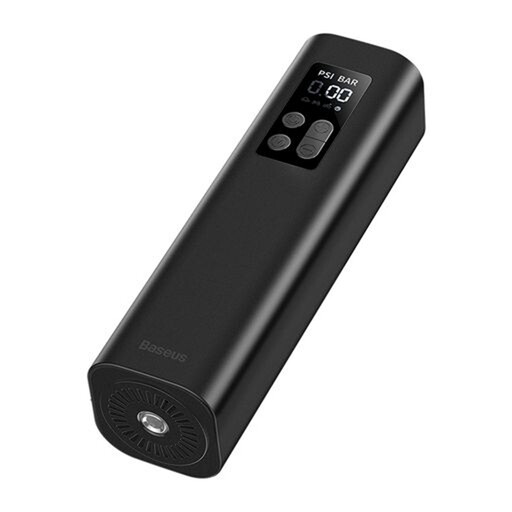
Why this product suits this profile: Its compact size makes it suitable for users looking for a portable air pump for occasional top-ups in the car or on the go.
Its small size focuses attention on its actual purpose rather than on a maximum pressure figure alone.
Compact design and easy portability; the exact features should be checked on the product page before buying.

Why this product suits this profile: This battery-powered air pump has a digital display, several pressure units and five modes for cars, motorbikes, bicycles, balls and custom settings.
Alongside 150 PSI, the product specifications state an airflow rate of 17 l/min, a 4,000-mAh battery and an automatic shut-off.
Digital display, LED light with three modes and USB-C input and output according to the product description.
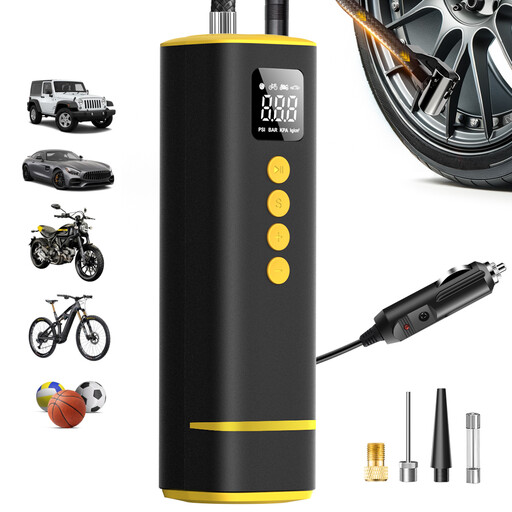
Why this product suits this profile: This wired device is appealing to users who prefer a 12-volt power supply in the vehicle and want to inflate car, motorbike and bicycle tyres.
The 12 V power supply avoids relying on a depleted internal battery; check that the cable provides sufficient reach before buying.
12-volt connection, stated maximum pressure of 150 PSI and suitability for several tyre types according to the product description.
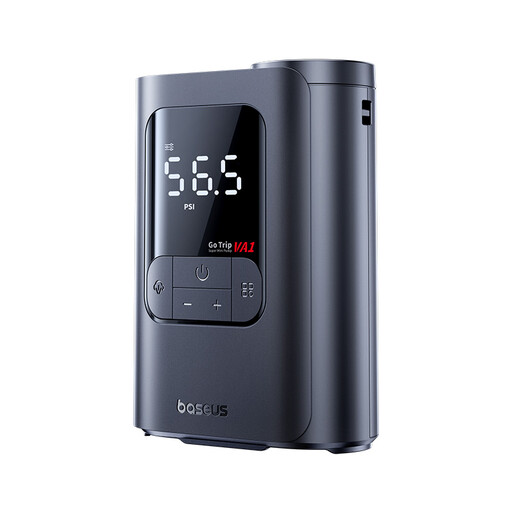
Why this product suits this profile: This cordless model is designed for users looking for one solution for cars, motorbikes, bicycles, e-bikes and balls.
The product description specifies a 2,500 mAh battery, five modes and an automatic shut-off rather than just a maximum pressure figure.
Stated pressure accuracy of ±0,05 BAR, USB-C input and three air nozzles according to the manufacturer’s specifications.
We have put together a complete, regularly updated list of products that fully meet these strict selection criteria and the safety regulations applicable in the EU.
Its lifespan depends on the battery, motor, storage conditions and frequency of use. Frequent continuous operation without cooling breaks can place greater strain on the components. For a longer service life, pay attention to the permitted operating time, charge the device regularly and store it in a dry place.
Yes, provided the model is designed for passenger car tyres and covers the required pressure range. Small devices are often intended for correcting tyre pressure rather than filling a completely flat tyre. Before buying, compare the airflow rate, hose connection, power supply and operating time.
The motor requires considerably more energy while inflating than it does in standby mode. The actual operating time depends on tyre size, starting pressure and target value. If the pump is only used occasionally, recharging it after use is usually sufficient. If you carry it in the car as a regular breakdown aid, check the battery level at regular intervals.