
Lieferung heute & morgen

Qualitätsgarantie

Willkommens-Angebote freischalten: KOSTENLOSE Lieferung | Bis zu 80 % RABATT | Kostenlose 30-Tage-JoyPlus-Testphase
App herunterladen
An electric air pump for your car can be a handy companion on the road, whether you need to adjust tyre pressure after a long drive or inflate bicycle tyres, motorcycle tyres and balls. However, portable models differ significantly in terms of power supply, air volume, pressure range and operation.
If you only look at claims like "150 PSI" or "fast inflation", you might end up with a device that doesn't suit your vehicle or intended use in everyday life. The following criteria will help you separate marketing promises from genuinely relevant product features.
A 150 PSI air pump may boast a high theoretical maximum value. However, this figure tells you little about how quickly it will fill a car tyre. For passenger car tyres, much lower pressure ranges are usually relevant. What matters more are:
For lorry, trailer or large SUV tyres, a small mini compressor for your car may be too slow or unsuitable. The product description should clearly state the intended use.
A cordless air pump works independently of a 12-volt socket. That's handy for bicycles, motorcycles, camping and roadside breakdowns. However, the battery must be charged before you set off. In low temperatures, the usable capacity can also decrease.
For long journeys or multiple vehicles, a model with an additional 12-volt connection can be useful. A wired tyre inflator doesn't need a pre-charged battery, but it does rely on the car's power supply and a sufficient cable length.
A digital tyre inflator shows the set or measured pressure. What remains crucial is whether you enter the target value in the correct unit and whether the hose sits securely on the valve. PSI, BAR and kPa must not be confused.
The correct tyre pressure is listed in your owner's manual, on the B-pillar or inside the fuel filler flap. Pressure should be checked when the tyres are cold. An automatic shut-off reduces the risk of exceeding the pre-set value, but it doesn't replace a final check with a tyre pressure gauge.
Check whether the pump runs via USB-C, an integrated battery, a 12-volt cable or multiple power sources. For battery-powered devices, capacity, charging time and stated operating duration are relevant details. A high mAh figure alone doesn't tell you how many tyres can actually be inflated.
The pressure range should match your intended use. For cars, motorcycles and bicycles, pre-set modes are helpful, while a freely adjustable mode offers more flexibility for different tyres or balls. An automatic shut-off stops the process when the pre-set target value is reached.
Also pay attention to the included adapters. A car valve, a bicycle valve and a ball valve don't always use the same connection. For an electric ball pump, suitable needle adapters should be included.
A portable electric air pump should fit in your glovebox, rucksack, pannier or motorcycle storage compartment. Small cases are easy to carry, but they can heat up more during longer inflation cycles. Information about operating intervals and cooling times is therefore more useful than mere advertising claims about compactness.
An LED light can be helpful in the dark. Depending on the model, it serves as a torch or also offers flashing and SOS modes. This feature improves visibility when using the pump, but it doesn't replace a hi-vis vest or proper breakdown safety measures.
The following selection groups models according to specific usage scenarios. Technical details refer to the respective product descriptions and may vary depending on operating conditions.
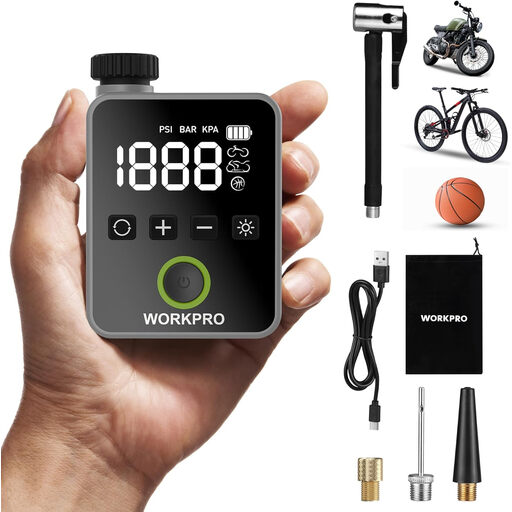
Why this product fits the profile: This compact model weighs 270 g according to the product information and supports bicycle, motorcycle and ball modes, plus a freely adjustable mode. That makes it suitable for occasional corrections on the go.
The display supports PSI, BAR and kPa. The automatic shut-off limits the process to the set value. According to the product description, it is not intended for lorry or trailer tyres.
270 g weight, four attachments, LED display, automatic shut-off and a stated pressure range of 3 to 140 PSI.
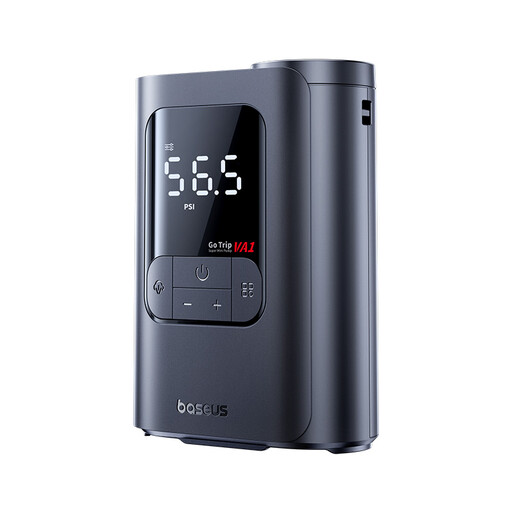
Why this product fits the profile: This cordless model is designed for cars, SUVs, light commercial vehicles, motorcycles, bicycles and balls. Five modes and a stated pressure accuracy of ±0.05 BAR make it easy to adapt to different applications.
The product description states the intended use and excludes heavy lorry tyres. Before use, the 2500 mAh battery must be charged via USB-C.
Cordless operation, five inflation modes, USB-C charging, three attachments and a weight of approximately 459 g without packaging.
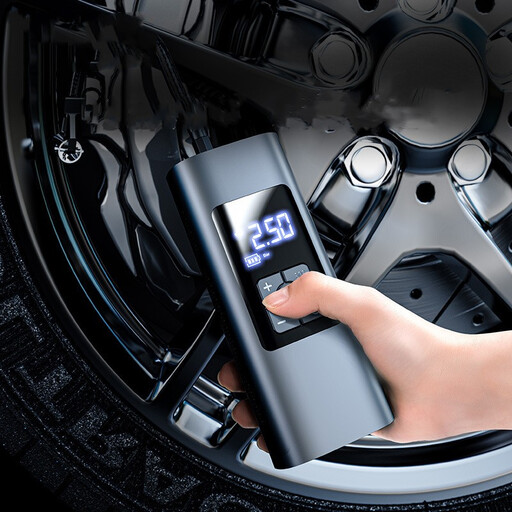
Why this product fits the profile: The combination of a 6000 mAh battery and 12-volt operation appeals to users who regularly need to inflate car, motorcycle, bicycle and sports equipment.
The dual-power function reduces reliance on a single power source. The digital display shows PSI, BAR and kPa; the automatic shut-off limits the set pressure.
6000 mAh battery, 12-volt alternative, multiple adapters, digital pressure display and integrated LED light.
We've put together a complete, regularly updated list of products that fully meet these strict selection criteria and the safety regulations in force in the EU.
The lifespan depends on battery chemistry, charge cycles, temperature, frequency of use and storage. Store the device in a dry place and not permanently in extreme heat or severe frost. A fully charged battery should not be left unattended for months; regular checks can prevent deep discharge.
For occasional pressure corrections, bicycles, motorcycles and balls, it can be a handy mobile addition. If you frequently inflate large tyres or use commercial vehicles, you should check whether the air volume, operating duration and connection are suitable. An electric pump does not replace professional breakdown assistance for tyre damage.
With battery models, the main cost is the electricity for charging, which is usually low depending on the battery and your electricity tariff. A 12-volt model uses the vehicle battery during operation. When making your purchase decision, factors like battery replacement, charging accessories, operating duration and suitable performance are more relevant than the pure electricity consumption.