
Lieferung heute & morgen

Qualitätsgarantie

Willkommens-Angebote freischalten: KOSTENLOSE Lieferung | Bis zu 80 % RABATT | Kostenlose 30-Tage-JoyPlus-Testphase
App herunterladen
An electric air pump for car tyres can save you a lot of time on the road – provided it suits your vehicle, power source and intended use. Many models boast 150 PSI, ultra-fast inflation or multiple operating modes. However, these specifications aren’t always directly comparable.
If you only look at the maximum pressure rating, you’ll miss important points: a cordless tyre pump can be useless with a flat battery, a 12-volt compressor needs a suitable vehicle socket, and a compact device isn’t automatically designed for several completely deflated car tyres.
A 150 PSI air compressor can theoretically reach a high maximum pressure. For normal car tyres, however, the pressure recommended by the vehicle manufacturer is usually much lower. So what really matters isn’t just the peak value, but also:
A high maximum pressure alone tells you very little about how quickly a tyre can be brought from a low pressure up to the recommended level.
A battery-powered air pump for car tyres is flexible to use, but it needs a charged battery. When inflating several tyres one after another, runtime, motor power and heat build-up can be decisive. Claims like “up to eight tyres” refer to specific conditions and particular tyre sizes. You shouldn’t automatically assume they apply to every vehicle.
For regular car journeys, a 12-volt device with a long cable can be a sensible choice. For a bicycle, e-bike or motorcycle, on the other hand, a cordless tyre pump offers greater freedom of movement.
A digital tyre pump with an LCD display makes it easier to read and set the pressure. Nevertheless, the display doesn’t replace regular checks with a suitable tyre pressure gauge. Especially for safety-critical vehicle tyres, you should set the pressure according to the figures on the fuel filler cap, the door pillar or in the owner’s manual.
A corded compressor is usually powered via the vehicle’s 12-volt socket. This is practical for longer use, but it does require the socket to have sufficient capacity. With many models, the engine should be running during operation so that the vehicle battery isn’t unnecessarily drained.
A cordless tyre pump, on the other hand, needs a charged lithium-ion battery. Check:
Multiple units such as PSI, BAR, kPa and kg/cm² are useful. In the UK, tyre pressure is often given in PSI or BAR. A tyre inflator with an LCD display should clearly show the target value and, if possible, switch off automatically.
Important: always set the pressure specified by the vehicle manufacturer. The maximum pump pressure is not a recommended driving level.
For bicycle tyres, different valves are used depending on the type of bike. Adapters for Presta and Schrader valves are often relevant. A ball adapter extends the range of use, but doesn’t tell you anything about suitability for large air mattresses or other high-volume items.
Also pay attention to:
An electric bicycle pump is often very compact, whereas a more powerful portable tyre compressor for car tyres can bring more weight and heat build-up.
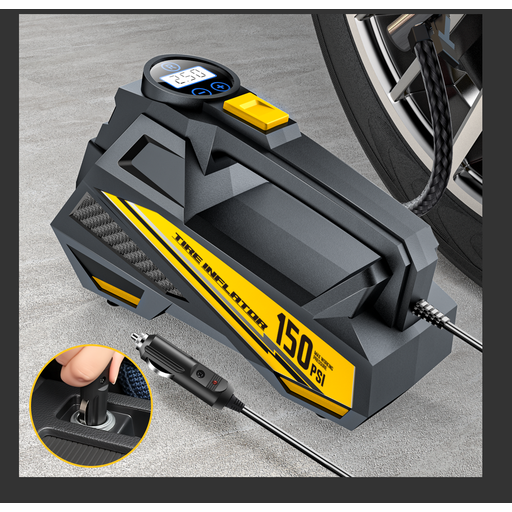
Why this product fits the profile: This corded model uses a 12-volt vehicle socket and is suitable for car, motorcycle and bicycle tyres as well as balls.
The power supply doesn’t rely on an integrated battery. The LCD display, automatic shut-off and multiple pressure units support controlled use.
12-volt connection, maximum stated pressure of 150 PSI, LCD display and LED light.
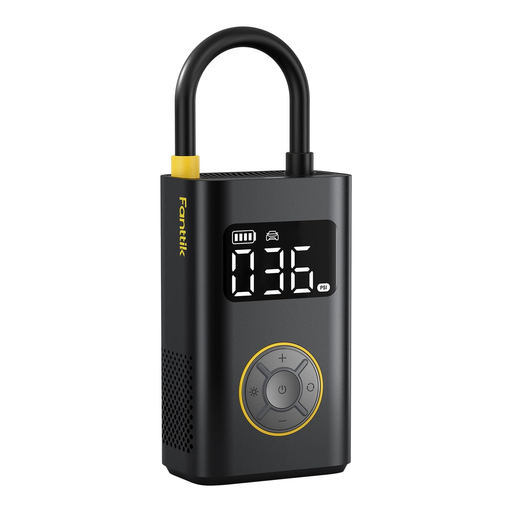
Why this product fits the profile: This cordless model offers four automatic modes plus a manual mode and is designed for compact cars, SUVs, motorcycles, bicycles and balls.
The automatic shut-off reduces the risk of exceeding the set target value. The integrated hose compartment makes storage easier.
7.4-volt battery with 2.5 Ah, maximum stated pressure of 150 PSI, easy-to-read display and integrated cooling.
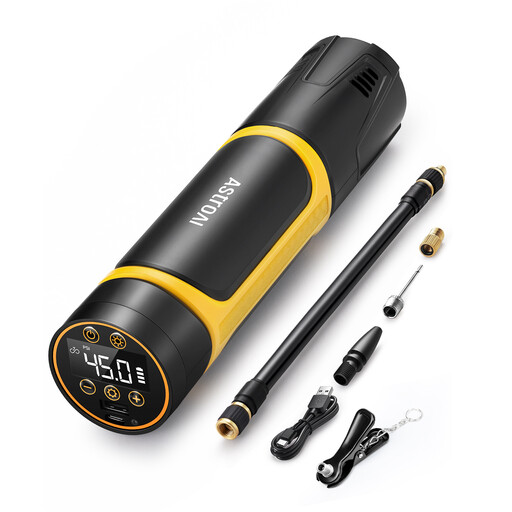
Why this product fits the profile: Suitable for users who want to combine an electric bicycle pump, motorcycle air pump and car tyre pump in one compact device.
Five operating modes and adapters for Presta, Schrader and ball valves make the usage limits more transparent than a device with only one universal connector.
Three 1500 mAh batteries, four pressure units, LCD display, LED light and USB-C input and output.
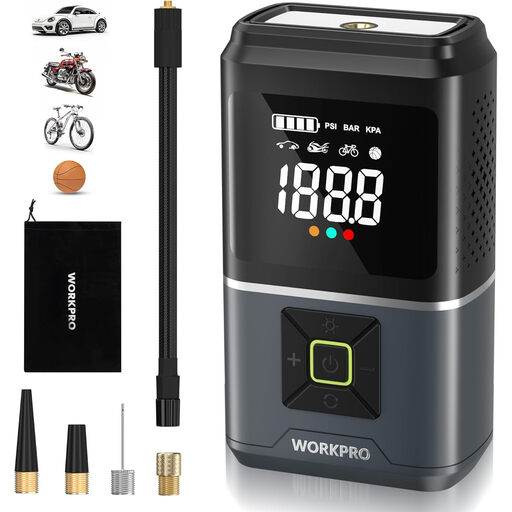
Why this product fits the profile: The cordless design, digital display and emergency light are designed for storage in the car and occasional use on the go.
The display shows the pressure during inflation. An LED light with illumination and SOS mode supports use in poor lighting conditions.
7.2-volt battery with 2500 mAh, 150 PSI maximum pressure, three operating modes and stated inflation of a 2.0-bar car tyre in approximately 90 seconds.
We’ve put together a complete, regularly updated list of products that fully meet these strict selection criteria and the safety regulations in force in the EU.
With a 12-volt compressor, the engine should be running as per the manufacturer’s instructions. Cables, hoses and plugs must be checked for damage before each use. After longer periods of operation, the specified breaks must be observed.
For most cars, a device that reliably reaches the recommended vehicle pressure is sufficient. A maximum value of 150 PSI provides a reserve, but it doesn’t mean a higher inflation speed. What matters are the vehicle specification, air delivery rate and operating duration.
The runtime depends on battery capacity, tyre size, starting pressure and target value. When inflating several tyres, the device can get warm. So pay attention to the information on maximum operating duration and fully charge the battery before longer journeys.
For pressure corrections and smaller car tyres, it can be suitable, provided the model is designed for the respective tyre type. For large SUVs, vans or completely deflated tyres, you should check the manufacturer’s information on tyre size, runtime and usage limits particularly carefully.