
Lieferung heute & morgen

Qualitätsgarantie

Willkommens-Angebote freischalten: KOSTENLOSE Lieferung | Bis zu 80 % RABATT | Kostenlose 30-Tage-JoyPlus-Testphase
App herunterladen
An electric bathroom radiator with thermostat can heat your bathroom independently of your central heating and double as an electric towel warmer. If you rent, are renovating or own your home, the key features to look for are precise temperature control, a programmable thermostat and a timer.
However, the product description alone is not enough to make an informed choice. Some features may sound useful but reveal little about whether the radiator is actually suitable for your bathroom.
A basic thermostat maintains a set temperature. A programmable thermostat can also be set to heat at specific times, such as in the morning and evening. If you look only for the word “thermostat”, you may end up without a weekly schedule or timer.
Check whether the model you’re considering is explicitly described as having a timer, a delay-start function or several heating programmes.
Electric towel warmers are often used in damp bathrooms. Make sure towels do not completely cover the air outlets or heating surfaces. The appliance must also be suitable for the space where you intend to use it.
Check details such as:
If the product is not clearly stated to be suitable for bathroom use, don’t assume it is based on the product name alone.
An electric bathroom radiator can warm towels and help raise the room temperature. Whether it can heat an entire bathroom sufficiently depends on the room’s size, insulation, external walls, window area and the temperature you want to achieve.
A lower-powered model may suit a small room or work well as supplementary heating, while a larger bathroom may need a different heating solution. So compare more than just dimensions and design: check the stated power consumption and recommended use, too.
Stepped or digital temperature control makes it easier to adjust the heat to suit your needs. A towel radiator with timer is especially useful if you only need heat at certain times. This can help prevent the appliance from running for longer than necessary.
Check the:
SPCC steel, stainless steel and aluminium can each offer different properties, depending on the design. The quality of the finish, the coating and the care instructions are what matter most. A white bathroom radiator can often blend easily into an existing bathroom, but should be cleaned regularly with a soft, damp cloth.
Avoid harsh or abrasive cleaning products unless the manufacturer specifically says they are suitable.
Before ordering, measure the available wall space and check the position of the socket and mounting points. Also allow for:
The SONNI model is listed as 71 cm long, 66.5 cm wide and 11 cm high, with a weight of 14,9 kg. Check these measurements against the intended installation area.
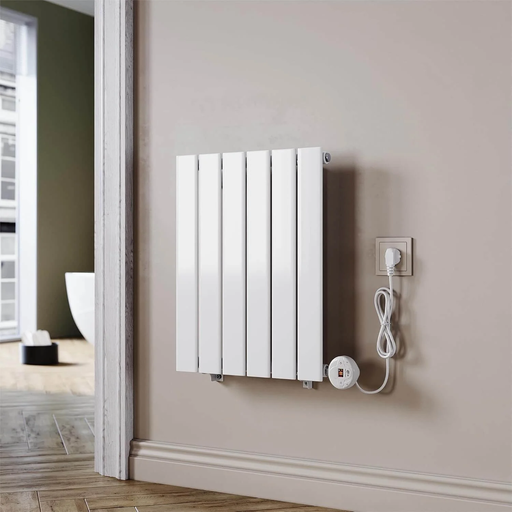
Why this product suits this profile: It combines a thermostat and timer with a white panel design, making it a good option if you’re looking for supplementary heating with straightforward controls.
The product details explicitly mention a programmable thermostat and timer. Before using it in a bathroom, you’ll still need to check the IP rating, installation clearances and connection requirements.
SPCC casing, white finish, timer and programmable temperature control, according to the product description.
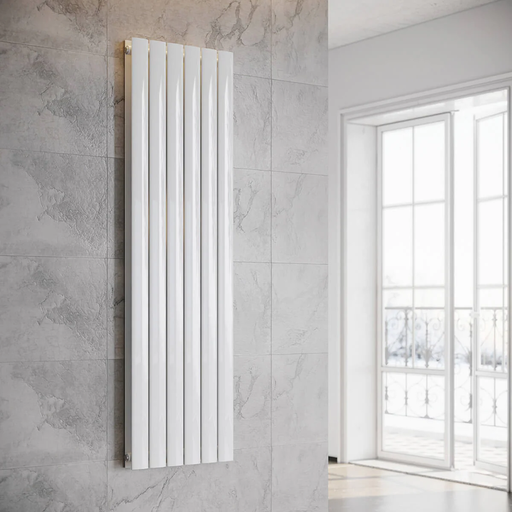
Why this product suits this profile: If you’re renovating and already have central heating, a flat wall-mounted radiator with a central connection may be worth considering. However, it isn’t an electric model, so it should only be considered as an alternative heating system.
Its clear description as a radiator with a central heating connection helps distinguish it from an electric bathroom radiator.
White panel design, wall-mounted installation and central connection; dimensions listed as 1600 × 462 mm.
Why this product suits this profile: If you need heat at regular times, you can set the timer to fit your morning routine or to warm towels.
Setting the operating time in advance can help prevent the radiator running continuously. Towels must still not completely cover the heating surfaces or air outlets.
Timer, temperature control and use as supplementary heating or a towel warmer, according to the product description.
We’ve put together a complete, regularly updated list of products that meet these strict selection criteria and fully comply with the safety regulations in force in the EU.
You can calculate the electricity consumption roughly as follows:
Power in kilowatts × hours of use × electricity price per kilowatt-hour = running costs
A device with a power consumption of 1 kW running for two hours a day would use 2 kWh per day. Actual consumption depends on how often the thermostat needs to switch the heating back on. A timer and a suitable temperature setting can limit how long it runs, but they’re no substitute for calculating your likely energy use.
No. Before buying, check the IP rating, installation location, minimum clearances and connection requirements. There are stricter requirements, particularly around showers and baths. If you’re unsure, have the installation carried out by a qualified electrician.
There’s no reliable one-size-fits-all answer. Its lifespan depends on factors including the materials, coating, operating time, humidity, installation and maintenance. Look for clear manufacturer information, easy-to-follow instructions and replacement or service parts that are available.
A programmable thermostat can match heating times to your actual needs. Whether this reduces costs depends on the appliance’s power, electricity price, room temperature and how long you use it. The key is to avoid running it for longer than necessary.