If fresh splashes can be wiped away after cooking, you don’t need an electric brush just for that. But if you’re dealing with stubborn residue or narrow grout lines, a compact device with the right interchangeable attachment could be useful. First, check that the attachment and cleaner are suitable for your tiles and any adjoining surfaces. Then compare how easy the device is to handle, what’s included and how well it’s protected against water. The models mentioned are examples and haven’t been tested against each other for your particular kitchen splashback.
Who might find an electric brush useful?
Quick clean-up after cooking
If you want to remove fresh splashes from suitable tiles with minimum fuss, first check whether a cloth will do the job. The German Environment Agency lists standard cleaning products and microfibre cloths as basic essentials for wipe- and scrub-resistant surfaces.
Grout lines and edges
If residue is mainly in narrow grout lines or around joins, a suitable, easy-to-control attachment matters more than a large brush head. Bosch DIY lists tiles and grout as suitable applications for the UniversalBrush.
Delicate or coated surfaces
If you’re cleaning tiles next to glossy or coated surfaces, choose an attachment and cleaning product that are suitable for each material. The North Rhine-Westphalia Consumer Advice Centre recommends using soft cloths on these surfaces.
What should you look for when buying?
First, consider whether you’ll mainly be cleaning open areas of tile, narrow grout lines or delicate adjoining surfaces. You can then work out more easily which attachment shape and included accessories will suit your kitchen.
| What you need |
What to check when buying |
Who is this important to? |
| Cleaning tiled surfaces |
Check whether a suitable surface-cleaning attachment is included and whether it’s easy to manoeuvre. |
After cooking, I usually find fresh splashes on the tiles and want to remove them quickly without having to use another appliance unnecessarily. Around 36% of consumers prioritise quick cleaning of larger surfaces. |
| Reaching grout lines and edges |
Match the width of the grout lines and the joins to the shape and size of the attachment. |
When there’s residue in narrow grout lines, I need a small head that I can guide precisely. Around 29% of consumers prioritise cleaning grout. |
| Protecting delicate surfaces |
Follow care instructions and test the attachment and cleaning product carefully in an inconspicuous area. |
When tiles meet glossy or coated surfaces, I want to tailor my cleaning approach to each material. Around 21% of consumers prioritise protecting delicate surfaces. |
| What’s included and accessories you may need |
Check whether the battery, charger and suitable attachments are included with the specific version. |
If I’ll only be using it occasionally, I want to know in advance which parts I’ll need to get started and tackle my cleaning jobs. Around 14% of consumers prioritise checking what equipment and accessories they’ll need. |
Avoiding buying pitfalls
-
A large brush head is automatically suitable for grout lines too
Ryobi states that the R18CPS-0 has a 15 cm brush head. However, narrow grout lines and joins require a different approach from open areas of tile.
Compare the head size with the tight spots in your kitchen, and check whether a suitable detail attachment is included or available.
You may need an additional detail attachment or a different tool for narrow grout lines.
-
The basic tool automatically includes everything you need to get started
Einhell states that the PICOBELLA 18/90 is supplied without a battery or charger.
Check what’s included with the specific version and whether you already own a compatible battery.
With this Einhell version, you may need to buy a battery and charger separately.
-
An abrasive attachment is suitable for every surface
The North Rhine-Westphalia Consumer Advice Centre points out that even microfibre cloths can be too harsh for glossy or coated surfaces.
Follow the care instructions and carefully test a new attachment in an inconspicuous area.
-
An IP rating applies to the whole device and while it’s charging
Manufacturers describe different levels of protection for different parts. For the Ryobi R18CPS-0, the IPX7 rating specifically applies to the battery compartment.
Read the information for each part of the device and follow the charging instructions. Don’t assume that a protection rating applies to the charger or connectors.
Brands and device types to help you compare
Bosch DIY
The UniversalBrush is a compact cordless cleaning brush that Bosch DIY describes as suitable for tiles, grout and kitchen cleaning, among other tasks.
- Bosch DIY lists interchangeable accessories, IPX5 splash protection and a Micro-USB charging port.
- Check what’s included with the specific version. The protection rating doesn’t mean the charging port or charger can get wet.
Einhell
The PICOBELLA 18/90 combines brushes and pads with the Power-X-Change battery system and is also marketed for use in the kitchen and bathroom.
- Einhell lists IPX4 protection, two speed settings, SOFT and MEDIUM brushes, and three pads included.
- The basic tool reviewed is supplied without a battery or charger. Also check whether the specific attachment is suitable for your tiles and grout.
Ryobi
The R18CPS-0 is an 18V ONE+ rotary brush with a 15 cm head, making it better suited to larger appropriate surfaces than narrow grout lines.
- Ryobi states that the battery compartment is protected to IPX7.
- This rating applies to the battery compartment, not automatically to the whole device. Compare the head size with the tight spots you need to clean, and check whether a battery and charger are included.
SonicScrubber
The manufacturer describes the Household System as a battery-powered detail-cleaning tool for areas such as kitchens and grout lines.
- According to the manufacturer, the set includes four brush heads and requires four AA batteries.
- Before buying, check the specific version, what’s included and whether the brushes are suitable for your surfaces.
Joybuy product selection
This selection includes electric cleaning brushes whose product descriptions mention tiles or kitchen areas. Check that the attachment shape and what’s included suit your grout lines and adjoining surfaces.
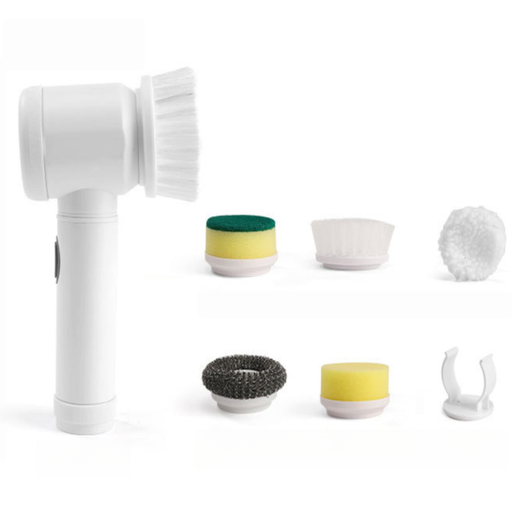 No image available
Electric handheld cleaning brush with 10 interchangeable attachments
The listed kitchen applications make this handheld device an option for a range of cleaning tasks.
10 interchangeable attachments, including soft brushes, sponges and steel wool brush heads.
Choose an attachment to suit the surface; the listed attachment types aren’t automatically suitable for every tile.
View at Joybuy
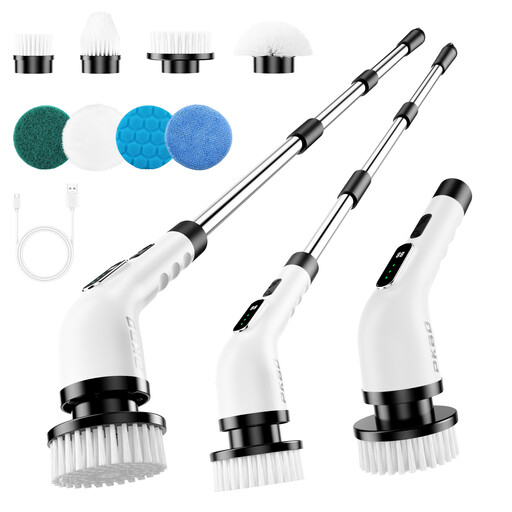 No image available
Electric cleaning brush with 8 attachments
The product information lists tiles, grout and kitchen surfaces as suitable applications, making it worth comparing with a range of cleaning tasks.
8 attachments, 3 speeds, LCD screen and telescopic handle.
Capacity is stated as 2500 mAh.
View at Joybuy
 No image available
Electric rotary brush with 7 brush heads
The product description lists tiles, grout and kitchen areas as suitable applications. An angled head may be worth considering for narrow spaces.
7 interchangeable heads, including a flat head for tiles and an angled head for grout lines.
2 speeds, telescopic handle and LED charging indicator.
View at Joybuy
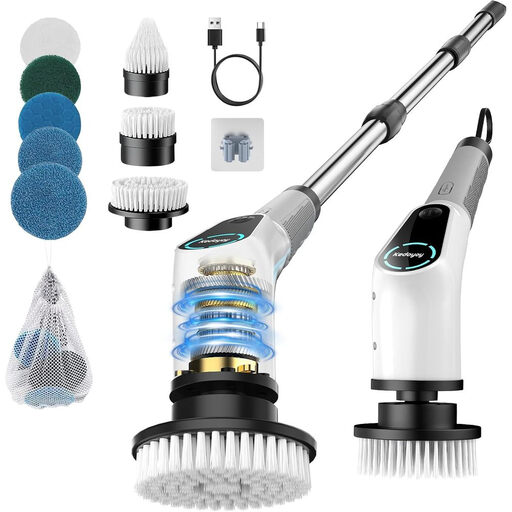 No image available
8-in-1 electric cleaning brush with adjustable handle
The product information lists tiles and kitchen surfaces; the adjustable handle is one factor to consider when cleaning at different heights.
8 interchangeable brush heads and 2 speeds.
Handle length: 30–137 cm. USB-C charging port.
View at Joybuy
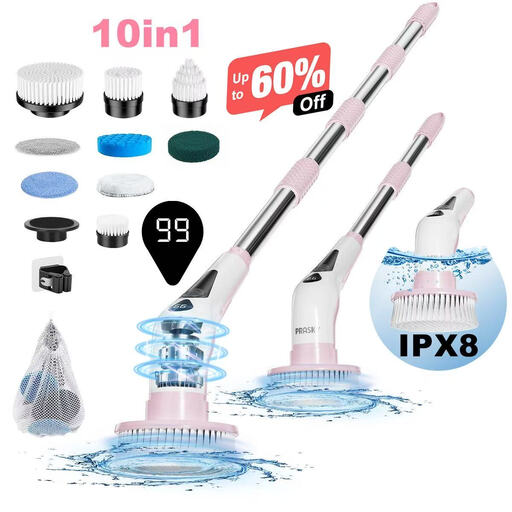 No image available
Prasky SL01A-2, Water Drop Pink, EU plug
The product description lists tiles, kitchen areas and narrow gaps as suitable applications.
9 interchangeable brush heads and 2 speeds.
Four-part adjustable handle and USB-C charging.
View at Joybuy
Frequently asked questions
Do I need an electric brush for fresh splashes after cooking?
Not necessarily. For suitable wipe- and scrub-resistant surfaces, the German Environment Agency lists standard cleaning products and microfibre cloths as basic essentials. An electric brush may be more useful if you need mechanical help with stubborn residue or a detail attachment.
Can I use the same brush head on tiles, grout and delicate adjoining surfaces?
Don’t use an attachment on every material without checking first. Match the brush and cleaning product to the surface, and if necessary, carefully test the combination in an inconspicuous area. Clean and dry used attachments according to the manufacturer’s instructions.
What should I bear in mind when charging and using the brush around splashes?
Check the protection rating for each part of the device and follow the charging instructions. Bosch gives the UniversalBrush an IPX5 rating; for the R18CPS-0, Ryobi specifically states that the battery compartment is protected to IPX7. This doesn’t mean that the charger and connectors are protected. The Federal Institute for Materials Research and Testing recommends using suitable chargers for lithium batteries.
What markings and documentation should I check when buying?
For electrical products that require CE marking, the German Federal Network Agency explains the obligations of economic operators. These include the retailer checking the CE marking, as well as any required instructions and safety information in German. A CE mark isn’t an independent performance test of the cleaning brush.


