
Lieferung heute & morgen

Qualitätsgarantie

Willkommens-Angebote freischalten: KOSTENLOSE Lieferung | Bis zu 80 % RABATT | Kostenlose 30-Tage-JoyPlus-Testphase
App herunterladen
An electric chopper can process onions, herbs, vegetables, nuts or meat in next to no time. However, not every appliance suits every household. Compact models save space but quickly reach their capacity limit with larger quantities. Multifunctional devices offer more uses, but they require extra storage space and more cleaning effort.
This buying guide will help you make sense of the technical specifications and avoid common mistakes. The product selection is based on clear data such as power, bowl size, accessories, safety features and ease of cleaning.
A high power rating may seem impressive at first glance. However, it doesn't automatically tell you how well a device handles different types of food. What also matters are the maximum operating time, blade geometry, permitted ingredients and the breaks required between cycles.
When processing hard foods, you should read the manufacturer's instructions particularly carefully. For example, the Bear King QSJ-D03W5 can be operated continuously for a maximum of 40 seconds according to the product specifications, followed by a rest period. At the same time, it is not intended for ice cubes, bones, frozen foods or dry ingredients such as coffee beans.
With a bowl that has a total volume of 2.1 litres, the actual working volume may be smaller. The Philips Daily Collection HR7320/00 comes with a 2.1-litre bowl but states a working capacity of 1.5 litres. This difference matters when preparing family-sized portions and larger quantities.
For a mini food processor or small kitchen chopper, 0.5 to 0.6 litres is practical for herbs, onions and small portions. However, such bowls are less suitable for minced meat, dough or larger portions of vegetables.
An electric all-purpose chopper with cutting, grating and kneading attachments covers many tasks. At the same time, more individual parts need to be cleaned and stored safely. So before you buy, it's worth deciding whether you regularly need a food processor or whether a compact onion chopper will do the job.
Look for removable blades, dishwasher-safe parts and an easy-to-clean bowl shape. The motor housing on these appliances must never be submerged in water.
Motor power is given in watts, but it's only one factor to consider. According to the product data, a Grundig CH 5320 operates with 500 watts, two speed settings and a 0.5-litre glass bowl. This model is designed for soft to medium-hard foods; ice, coffee beans, spices and very hard materials are excluded according to the instructions.
The Philips HR7320/00 offers 700 watts, two speed settings, a pulse function and several attachments. This makes it suitable as a kitchen machine for chopping, slicing, grating, kneading and emulsifying. However, when making your decision, you should always refer to the manufacturer's specific list of permitted ingredients.
Glass bowls are resistant to odours and stains and allow you to see what's happening inside. However, they are heavier than plastic bowls and can be damaged by sudden temperature changes. With the Bear Chopper QSJ-D03Q1, the glass bowls are reportedly not heat-resistant and are not microwave-safe.
For single-person households or small prep tasks, a bowl around 0.5 litres is often sufficient. Families and those who regularly process larger quantities of vegetables or minced meat should look for a working volume of 1.5 litres or more.
An herb chopper needs different features from an electric meat grinder. For herbs and onions, a compact blade bowl is usually enough. An electric meat grinder, on the other hand, should come with suitable cutting plates, a feed chute and, if needed, sausage or kibbeh attachments.
Useful safety features include:
The blades on all models are sharp. Always unplug the appliance before opening, cleaning or changing attachments.
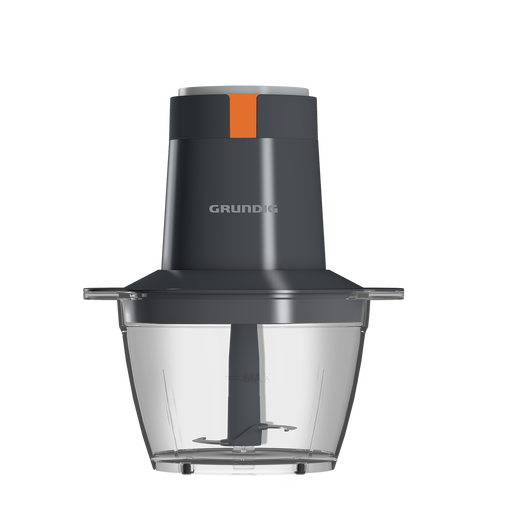
Why this product fits the profile: The 0.5-litre glass bowl is designed for smaller portions, onions, vegetables and nuts. Two speed settings allow for coarse or finer processing.
The product data clearly states its limits: the appliance is not intended for ice, coffee beans or very hard ingredients. This makes it easier to match the choice to your actual needs.
500-watt motor, removable stainless steel double blade, two speeds and dishwasher-safe glass bowl according to the product specifications.
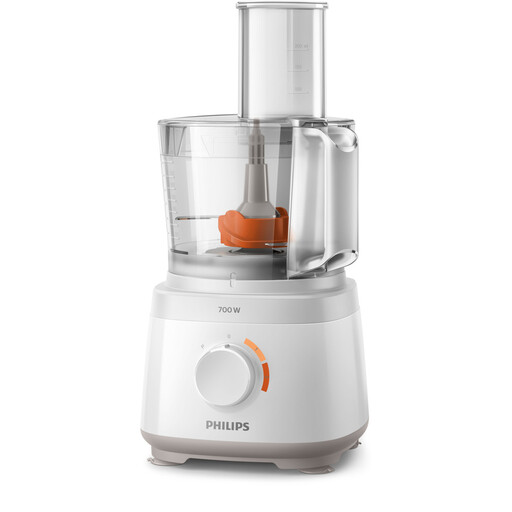
Why this product fits the profile: If you're looking for a versatile appliance for regular kitchen work, this one offers functions for chopping, slicing, grating, kneading and emulsifying in a single unit.
The working capacity of 1.5 litres is stated separately from the total volume of 2.1 litres. The attachments, pulse function and permitted operating time are also described in the product information.
700-watt motor, slicing and grating discs, kneading tool, LED display, child safety lock and dishwasher-safe removable parts according to the product description.
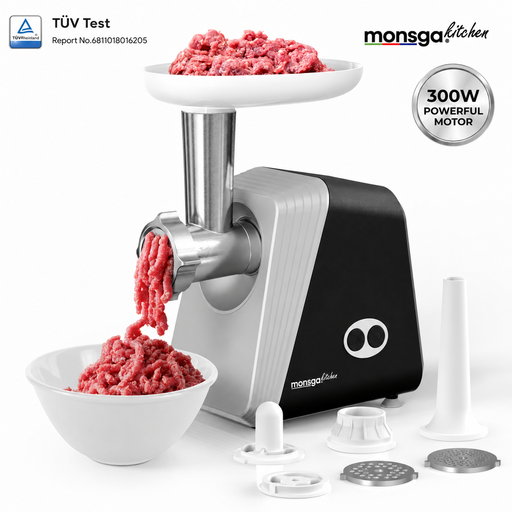
Why this product fits the profile: As an electric meat grinder, this model is aimed at households that want to prepare their own minced meat, sausages or kibbeh and need specific attachments for the job.
Rather than just highlighting a general wattage figure, the product description lists three cutting plates for fine, medium and coarse textures, along with specific accessories.
Three cutting discs, sausage filler, kibbeh attachment and details about overload and overheat protection according to the product description. The removable parts are cleaned by hand.
To ensure a long service life, blades and accessories should be freed from food residue after every use and dried thoroughly. With appliances that have a glass bowl, avoid sudden temperature changes. The motor housing should only be cleaned with a slightly damp cloth.
The ongoing electricity costs depend on the power, operating time and your electricity tariff. Since a chopper usually runs for just a few seconds or minutes per cycle, the actual consumption is mainly relevant if you use it frequently. A simple calculation is:
Power in kilowatts × operating time in hours × electricity price per kilowatt-hour = electricity cost.
For herbs and small quantities, a compact herb chopper such as the Excellent Houseware Herb Cutter with five blades may be sufficient. For larger quantities or multiple steps, models like the Severin Universal Chopper KM 3867 offer functions for coarse and fine chopping as well as processing nuts and crushed ice, according to the product description. Always check beforehand whether the specific ingredient and quantity are explicitly permitted.
We've put together a complete, regularly updated list of products that fully meet these strict selection criteria and the safety regulations in force in the EU.
For onions, herbs and soft vegetables, smaller motors are sufficient depending on the model. For regular quantities, nuts or meat, you need to consider power, blades, bowl size and permitted operating time together. A higher wattage doesn't replace checking the instruction manual.
The lifespan depends on how often you use it, the ingredients, cleaning and whether you observe the required rest periods. Overloading, running it for too long and using unsuitable hard foods can strain the motor and blades. So you should check the operating time limit before buying.
A food processor can combine several functions in one appliance, which can save storage space. For households that only chop herbs or onions, a small kitchen chopper is often sufficient. However, if you regularly slice, grate, knead and chop, you can benefit from a versatile model with the right attachments.