
Lieferung heute & morgen

Qualitätsgarantie

Willkommens-Angebote freischalten: KOSTENLOSE Lieferung | Bis zu 80 % RABATT | Kostenlose 30-Tage-JoyPlus-Testphase
App herunterladen
An electric citrus juicer should juice oranges, lemons or grapefruits quickly and cleanly. In practice, however, differences often only become apparent after several uses: the juice runs beside the glass, pulp clogs the sieve or cleaning takes longer than preparation. If you only focus on wattage or an attractive casing, you may end up buying an appliance that does not suit your household.
As a Joybuy Product Recommendation Officer, I therefore assess the specifications against clear, verifiable criteria. It is not advertising claims that matter, but ease of use, capacity, cleaning, safety requirements and the intended level of use.
A high power rating does not automatically mean a higher juice yield. With an electric citrus juicer, the shape of the cone, the direction of rotation and the pressing mechanism also affect the result. A 30- or 40-watt model may be sufficient for everyday household use, while an 85-watt lever-operated appliance is designed for a different way of working.
Also check whether the specification refers to the rated power or the maximum power. The Adler AD 4012, for example, is listed with a rated power of 40 watts and a maximum power of 60 watts.
A large collection container is practical for families, but it takes up more worktop space and may be more difficult to handle after use. For one or two glasses of juice, a 400- to 600-millilitre container may be sufficient. If you prepare several portions in the morning, models with a capacity of 1 to 1.4 litres give you more room.
The size of the container alone does not indicate how quickly the juicing process will be completed. Also check whether the juice runs directly into a glass or is first collected in a removable container.
An easy-to-clean citrus juicer should have as few hard-to-reach areas as possible. Removable cones, sieves and containers make cleaning easier. Whether these parts are dishwasher-safe varies from model to model. With the appliances mentioned, the motor housing must not be immersed in water.
The same rule applies to every electric juicer: unplug it before dismantling and cleaning it. Do not touch moving pressing cones with your fingers, hair or objects while the appliance is running. Children should only use the appliance under supervision. The correct mains voltage, a stable surface and an undamaged cable are also essential for safe operation.
Two pressing cones are useful if you want to process both small lemons and larger oranges. With an electric lemon squeezer, the small cone should hold the fruit securely so that it does not slip while being pressed. A sieve with an adjustable pulp setting is practical when different members of the household have different preferences.
A lever citrus juicer transfers pressure through the handle and can make it easier to juice several fruits. Other appliances start automatically as soon as pressure is applied to the cone. This start-stop system reduces the need to operate additional switches, but it does not replace even and controlled pressing.
A drip-free spout can hold back liquid after juicing and help limit splashes on the work surface. Also check whether the appliance is heavy enough to remain stable or has non-slip feet. A citrus juicer with a collection container is particularly useful if the juice is not going to be served immediately.
Compact dimensions and cable management are important in small kitchens. Glass containers offer a different feel from plastic containers, but they are heavier and potentially more prone to breaking. With an appliance featuring a retro-style casing, consider not only the design but also its height, depth and the space required for the lever.
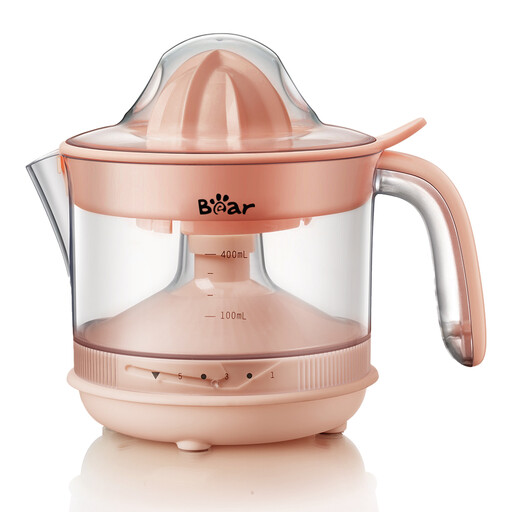
Why this product suits the profile: According to the product specifications, this compact model has a 400 ml capacity, 30 watts of power and dimensions of 200 × 141 × 176 mm. This makes it suitable for smaller households and limited worktop space.
Five adjustable settings and a removable design provide greater control over pulp and cleaning than a basic model without adjustable settings.
30 watts rated power, 400 ml capacity, non-slip base and removable components according to the product description.
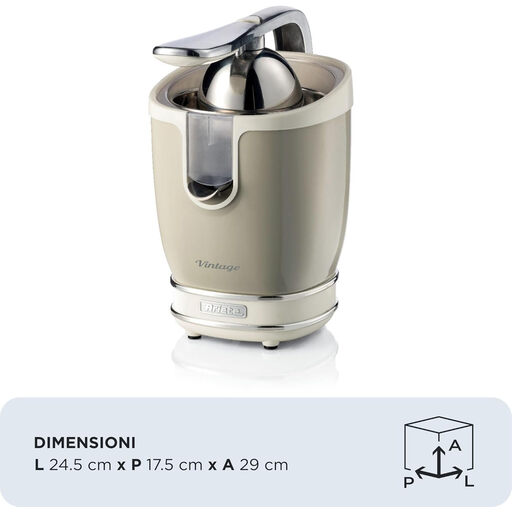
Why this product suits the profile: This lever-operated appliance combines a stainless-steel surface with a 1-litre container and an 85-watt motor. Its height of 31 cm should be taken into account when planning your kitchen space.
According to the supplier, the two pressing cones are suitable for both small and large citrus fruits. The drip-free spout addresses the common problem of juice ending up on the work surface.
85 watts, 1-litre capacity, stainless-steel construction and lever operation according to the product data.
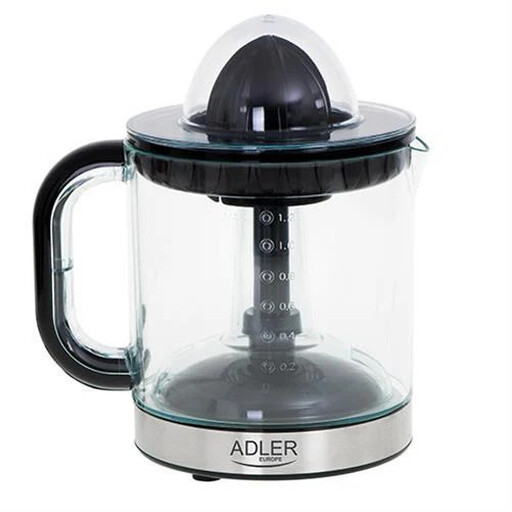
Why this product suits the profile: The 1.2-litre glass container is designed for several portions. Automatic start-up when pressure is applied and bidirectional rotation support consistent preparation in a family household.
According to the product specifications, the pulp sieve retains pulp and seeds. Removable parts are dishwasher-safe; the motor housing is excluded.
1.2-litre capacity, two pressing cones, automatic start-stop function and dishwasher-safe accessories.
We have put together a complete, regularly updated list of products that fully meet these strict selection criteria and the safety regulations applicable in the EU.
The electricity consumption of an electric orange juicer depends on its rated power and the actual operating time. With short juicing sessions, household consumption is generally lower than with appliances that run continuously for long periods. For an accurate estimate, multiply the power in watts by the daily usage time and your own electricity tariff.
Regular cleaning, dry storage and following the operating instructions are more important for service life. Only juice suitable citrus fruits, not hard objects, seeds or ice. If you notice unusual noises or vibrations, or the appliance becomes blocked, switch it off immediately and only inspect it once it has come to a complete stop.
The halved fruit is placed cut-side down on a pressing cone. Depending on the design, the motor starts automatically when pressure is applied or is operated using a lever. The juice passes through a sieve into a glass or collection container. An electric citrus juicer is designed for citrus fruits and should not be confused with a centrifugal or cold-press juicer for hard ingredients.
There is no reliable one-size-fits-all answer regarding service life. It depends on how frequently the appliance is used, how it is cleaned and stored, and how carefully the motor and accessories are handled. Models with removable parts can make maintenance easier. Wear parts such as pressing cones and sieves should be checked regularly for cracks and deformation.
This can only be assessed by considering the price of the fruit, the amount of juice produced, electricity costs and how often the appliance is used. You should also factor in the time needed for shopping, halving the fruit and cleaning. If you regularly process oranges, lemons or grapefruits, compare capacity, ease of use and the effort required for cleaning above all else.