
Lieferung heute & morgen

Qualitätsgarantie

Willkommens-Angebote freischalten: KOSTENLOSE Lieferung | Bis zu 80 % RABATT | Kostenlose 30-Tage-JoyPlus-Testphase
App herunterladen
Fresh juice from oranges, lemons or grapefruits can be prepared quickly with an electric citrus juicer. However, not every appliance is right for every household. If you only look at wattage, design or bold advertising claims, you can easily overlook important details such as awkward cleaning, a lack of pulp control or a juice container that is too small for the family.
The power rating mainly describes the motor’s output. With a traditional electric orange juicer, however, the reamer, rotation and strainer are also crucial. A compact 30- or 40-watt appliance may be perfectly adequate for oranges and lemons, while an 800-watt centrifugal juicer is designed for larger quantities as well as additional fruit and vegetables.
It is therefore important to match the design to the intended use. An electric lemon juicer is not automatically suitable for hard fruit or whole apples.
A traditional citrus juicer processes halved citrus fruit. Pips, ice cubes and hard objects should not be placed in the pressing area. If you are looking for a citrus fruit juicer for apples, carrots or other firm fruit, you will instead need a juicer with a feed chute and a cutting or grating filter.
Look for specific information about oranges, lemons, mandarins and grapefruits. For pomegranates or very small fruit, you should also check whether the reamer is designed for them.
Juice residue dries quickly on the strainer and reamer. An easy-to-clean citrus juicer should therefore have removable components. Also check whether these parts can be rinsed under running water or cleaned in the dishwasher. The motor housing must never be immersed in water.
With a traditional electric juicer, the motor usually starts when you press the fruit onto the reamer. A citrus juicer with lever reduces the effort required and can be more convenient when pressing several fruits in succession. Appliances with automatic start and stop respond to the pressure applied to the halved fruit.
A centrifugal juicer such as the Braun Multiquick 3 J300 works differently: fruit is fed through a chute, while a filter separates the juice from the pulp. This design is suitable for more versatile juice recipes, but it takes up more space and creates more cleaning work because of the filter.
For one person, a container with a capacity of 400 to 600 ml may be sufficient. Families are more likely to benefit from a capacity of 1.2 to 1.4 litres. When choosing an orange juicer, the capacity should match your usual consumption so that the container does not need to be emptied constantly.
A citrus juicer with pulp filter holds back pips and larger pieces of fruit. Some models offer several strainer settings or adjustable pulp control. This is useful if people in the household have different preferences.
Look for a non-slip base, a drip stop and reliable automatic shut-off. Removable parts should come off without requiring much force. Appliances with sharp filter components require particular care during cleaning.
For use in Germany, information about the operating voltage and mains plug is also relevant. The instruction manual should include details of the maximum continuous operating time, cleaning and safe use. Children should only use electric juicers under supervision.
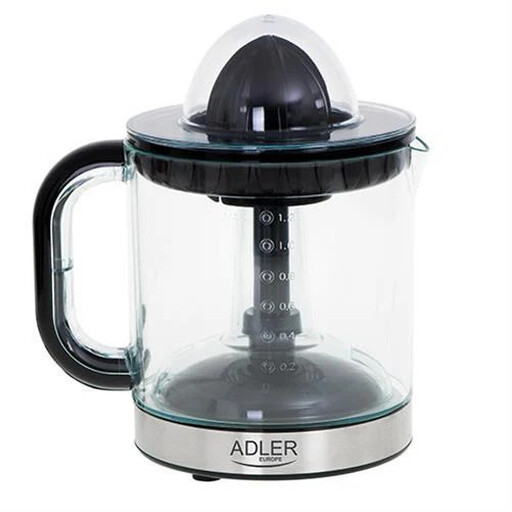
Why this product suits the profile: The 1.2-litre glass container is suitable for several glasses of juice without requiring an especially powerful motor.
The automatic start-stop function and two reamers make operation straightforward. The integrated strainer separates pulp and pips.
40 watts rated power, 1.2-litre capacity, two-way rotation and dishwasher-safe parts – excluding the motor unit.
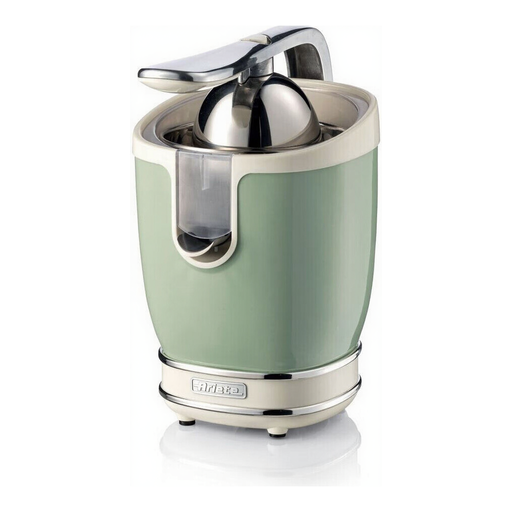
Why this product suits the profile: The lever operation and two reamers are designed for convenient juicing of large and small citrus fruit.
The drip stop helps reduce juice residue on the work surface. Its compact design is suitable for households that do not want to store a large juicer.
85-watt motor, 0.6-litre capacity, electric lever and two reamers for different fruit sizes.

Why this product suits the profile: This appliance is aimed at users who want to juice not only citrus fruit but also other prepared fruit and vegetables.
The 75 mm feed chute reduces preparation time. A fine stainless-steel filter and a foam separator are designed to produce clearer juice.
800 watts, two speed settings, 1.25-litre juice jug, 2-litre pulp container and drip stop.
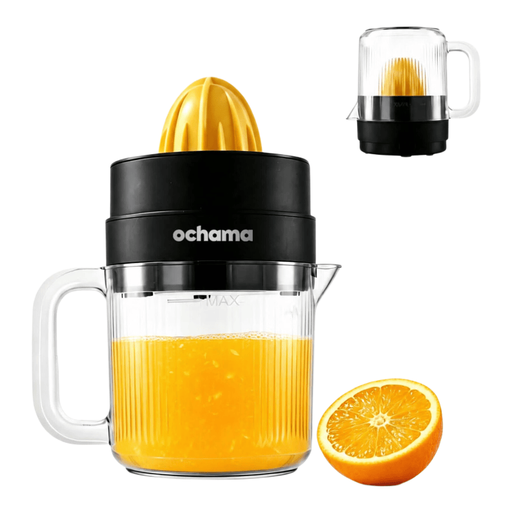
Why this product suits the profile: The semi-automatic operation and 1.4-litre capacity are suitable for regular family use without requiring a large appliance.
The removable parts make cleaning easier. The design works without cutting blades and is intended exclusively for suitable citrus fruit.
30 watts, 1.4-litre capacity, pulp separation and removable accessories. The motor housing must not be cleaned with water.
We have put together a complete, regularly updated list of products that fully meet these strict selection criteria and the safety regulations applicable in the EU.
Its lifespan depends on usage, cleaning and the strain placed on the motor. Follow the operating intervals specified in the instructions and allow the motor to cool down between longer juicing sessions. Juice residue should be removed promptly to prevent the strainers and reamers from becoming sticky.
Consumption depends on the motor’s power rating and the actual running time. A 40-watt appliance theoretically uses around 0.0067 kilowatt-hours when operated for ten minutes. An 85-watt juicer would use around 0.0142 kilowatt-hours over the same period. The actual cost depends on your electricity tariff and how long you use the appliance.
Choose a model with a pulp filter or adjustable strainer. With a traditional citrus model, the amount of pulp can usually be influenced by the strainer design. For especially clear juice, a centrifugal juicer with a fine filter may be more suitable.