
Lieferung heute & morgen

Qualitätsgarantie

Willkommens-Angebote freischalten: KOSTENLOSE Lieferung | Bis zu 80 % RABATT | Kostenlose 30-Tage-JoyPlus-Testphase
App herunterladen
An electric citrus juicer can make your daily juice preparation much simpler. However, eye-catching wattage figures, large capacities, or promises of high juice yield don't automatically mean you're getting the right appliance. What really matters is how well the juicer suits your typical quantities, the fruits you use, and your cleaning habits.
The motor power affects how forcefully the appliance works. On its own, though, it tells you very little about how much juice you'll actually get from an orange or grapefruit. The cone size, pressing mechanism, rotation pattern, and strainer all play a part. An electric juicer with moderate power can be perfectly adequate for a typical household, while a more powerful model offers extra headroom if you use it frequently.
A citrus juicer with a collection jug of 1.2 or 1.4 litres is fine for making several servings. For a single person, however, a smaller jug of 400 or 600 millilitres can be easier to handle and quicker to clean. Also check whether the jug is designed for serving or storing juice, and whether it can go in the fridge.
With many appliances, only the removable accessories can go in the dishwasher. The motor unit and power cord must never come into contact with water. So look for clear information about which parts are dishwasher-safe. Smooth surfaces, few individual components, and an easily accessible pulp strainer all help to reduce cleaning effort.
If you regularly juice oranges, lemons and grapefruits, look for at least two differently sized pressing cones. A small cone is suitable for lemons, while a larger one works for oranges or grapefruits. An automatic start-stop function activates the juicer with gentle pressure and stops as soon as you lift the fruit half away.
With an electric lemon juicer or an orange juicer that rotates in both directions, the alternating motion can help to extract the pulp more evenly. This is a technical feature, but it doesn't guarantee a specific juice yield. The actual amount you get depends on factors such as the fruit variety, ripeness, and how firmly you press.
A citrus juicer with a pulp strainer separates pips and larger fruit pieces from the juice. Depending on the design, you may be able to adjust the amount of pulp, or simply remove the strainer for cleaning. If you prefer clear juice, look for a finer filter. If you like more pulp, you'll need an adjustable or less restrictive solution.
For a multi-person household, 1.2 to 1.4 litres is practical because you don't have to refill constantly. A smaller 400 or 600 millilitre jug, on the other hand, suits single servings better. Glass can be good for direct storage, while plastic jugs are often lighter. What matters most are the manufacturer's specific instructions on cleaning, fridge use, and dishwasher suitability.
Also pay attention to the operating voltage. For UK households, the appliance should be compatible with your mains supply, for example with a rating of 220–240 V at 50–60 Hz or the appropriate nominal voltage. Check the safety instructions, earthing information, and the condition of the cable before first use.
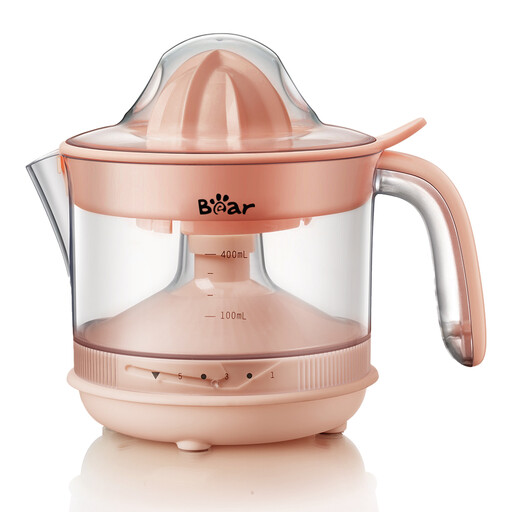
Why this product fits the profile: This compact model with a 400 ml capacity is designed for smaller quantities and making single servings. Five adjustable settings allow you to customise the pressing action.
The modest jug size means a large storage container doesn't take up unnecessary space. The removable design makes cleaning easier.
30 W rated power, five adjustable settings, BPA-free materials according to product information, and non-slip base.
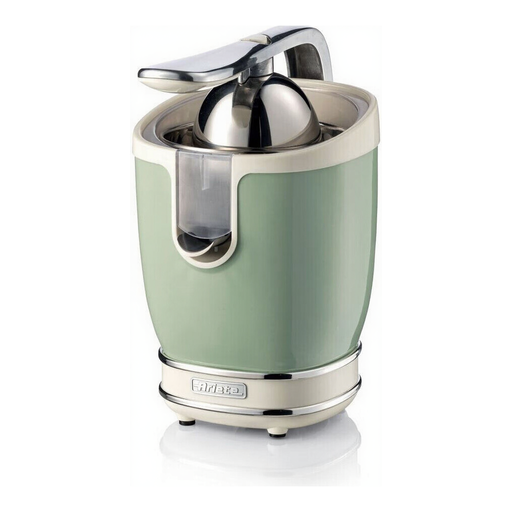
Why this product fits the profile: The electric lever reduces the manual effort you need. Two pressing cones, an 85 W motor, and a drip-free spout are designed for controlled juice preparation.
The two cones cover different citrus fruits. The drip-free spout addresses juice residue on the worktop, while the motor unit is cleaned separately.
85 W power, lever operation, two cones, and 0.6 l capacity according to the product description.
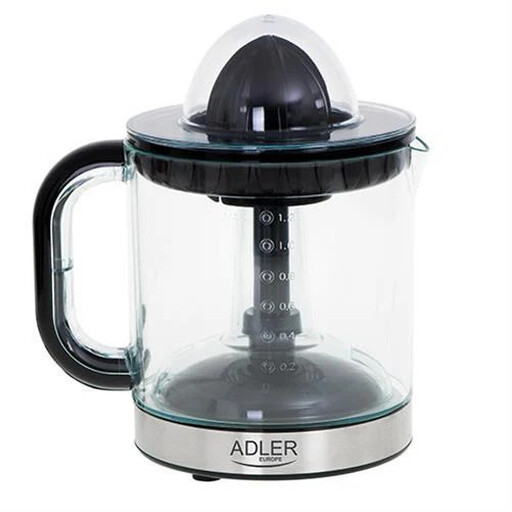
Why this product fits the profile: The 1.2-litre glass jug is designed for family-sized portions. Two cones, an automatic start-stop function, and alternating rotation support regular use.
The pulp strainer holds back pulp and pips. According to the product information, the glass jug, strainer and cones are dishwasher-safe; the motor unit is not.
40 W rated power, 60 W maximum power, 1.2 l glass jug, cable storage, and automatic start-stop function.
We've put together a complete, regularly updated list of products that fully meet these strict selection criteria and the safety regulations in force in the EU.
A classic electric citrus juicer is designed for oranges, lemons, limes and grapefruits. A slow juicer for fruit and vegetables, on the other hand, works with an auger and can, depending on the model, also handle harder ingredients or leafy greens. If you only juice citrus fruits, you often don't need the extra complexity of a slow juicer. For mixed juices with apples, carrots or vegetables, though, this type of appliance may be more suitable.
That depends on the specific model. Follow the instruction manual and avoid prolonged continuous operation if the manufacturer explicitly recommends breaks. If you notice unusual noise, vibration, or a blockage, switch the appliance off and unplug it.
First, unplug it. Then remove the cone, strainer and collection jug and clean them according to the manufacturer's instructions. The motor unit must not be immersed in water. With a dishwasher-safe citrus juicer, you need to check exactly which parts are approved for the dishwasher.
The power consumption depends on the rated power and the actual running time. An appliance with 40 W that runs for only a few minutes per juice session uses less energy in theory than a higher-powered model used for longer. So when making your buying decision, consider power, portion size, and ease of use together.