For the occasional glass, a compact juicer with a collecting jug or direct spout is a natural choice. For several servings, think about how you’ll collect and transfer the juice. If you’ll be using fruit of different sizes, look for suitable cones; pulp controls and removable parts can also affect how easy a juicer is to use and clean. Wattage alone doesn’t prove that a juicer will produce more juice.
Which juicer is right for you?
Holidaymakers with limited kitchen space
If you only make a glass or two of lemonade now and then, a compact design and easily accessible parts are important, so you can put the juicer away and clean it without fuss. Braun and CASO describe different designs, but neither provides a general ranking based on how much space they take up.
A round of drinks with different citrus fruits
If you’ll be juicing lemons repeatedly, and perhaps limes or oranges too, check which cones are included and how the juice is collected. WMF lists two cones for the Stelio, while CASO describes the CP 200 as having a universal juicing cone.
Guests with a preference about pulp
If you’d rather adjust the amount of pulp as you juice than strain the juice afterwards, look for a model with the relevant settings. Braun lists this feature for the CJ3000WH, while Bosch describes PulpControl on the MCP3500N.
What should you look for when buying?
First, check how much space you have in your holiday-home kitchen and how you’d like to clean the parts after juicing. Then consider the size of the fruit, how you’ll serve several portions and your preferences about pulp to narrow down the features you need.
| What matters |
What to look for |
Who is it important to? |
| Space and cleaning |
Compare the dimensions and weight with the storage space available; check which parts are removable and specifically stated to be dishwasher-safe. |
If I want to put the juicer away and clean it easily after occasional use, the effort involved afterwards matters most; around 36% of consumers put space and cleaning first. |
| Different fruit sizes |
Check what’s included: WMF lists two cones for the Stelio, while CASO lists a universal juicing cone for the CP 200. |
If you want to juice other citrus fruits as well as lemons, it’s worth checking that the cones are suitable; around 29% of consumers prioritise different fruit sizes. |
| Several servings |
Consider whether you’d rather collect the juice in a jug first or have it flow straight into a glass; if it has a direct spout, check the height of the glass it can accommodate. |
If I’m filling several glasses one after another, I want to collect the juice without unnecessary decanting; around 21% of consumers prioritise how the juicer handles several servings. |
| Pulp |
The Braun CJ3000WH is listed as having an adjustable pulp setting; check whether the feature applies to the version you want for each model. |
If you want to cater for different preferences about pulp at the table, look for a suitable setting; around 14% of consumers give this priority. |
Common buying mistakes
-
Assuming wattage means more juice
Motor power alone isn’t a reliable way to compare how much juice different models produce. Wattage is simply one of the specifications for a particular model.
Choose based on the size of the fruit, how the juicer works and how much cleaning it needs. Don’t treat power ratings as a ranking of juice yield.
-
Assuming the whole appliance is dishwasher-safe
Manufacturers’ claims often apply to individual parts, not the electrical base.
Check the manual for your exact model to see which parts can go in the dishwasher, and clean the base according to the manufacturer’s instructions.
-
Assuming an older ranking means a model is still available to buy
The 2026 comparison by the essen & trinken editorial team features the Bosch MCP3500N; Bosch lists the model as no longer available in its German online shop. This information relates to the Bosch shop.
Use editorial rankings as a guide only, and check the model and current retailer information separately.
Key brands at a glance
Braun
The CitrusQuick 1 CJ3000WH is an option for smaller quantities and adjustable pulp levels.
- Braun says the cone starts when you press the fruit down, alternates between clockwise and anti-clockwise rotation, and lets you adjust the pulp level.
- This manufacturer information doesn’t prove a measured juice yield or product lifespan.
WMF
The Stelio is designed for buyers who want to juice citrus fruits of different sizes using two cones and a direct spout.
- WMF lists two juicing cones, a direct spout, a drip stop and dishwasher-safe parts.
- Check that your glass or carafe fits under the spout, and see which parts the manual says can go in the dishwasher.
CASO
The CP 200 is an electric lever juicer for buyers who want to press fruit using a lever arm.
- CASO lists a universal juicing cone, removable dishwasher-safe parts and a drip stop.
- Bear the stated dimensions of 180 × 290 × 250 mm and weight of 2.3 kg in mind when storing or transporting it. This doesn’t mean it will produce more juice than other models.
Bosch
The VitaPress MCP3500N has a design with a removable juice jug and pulp control.
- Bosch lists an 800 ml jug, PulpControl and dishwasher-safe parts for the MCP3500N.
- Bosch lists the model as no longer available in its German online shop; this doesn’t tell you whether other retailers have it in stock.
Philips
The HR2752/50 is an option for buyers who want to take the manufacturer’s claims about quiet operation into account.
- Philips lists an 85 W motor and describes the model as particularly quiet.
- Without comparable independent noise measurements, it’s not possible to rank it against other juicers.
Electric citrus juicers at Joybuy
This selection includes electric citrus juicers for holiday-home kitchens, from compact models for smaller quantities to a lever juicer with a collecting jug.
 No image available
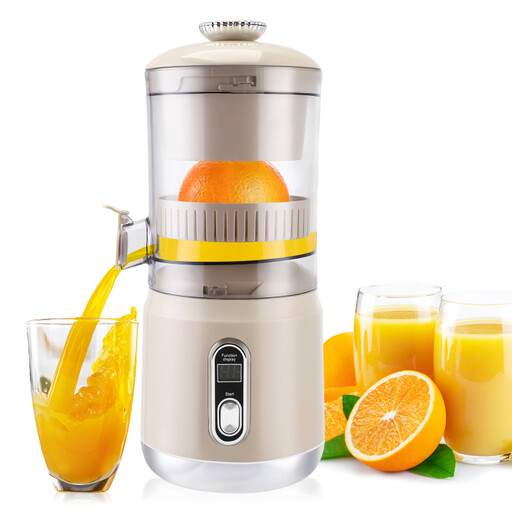
Rechargeable electric citrus juicer with drip stop, white
A possible choice if you want to juice citrus fruit without a cable and clean the removable parts after use.
The description lists removable, dishwasher-safe parts and fruit up to 7.5 cm. Check the cleaning instructions for the appliance itself before buying.
View at Joybuy
 No image available
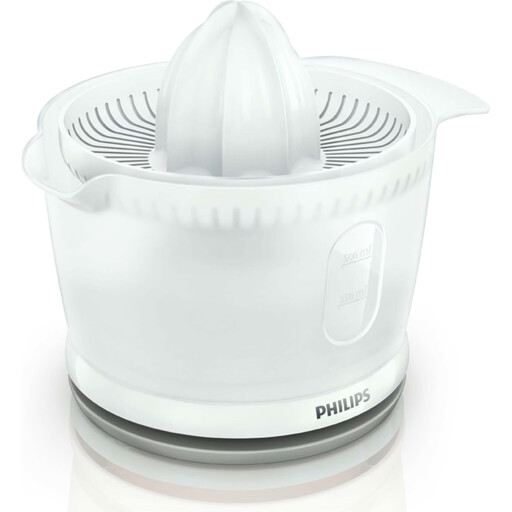
Philips HR2738/00, 25 W
The removable jug is a good option if you’d like to collect the juice first and then pour it into glasses.
The description lists a 500 ml capacity, dimensions of 14.5 × 19.7 × 16.4 cm, cable storage and removable, dishwasher-safe parts. It also specifies a drip-free spout.
View at Joybuy
 No image available
Bear CZJ-A04B1, five pulp settings
Adjustable pulp levels may be useful if you want to cater for different preferences in your group.
The title lists five pulp settings. The description specifies a 400 ml capacity, a removable design and dimensions of 200 × 141 × 176 mm.
View at Joybuy
 No image available
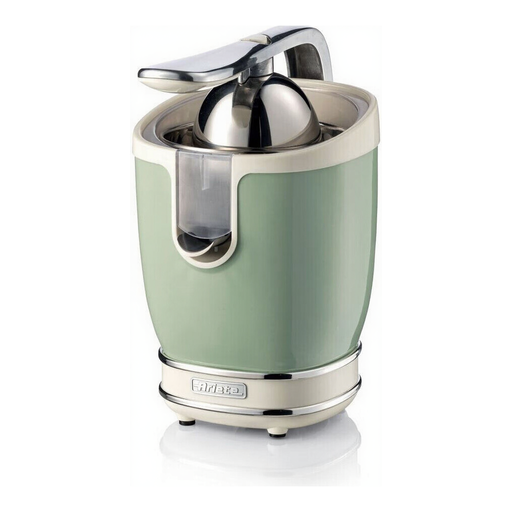
Ariete 0413GR, 0.6 l, light green and cream
The lever design is an alternative if you’d prefer to use a pressing arm and juice several pieces of fruit.
The description lists two juicing cones, a lever, a drip-free spout and a 0.6 l jug. The stated dimensions are 24 × 32 × 24 cm.
View at Joybuy
Frequently asked questions
What should I do before using the juicer for the first time at my holiday home?
Read the manual for your specific appliance and wash the citrus fruit in lukewarm water before juicing; the Verbraucherzentrale also recommends drying it by rubbing. If the juicer has a direct spout, check that your glass or carafe will fit underneath.
Can I put the whole electric juicer in the dishwasher?
No. The phrase “dishwasher-safe parts” doesn’t automatically apply to the whole appliance. Remove only the parts that the manual for your model says are dishwasher-safe, and clean the electrical base according to the manufacturer’s instructions.
What are my rights when buying online in Germany?
For a typical distance purchase from a trader, the EU’s Your Europe portal explains that you generally have a 14-day right to cancel, although exceptions apply. If goods are faulty, you are also generally entitled to a legal guarantee of at least two years from the date you receive them; this is separate from any voluntary manufacturer’s warranty.
Can I put an old electric citrus juicer in household waste?
No. The Umweltbundesamt explains that electrical waste must be collected separately; use an appropriate collection or take-back point.


