First, choose a brush head to suit the glaze, grout and type of dirt, then decide whether you’ll mainly be cleaning open surfaces or narrow grout lines. A longer handle can be useful for high-up tiles. If the brush will be kept in a shared cupboard, also consider how much space it takes up, whether the heads can be distinguished from one another and whether they can dry fully before being put away. For small or lightly soiled areas, manual cleaning may be enough.
Who is an electric cleaning brush suitable for?
People who clean tiles and grout
If you’re cleaning glazed wall tiles and grout, choose a brush head and cleaning product to suit the materials rather than focusing on motor power alone. Bosch DIY describes its UniversalBrush as suitable for tiles and grout; Agrob Buchtal advises protecting cement-based grout when cleaning.
People who share a cleaning cupboard
If several people use the same brush, removable heads that are easy to tell apart can help, along with somewhere to let them dry properly after cleaning. The Federal Institute of Public Health recommends keeping cleaning equipment for the kitchen separate from equipment for bathrooms and toilets; the Federal Environment Agency stresses the importance of letting equipment dry.
People cleaning high wall tiles
If you need to reach upper tiles, consider a longer or telescopic handle and check that its folded length will fit in your cupboard. In its test, BILD’s buying guide praised the telescopic handle on the Kedoyoy ZY-CB02, but noted its bulky size when packed away.
What should you look for when buying one?
For glazed wall tiles and a shared cleaning cupboard, first check that the brush is suitable for your surfaces and comes with the right heads. Handle reach, storage space and everything included in the box can then help you decide.
| Criterion |
What to check before buying |
Who should pay particular attention? |
| Protecting glaze and grout |
Check the guidance for the brush head and tiles; choose a cleaning product to suit the grout and start on an inconspicuous area. |
If I want to avoid damaging the glaze and grout with an unsuitable brush head or cleaner, checking material compatibility comes first. Around 28% of consumers would prioritise this too. |
| Brush heads for surfaces and grout |
Measure the narrowest area and the open surface; check which heads are actually included and whether they’re suitable for each task. |
If you want to clean narrow grout lines and joints as well as open tiled areas, you’ll need heads suited to both. Around 22% of consumers would prioritise having suitable heads for surfaces and grout. |
| Shared use and storage |
Check whether the heads are removable and can be cleaned according to the instructions, and whether they can dry completely before being put away. Keep kitchen cleaning equipment separate from bathroom and toilet equipment. |
If several people use the brush, I want to be able to identify the heads and store them clean and dry. Around 22% of consumers would put hygiene and shared storage first. |
| Reach and packed size |
Check the working height and how you hold the handle, then compare its extended and stored lengths with the space available. |
If you need to reach upper tiles, a longer handle may matter more than compact storage. Around 17% of consumers would prioritise reach. |
| What’s included and ongoing costs |
Check the included heads, compatible battery system and any components you may need to buy separately. |
If I want to use the brush straight away, I check whether the battery, charger and required heads are included. Around 11% of consumers would prioritise the included equipment and potential extra costs. |
Which buying pitfalls should you avoid?
-
Assuming an IP rating means the whole device is waterproof
Protection ratings don’t necessarily apply to every component: Bosch DIY lists IPX5 splash protection for the UniversalBrush, while Ryobi’s IPX7 rating specifically applies to the battery compartment of the R18CPS-0.
Read the instructions for the complete model before wet cleaning or charging it. Don’t submerge the electric unit based on an IP rating alone.
-
Assuming a bare tool is a complete kit
According to the manufacturer, the Einhell PICOBELLA 18/90 is supplied without a battery or charger.
Check what’s included against your existing battery system and make sure it comes with the heads you need for tiles and grout.
-
Scrubbing hard or using an acidic cleaner on every type of grout
Agrob Buchtal warns against abrasive additives and notes that acidic cleaners can damage cement-based grout.
Choose a cleaner and brush head to suit the tiles and grout, and rinse away loosened dirt thoroughly.
-
Choosing extra reach without checking shared storage space
In the test of the Kedoyoy ZY-CB02, BILD’s buying guide noted that its telescopic handle came with a bulky packed size. Cleaning accessories also won’t dry well if they’re put away while damp.
Choose a longer handle only if you need the extra reach, and make sure there’s space for the heads to dry.
Relevant brands to help you choose
The information below relates to the product lines and tests mentioned, not to each brand’s entire range.
Bosch DIY
Bosch DIY describes the UniversalBrush as a compact cordless hand-held brush for tiles, grout and tight spaces.
- Bosch DIY lists IPX5 splash protection, Micro-USB charging and interchangeable heads. A soft, non-abrasive head is also described separately.
- The separate head isn’t necessarily included with every kit. F.A.Z. Kaufkompass praised the replacement heads but criticised the water protection and charging port.
Einhell
The PICOBELLA 18/90 combines different brushes and pads with the Power-X-Change battery system.
- Einhell says the listed package includes, among other items, SOFT and MEDIUM brushes, pads and a wall bracket.
- The battery and charger aren’t included. Check separately which head is suitable for your tiles and grout.
Ryobi
According to Ryobi, the ONE+ R18CPS-0 has a rotating 15-cm head for a range of cleaning tasks.
- Ryobi specifies IPX7 protection for the battery compartment only. In BILD’s test, the product’s handling and performance when wet were rated positively.
- BILD’s test criticised the lack of handle-length and angle adjustment, as well as the limited range of accessories. These comments apply to the model tested.
Kedoyoy
The ZY-CB02 featured in BILD’s test is a brush with a telescopic handle for harder-to-reach areas.
- The test team praised the cleaning performance in the bathroom and the adjustment options on the model tested.
- The same test criticised its bulky packed size and the stiff mechanism for changing brush heads. The verdict applies to the ZY-CB02 tested.
HAUSHOF
BILD’s test describes an electric hand-held brush called the “HAUSHOF electric cleaning brush”.
- The test team praised the three modes and the product’s ease of use.
- The test notes that it has no telescopic handle and a bulky design. The name doesn’t include a full model number, so the results can’t be reliably linked to a specific product for sale.
Joybuy products for wall tiles and grout
These Joybuy products are for people who clean tiles and grout and would like a longer or adjustable handle.
 No image available
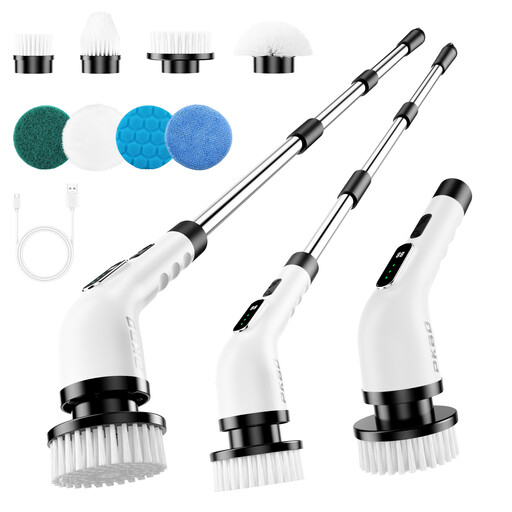
9-in-1 cleaning brush with telescopic handle
The telescopic handle is designed for reaching higher areas; the listed uses include tiles and grout.
The title specifies 3 speeds, 8 heads and a 2500 mAh battery.
View at Joybuy
 No image available
Rotating cleaning brush with telescopic handle
The product information lists tiles and grout as suitable uses; the telescopic handle is designed for hard-to-reach areas.
It comes with 7 interchangeable heads and 2 speeds.
View at Joybuy
 No image available
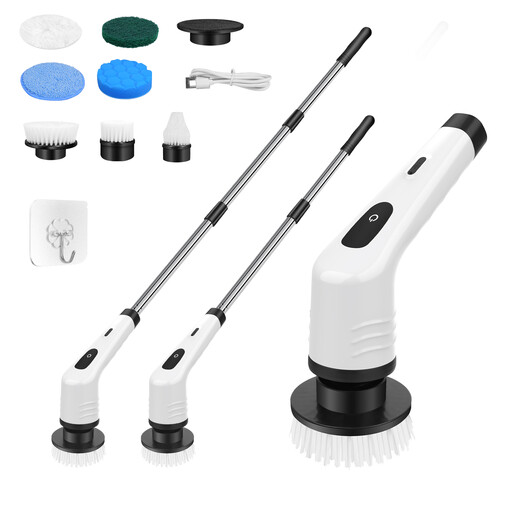
Rotating cleaning brush with telescopic handle, White
The product information lists tiles and bathroom grout as suitable uses; the adjustable-length handle is designed for higher areas.
It comes with 7 interchangeable heads and 2 speed settings.
View at Joybuy
 No image available
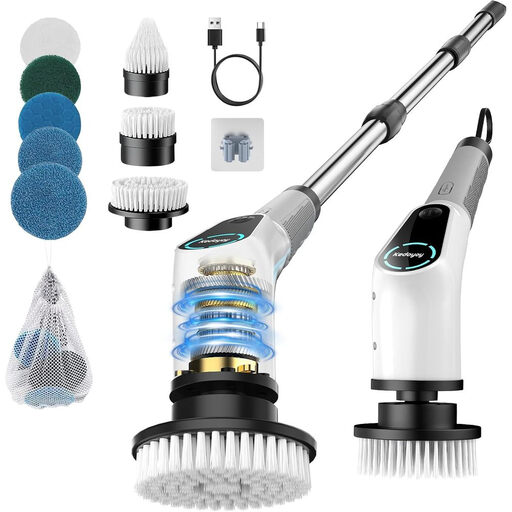
Cordless cleaning brush, 8-in-1, 30–137 cm handle
The adjustable handle can help you reach higher areas in the bathroom and on tiled walls; according to the product information, the device must not be submerged.
The title specifies 8 interchangeable heads, 2 speeds and USB-C charging.
View at Joybuy
 No image available
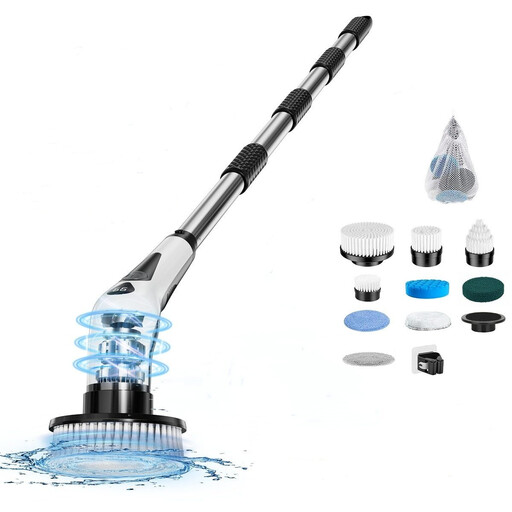
Cleaning brush with 9 heads, 30–130 cm handle
The product description recommends the flat head for tiles and walls, and the corner head for grout. The extension handle is designed for higher areas.
It comes with 9 interchangeable heads and an LED battery indicator.
View at Joybuy
Frequently asked questions
Can I clean a splash-resistant brush under water?
No. An IP rating alone doesn’t mean you can do that. Bosch DIY describes the UniversalBrush as IPX5-rated for use in damp environments; on the Ryobi R18CPS-0, IPX7 applies specifically to the battery compartment. Follow the instructions for the complete model when it comes to water contact, cleaning the heads and charging.
How should I store brush heads in a shared cleaning cupboard?
Clean used heads according to their instructions and let them dry thoroughly before putting them away. The Federal Institute of Public Health recommends keeping cleaning equipment for the kitchen separate from equipment for bathrooms and toilets; labelling interchangeable heads can also make it easier to tell them apart.
What applies if something goes wrong: a warranty or your statutory rights?
Your statutory rights for faulty goods are against the seller; a guarantee is an additional voluntary promise with its own terms. If a product is faulty, the first step may be repair or replacement. The Verbraucherzentrale explains the difference between statutory rights and a guarantee.
Where should I take an old electric brush and its battery in Germany?
Take electrical waste to an authorised collection or take-back point, such as a local authority recycling centre. Used batteries and removable rechargeable batteries must not go in household waste; the Federal Ministry for the Environment lists return points at retailers and local authorities. For built-in batteries, follow the collection point’s guidance and don’t try to force the device open.
Do I need to use disinfectant regularly on ordinary bathroom tiles?
The Federal Environment Agency advises that disinfection is generally not necessary in private households. The Federal Institute of Public Health recommends ordinary household cleaning products and separate cleaning equipment for bathrooms and toilets as everyday measures; this doesn’t cover every exceptional situation where there may be a specific medical reason.


