
Lieferung heute & morgen

Qualitätsgarantie

Willkommens-Angebote freischalten: KOSTENLOSE Lieferung | Bis zu 80 % RABATT | Kostenlose 30-Tage-JoyPlus-Testphase
App herunterladen
An electric coffee grinder can make preparing coffee at home or in the office easier. Before you buy, though, it’s worth taking a closer look at the grinding mechanism, capacity and controls. Product descriptions such as ‘powerful’ or ‘precise’ don’t, on their own, tell you whether a grinder is right for espresso, filter coffee or everyday use.
A coffee grinder rated at 180 or 200 watts can grind coffee beans quickly. However, the wattage mainly describes the motor’s electrical power consumption. It doesn’t directly indicate how consistently the beans will be ground.
With a coffee grinder with stainless steel blades, the result depends heavily on the grinding time, the amount of beans and how they move around inside the container. This design may be perfectly adequate for French press or simple filter coffee. If you’re looking for repeatable grind sizes for espresso, it’s better to choose a burr coffee grinder with adjustable settings.
An electric coffee bean grinder with a 75 g capacity can grind enough beans for several cups or a whole pot in one go. For single servings, however, a smaller container is often more practical, as you’ll need to measure out fewer beans.
Important: the maximum capacity doesn’t indicate how long the grinder can safely run. If you overfill the container, the beans may not be ground evenly, or the blades may be put under greater strain.
Espresso usually requires a much more controlled and consistent grind than simple filter coffee. A grinder with stainless steel blades may be able to produce fine coffee grounds, but often doesn’t offer precisely defined grind settings. In that case, the grind size is controlled mainly by how long you run the grinder.
Before buying, check whether the product actually has adjustable grind settings, a conical burr or a flat burr.
A blade grinder chops beans with rotating blades. Models such as the Bosch TSM6A017C and Aigostar CG-200 have stainless steel blades and are operated at the touch of a button. The longer you hold the button down, the finer the grind can be. This design is compact and usually easy to use.
A burr grinder processes beans between two grinding surfaces. For an espresso coffee grinder or a versatile filter coffee grinder, this design typically allows you to adjust the grind more precisely. With these grinders, the number of settings, container size and ease of use are all important.
For use in UK households, check that the appliance is suitable for 220–240 V and 50–60 Hz. A coffee grinder with 180 watts may be powerful enough for home use, but you should consider its rated power alongside the grinding mechanism.
The Bosch TSM6A011W and Bosch TSM6A017C are rated at 180 watts. According to the product details, the Aigostar CG-200 has 200 watts. This doesn’t provide a basis for ranking the models overall; they also differ in capacity, design and controls.
A 75 g coffee grinder is a good choice if you want to prepare several servings in one go. For small kitchens, offices or occasional use, a compact grinder with a capacity of around 60 g may be enough.
You should also look for:
The motor housing of the models mentioned must not be immersed in water. Unplug the grinder before cleaning it. Stainless steel blades remain sharp even after the grinder has been switched off, so don’t touch them with your fingers.
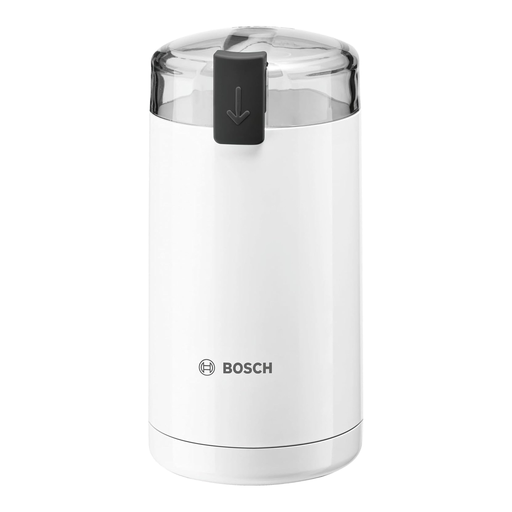
Why it suits this type of user: This compact coffee grinder has a 180-watt motor, holds up to 75 g of coffee beans and is operated with a push-button. It’s a good fit for households looking to grind coffee without complicated settings.
The specifications give clear details on capacity, power and safety features. This makes it easier to judge whether the grinder is right for you, rather than relying on a vague claim about power.
180 watts, 75 g capacity, stainless steel grinding mechanism according to the product details, and operation only when the lid is closed.
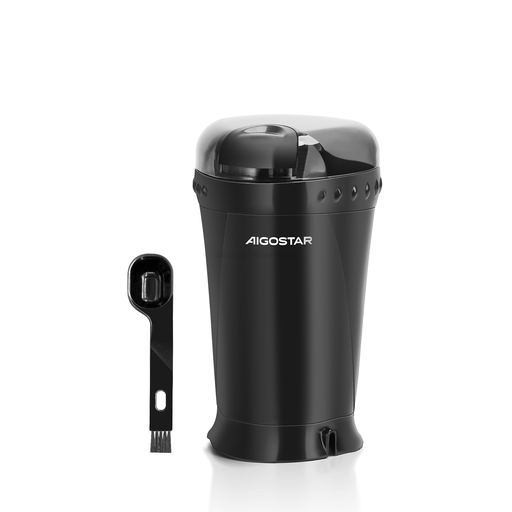
Why it suits this type of user: Its 60 g capacity and transparent lid make it well suited to single servings, while allowing you to keep an eye on the grinding process.
The capacity is clearly defined, helping you avoid choosing an unnecessarily large grinder for small amounts.
200 watts, 60 g capacity, stainless steel blades and one-button operation according to the product details.
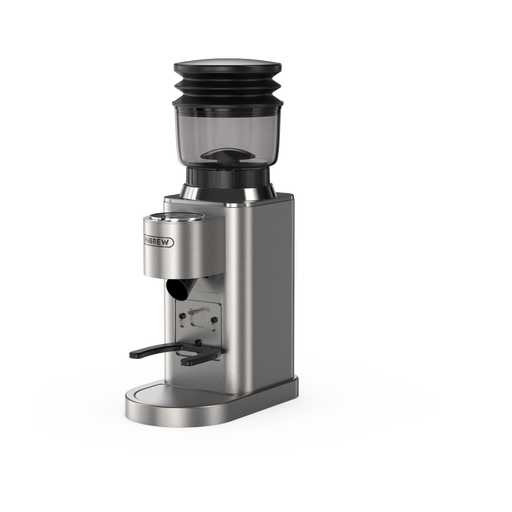
Why it suits this type of user: Its conical burr, 48 grind settings and timer-controlled operation make it a good choice for anyone who wants to compare different brewing methods.
You don’t have to rely solely on how long you hold the button down to adjust the grind. The 48 settings and timer make it easier to fine-tune and repeat your preferred results.
420 stainless steel conical burr according to the product details, 48 grind settings and modes for different portafilter sizes.
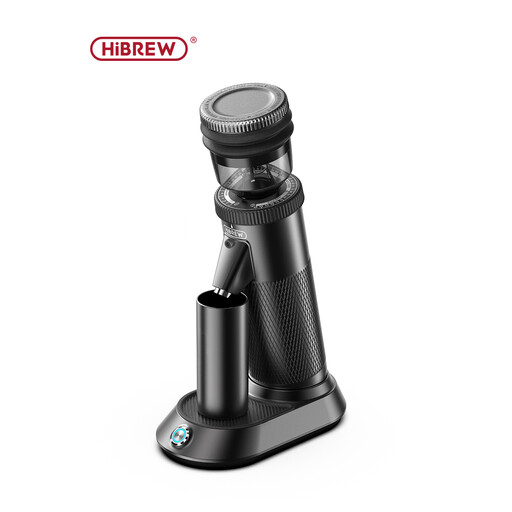
Why it suits this type of user: With 36 grind settings, a 50 g bean hopper and 180 watts of power, this grinder is designed for anyone who wants to make espresso, pour-over, moka or filter coffee.
The 36 adjustable settings mean you’re not limited to controlling the grind by running time alone. The 50 g hopper also limits the amount ground in one go.
48 mm conical burr, 36 grind settings and two specified speeds of 400 and 500 revolutions per minute.
We’ve put together a complete, regularly updated list of products that meet these strict selection criteria and fully comply with the safety regulations in force in the EU.
It depends on the design, the amount of beans and how fine you want the grind. Blade grinders are usually used in short bursts. Some product details recommend around 20 to 30 seconds for a fine grind. Always follow the instructions for your specific model. Stop grinding if the appliance starts to get unusually hot.
There’s no reliable way to give a general lifespan. It depends on factors such as how often you use the grinder, the quantity of beans, cleaning and the strain on the motor. Don’t exceed the maximum filling capacity. Regularly removing coffee grounds and storing the grinder in a dry place can help keep it in good working order.
With short grinding times, electricity consumption per use is generally modest. The actual cost depends on the power rating, how long you run the grinder and your electricity tariff. For a 180-watt grinder, a 30-second run equates to 0.09 watt-hours mathematically. You may also need to factor in the cost of cleaning and replacement parts, if these are available for your chosen model.