
Lieferung heute & morgen

Qualitätsgarantie

Willkommens-Angebote freischalten: KOSTENLOSE Lieferung | Bis zu 80 % RABATT | Kostenlose 30-Tage-JoyPlus-Testphase
App herunterladen
Freshly ground coffee beans are an essential part of the brewing process for many coffee lovers. However, an electric coffee grinder is not automatically suitable for every brewing method. There are significant differences between blade grinders, conical burr grinders, battery operation and the many available grind settings. If you focus only on wattage or eye-catching product descriptions, you may end up with a device that is too imprecise for espresso or too inflexible for a French press.
This buying guide explains which technical details really matter and which product features suit different usage scenarios.
Motor power alone says little about the quality of the grind. A 200-watt device with blades can chop beans quickly, but it usually does not offer a clearly defined grind-size scale. Fineness is often controlled by how long the grinder runs. This can result in very fine and coarser particles being produced at the same time.
For espresso, pour-over coffee or a French press, a consistent grind size is often more practical. In these cases, an electric coffee grinder with burrs may be more suitable than a basic model with rotating blades.
The number of settings should match how you intend to use the grinder. An electric coffee grinder with adjustable grind size is useful if you regularly switch between espresso, moka pot, pour-over coffee and French press. However, it is also important that the setting is easy to understand and remains stable during use.
Stepless fine adjustment can be helpful for espresso. For occasional filter-coffee drinkers, several clearly separated settings are usually sufficient.
A small coffee bean grinder is ideal for single servings, the office or use on the go. If you regularly prepare several cups at once, check the bean hopper capacity. Specifications such as 50, 60 or 75 grams correspond to several servings depending on the dose, but should not be confused with unlimited continuous operation.
Battery-powered models also involve charging times and battery life. A battery coffee grinder offers flexibility, but needs to be sufficiently charged before use and should only be used with dry coffee beans.
A conical burr grinder crushes the beans between two grinding surfaces. Models such as the STARESSO D6E PLUS and the Starseeker E55 Pro use this type of mechanism. The product details for the STARESSO specify stainless-steel burrs with triple coaxial alignment and dual bearings. The Starseeker E55 Pro is listed as featuring a 55-mm titanium-alloy conical burr grinder.
A coffee grinder with stainless-steel burrs may appeal to users who value a mechanical grinding system and want to prepare coffee using different methods. Blade models such as the Bosch TSM6A011W, Aigostar CG-200 and Severin KM 3879, on the other hand, operate using short pulses and timed grinding. They are simpler in design, but normally offer less control over grind size.
The appropriate setting depends on the brewing method:
A coffee grinder for espresso should therefore offer as much fine adjustment as possible. For a coffee grinder for French press, a sufficiently coarse range is important. If you use several brewing methods, do not focus only on the maximum number of settings. Check the actual adjustment range available.
A one-touch button is straightforward for everyday use. Devices with a timer or display allow you to repeat the grinding time more accurately. A transparent container makes it easier to monitor the contents, but this should not obscure the fact that residue needs to be removed regularly.
You should also look for:
The burrs and motor unit should not be rinsed with water or immersed. Blade grinders have sharp blades, which should only be touched after the appliance has been disconnected from the mains.
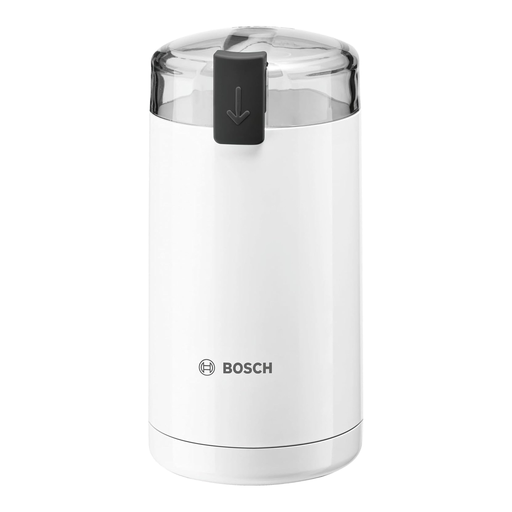
Why this product suits the profile: This compact mains-powered appliance has a power rating of 180 watts, holds up to 75 g of beans and is operated using a push button. It is suitable for simple preparation at home.
The specifications clearly state the capacity, power rating and safety lock. This makes it easier to compare the appliance with a small conical burr grinder.
75-g container, 180-watt motor, compact dimensions of 90 × 90 × 170 mm and lid safety function.

Why this product suits the profile: This device is designed for users who want to prepare espresso and pour-over coffee with finely tuned settings.
The product details specify a 55-mm conical burr grinder, stepless adjustment and a removable outlet for cleaning.
55-mm titanium-alloy conical burr grinder, 0.01-mm fine adjustment and aluminium-alloy metal housing, according to the product description.

Why this product suits the profile: This portable battery-powered coffee grinder is designed for the office, camping and travel, and supports espresso, moka pot, pour-over coffee and French press.
Instead of relying on unclear timed operation, this model offers adjustable grind size and one-touch operation. The 1000-mAh battery is charged via Type-C.
Metal housing, stainless-steel burrs, 1000-mAh battery and a stated charging time of approximately 2.5 hours.
We have put together a complete, regularly updated list of products that fully meet these strict selection criteria and the safety regulations applicable in the EU.
Remove coffee residue with a dry brush whenever possible after every use. With a conical burr grinder, clean the accessible parts according to the instructions. Keep water away from the motor and do not pour it directly into the grinder. With blade grinders, short pulses help prevent the device from running unnecessarily for too long at a time.
The ongoing costs of an electric coffee grinder mainly consist of electricity, cleaning and, where applicable, replacement parts. Battery-powered models also require battery care. To extend the product’s service life, follow the maximum filling level and recommended breaks.
For espresso, a finely adjustable burr grinder is a sensible choice. A sufficiently fine adjustment range and stable mechanics are particularly important. Stepless adjustment, as specified for the Starseeker E55 Pro, can make fine-tuning easier. Suitability also depends on the beans, portafilter and desired brewing time.
There is no standard service life. It depends on the burrs, motor, frequency of use, quantity of beans and care. Regular dry cleaning, observing recommended breaks and using the grinder only with dry coffee beans help reduce unnecessary strain.
For regular use at home, a mains-powered model is usually more convenient because there is no charging time. A battery coffee grinder, on the other hand, offers greater flexibility in the office, while camping or when travelling. The key factors are the level of mobility you need, the number of servings prepared each day and whether you can charge the battery in good time.