
Lieferung heute & morgen

Qualitätsgarantie

Willkommens-Angebote freischalten: KOSTENLOSE Lieferung | Bis zu 80 % RABATT | Kostenlose 30-Tage-JoyPlus-Testphase
App herunterladen
An electric coffee grinder can make preparing coffee easier: add the beans, select the grind setting or grinding time, and use the ground coffee straight away. However, not every model delivers the right results. If you focus only on wattage, glossy casings or ambitious claims, you could end up buying a coffee grinder that is unsuitable for your needs.
This guide explains what households, offices and espresso or filter coffee drinkers should look out for. The product recommendations are based on the technical specifications provided for each model.
The power rating mainly describes the motor’s electrical power consumption. On its own, it says little about whether the grounds will be uniform. The type of grinder, grinder size and adjustment options are particularly important when it comes to the consistency of the ground coffee.
A simple coffee grinder with a blade can chop beans quickly. The fineness is often controlled by how long you press the button. A flat-burr or conical burr grinder, on the other hand, usually offers a more clearly defined grind setting.
An espresso grinder generally needs finer settings than a grinder for filter coffee or French press. Models with just one grinding mode are mainly suitable for users looking for a simple solution. If you switch between espresso, moka, pour-over and filter coffee, look for an adjustable grinder with several settings.
A high bean capacity is useful if you regularly prepare several portions or pots of coffee. For a single cup, however, a large storage container may take up more worktop space than necessary. It is also advisable to grind only the amount you need and store the beans in a dry place away from light.
With an electric coffee bean grinder with a blade, the beans are chopped by rotating blades. The grinding time affects the fineness. This design is often compact and easy to use, but it can produce particles that are less uniform in size.
A flat-burr grinder works with two grinding discs. A conical burr grinder uses a conical grinding geometry. Both designs often allow finer adjustment of the grind and are therefore appealing to users who want to try different preparation methods.
Check the exact number of grind settings or whether the adjustment is stepless. A device with 30 or 48 settings allows more precise adjustment than a model with just one grinding mode. For everyday use, a timer, quantity dosing or a cup selector are also useful, as they make it easier to prepare repeatable portions.
Compact devices with a capacity of around 50 to 75 grams often fit well in small kitchens or offices. Larger models with a capacity of 200 grams or more are more suitable for several people. Also check whether the bean hopper, grounds container or grinding unit can be removed. Residue should be removed with a dry brush or as instructed in the manual.
For use in Germany, the specifications for a mains voltage of 220 to 240 volts and the frequency are relevant. Safety systems that prevent the grinder from starting if the lid is not fitted correctly are another practical feature. Always unplug the appliance before cleaning.
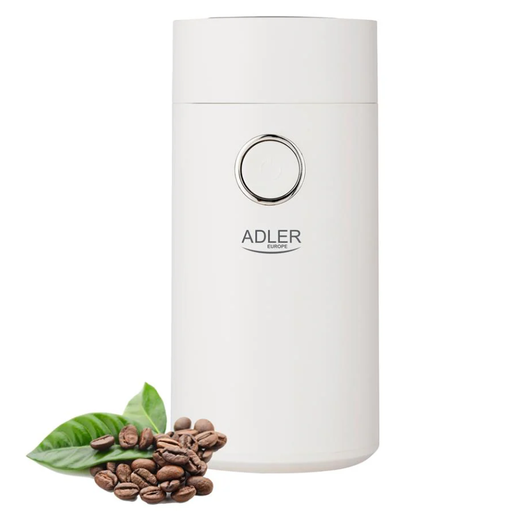
Why this product suits this profile: This compact appliance is aimed at households and offices that want to grind up to 75 grams of beans in one go and prefer straightforward operation.
The transparent cover makes the grinding time visible. A safety lock prevents operation if the lid is not closed correctly.
150 W power, a metal container, cable storage and dimensions of 9,6 × 9,6 × 19,6 cm.
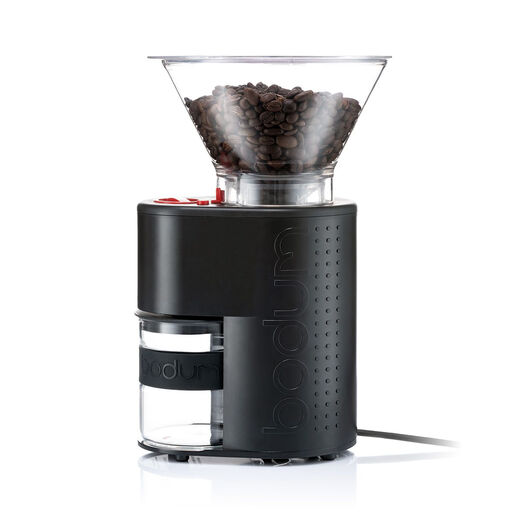
Why this product suits this profile: This model is a good choice for users looking for a larger bean capacity and an adjustable setting for different coffee preparation methods.
The conical burr grinder and adjustable grind setting address the limitation of having just one grinding mode. The timer helps deliver more consistent dosing.
160 W power, 220 g capacity and an antistatic borosilicate glass grounds container according to the product description.
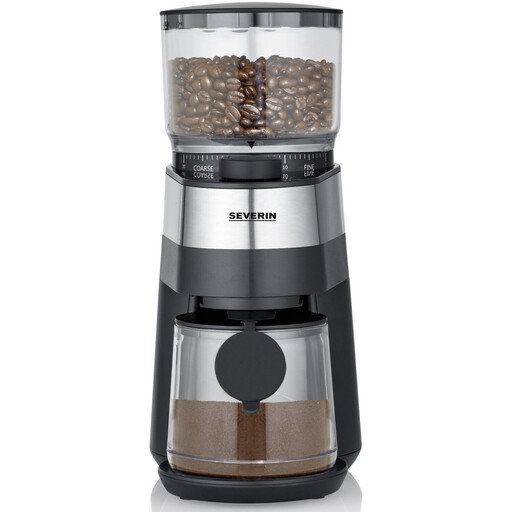
Why this product suits this profile: This burr grinder is suitable for households that regularly prepare several cups and need different grind settings.
30 grind settings and quantity dosing for 2 to 12 cups avoid the inflexible one-button selection found on simpler appliances.
140 W, flat-burr grinder, 240-g bean hopper and removable grounds container with aroma seal according to the manufacturer’s specifications.

Why this product suits this profile: This model is aimed at users who prefer automatic dosing and compatibility with different portafilter sizes.
48 grind settings and a timer adjustable in 0.1-second increments offer more control than simply controlling the grinding time.
420-grade stainless steel conical burr grinder, 150 W power and modes for 51, 54 and 58 mm portafilters according to the product data.
We have put together a complete, regularly updated list of products that fully meet these strict selection criteria and the safety regulations applicable in the EU.
An electric coffee grinder usually uses energy for only a short period at a time. The key factors affecting running costs are therefore how long each grinding cycle lasts, motor power and frequency of use. In a household preparing one portion a day, electricity consumption is generally low compared with many other kitchen appliances; the exact cost depends on your electricity tariff and operating time.
Clean the bean hopper and outlet regularly using a dry method. Only grind products for which the appliance is explicitly designed. Some models may be used exclusively with dry coffee beans. An electric spice and coffee grinder is suitable only if the manufacturer approves both applications. Oily beans, hard foreign objects or spices can put strain on the grinder.
For espresso, a model with a conical or flat-burr grinder and plenty of grind settings is more suitable than a device fitted only with a timer-controlled blade. It is also important that the product description explicitly states that a fine grind range is available.
Its lifespan depends on the grinder, build quality, frequency of use and care. Avoid overfilling the appliance, running it continuously for longer than specified in the operating instructions and allowing moisture into the motor area. With a conical burr model, you should also check whether replacement or cleaning parts are available.
For a few portions a day, a compact coffee grinder with a capacity of 50 to 75 grams may be sufficient. In a larger office or where several pots are prepared, a larger bean hopper, quantity dosing and a removable grounds container are more practical. The key is to match the capacity to your actual daily requirements.