
Lieferung heute & morgen

Qualitätsgarantie

Willkommens-Angebote freischalten: KOSTENLOSE Lieferung | Bis zu 80 % RABATT | Kostenlose 30-Tage-JoyPlus-Testphase
App herunterladen
Freshly ground coffee beans can transform your home brewing. When buying an electric coffee grinder, many people first look at wattage, design or particularly large capacity claims. On their own, these figures tell you little about whether the appliance is suitable for espresso, filter coffee or French press.
Typical buying mistakes arise from three points:
What really matters is how the electric coffee grinder is constructed and which brewing method it is meant to suit.
A coffee grinder with stainless steel blades chops the beans using fast-rotating blades. The desired fineness is usually achieved through short or longer grinding intervals. Such appliances are often compact, easy to use and suitable for occasional filter coffee. However, an exactly reproducible setting is more difficult.
A conical burr grinder, on the other hand, works with two grinding surfaces between which the beans are crushed. Models like a coffee grinder with a conical burr typically offer several fixed grind levels. This makes it easier to adjust for espresso, pour-over or French press. Before buying, you should check how many levels are actually available and whether the manufacturer provides information about the bean hopper, grinding chamber and cleaning.
Espresso generally requires a finer grind than filter coffee. French press usually needs a coarser setting. An espresso coffee grinder should therefore have sufficiently fine levels and as controlled a dose as possible.
For a French press coffee grinder, coarser settings and easy emptying are important. With blade grinders, the grind size can often only be roughly determined by the running time. If you regularly switch between several brewing methods, you will usually benefit from a conical burr grinder with a clear scale.
A 60 g coffee grinder is enough for roughly several cups, depending on the dose. A 75 g coffee grinder offers a bit more leeway for households, small offices or several people. What matters is whether you need that fill volume per grinding session, or whether a smaller chamber is easier to keep clean.
Also pay attention to:
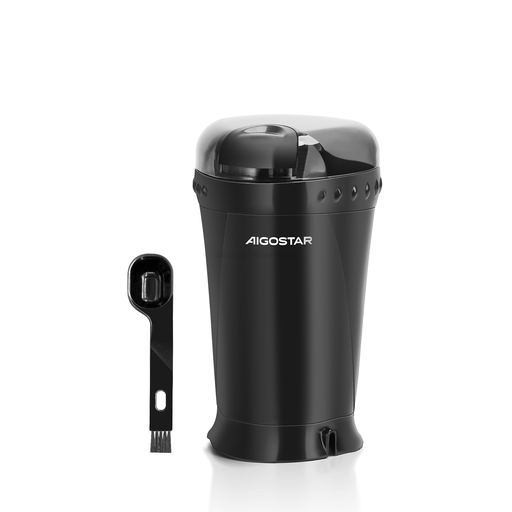
Why this product suits the profile: This compact model with 200 W, 60 g capacity and one-button operation is ideal for users who want to grind coffee beans occasionally and have limited counter space.
The transparent chamber lets you see the grinding progress. Fineness is controlled by how long you press the button, rather than by a vague marketing claim about a fixed grind setting.
200 W motor, 60 g fill capacity, compact dimensions and stainless steel blades.
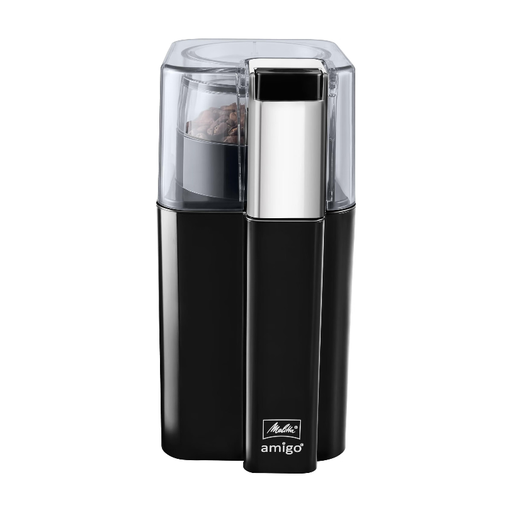
Why this product suits the profile: The capacity of up to 60 g, the transparent lid and the push-button operation are straightforward and practical for daily coffee in the household.
The product specifications clearly state the stainless steel impact blade and that the grind size is adjusted by the grinding duration. This makes the actual operating logic easier to understand.
60 g capacity, safety feature when the lid is closed and a compact design.
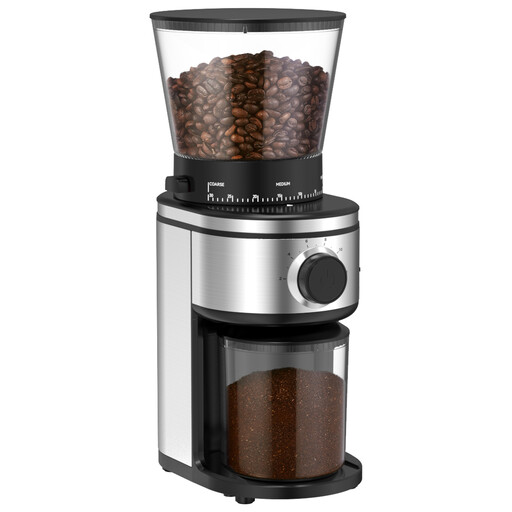
Why this product suits the profile: The conical burr grinder and 30 grind levels appeal to users who want to switch between fine espresso and coarse French press grinds.
Instead of just highlighting the motor power, this model provides specific details about the burr grinder and the 30 adjustable grind settings.
Conical burr grinder, 30 settings, plus a removable upper burr and grinding chamber according to the product description.

Why this product suits the profile: 48 grind levels, timed grinding and three modes for 51 mm, 54 mm and 58 mm portafilters are designed for frequent changes and espresso-focused use.
The product description specifies concrete grind levels and a timer with 0.1-second accuracy. Before buying, you should still check compatibility with your espresso machine.
420-grade stainless steel conical burr grinder, 48 grind levels and a digital control panel according to the product specifications.
We have put together a complete, regularly updated list of products that fully meet these strict selection criteria and the safety regulations in force in the EU.
The lifespan depends on the burr type, frequency of use, quantity of beans and cleaning. With a blade grinder, you should stick to the recommended short intervals and let the motor cool down between sessions. With a conical burr grinder, regular cleaning and replacing worn grinding parts are important. Hard foreign objects or unsuitable ingredients can damage the appliance.
For regular espresso, a model with a conical burr grinder and several finely graduated settings is usually more practical than a coffee grinder with stainless steel blades. Also check whether the grinder is suitable for the diameter of your portafilter and whether the dose can be controlled by time or by volume.
The actual running costs are generally modest with short grinding sessions. What matters is the motor power in watts and the running time. An appliance with 200 W that runs for only a few seconds per portion does not automatically use more electricity than a weaker model with a longer operating time. Regardless, the coffee grinder should be unplugged from the mains after use.