
Lieferung heute & morgen

Qualitätsgarantie

Willkommens-Angebote freischalten: KOSTENLOSE Lieferung | Bis zu 80 % RABATT | Kostenlose 30-Tage-JoyPlus-Testphase
App herunterladen
Freshly ground coffee beans can require a very different grind size depending on your brewing method. An electric coffee grinder saves you time and effort, but it isn’t automatically suitable for every use. If you only focus on wattage, design or bold marketing claims, you could easily end up with a machine that’s too imprecise for espresso, produces too many fine particles for French press, or is difficult to clean.
That’s why this selection from the Joybuy Product Recommendation Officer focuses on clear, measurable features: the burr type, grind adjustment, capacity, operation and intended use.
A high motor power rating simply describes the electrical drive. For grind quality, however, the design and adjustment of the burr set are what really matter. A machine with stainless steel blades can chop coffee beans quickly, but it usually doesn’t offer clearly defined grind settings. The grind size then depends heavily on how long you run it and how you press the button.
For espresso or pour-over, an electric coffee grinder with conical burrs or flat burrs is usually easier to adjust precisely. A blade grinder, on the other hand, can be a compact and budget-friendly option for simple filter coffee preparation.
A number like 30 or 48 steps is only useful if the adjustment range suits your brewing method. For a coffee grinder for espresso, a fine and repeatable setting is what counts. For a coffee grinder for French press, a sufficiently coarse range is important. Stepless systems allow fine adjustments but take more time to set up.
A large hopper can be handy for offices or multiple people. If you only grind one portion a day, you might benefit more from a compact grinder or a smaller catch container. What’s more, coffee shouldn’t sit in the hopper for too long. So check the capacity in grams and compare it with your usual consumption.
A stainless steel burr set can be robust and easy to maintain. With blade grinders, the grind size is often achieved through short or long pulses. That’s simple, but less precisely repeatable.
A conical burr set feeds the beans between two conical grinding surfaces. Models like the CHEFFANO BG710 or the HiBREW G5 are said to feature an adjustable conical burr set. The practical advantage is a more targeted adjustment for espresso, moka, pour-over or coarse coffee. Whether the setting works with your espresso machine still depends on the bean, the portafilter and the desired extraction.
A coffee grinder with adjustable grind size should have clearly visible steps or an easy-to-read adjustment ring. A timer, pulse function or portion selection is also helpful. A time setting of 0.1 seconds, as mentioned for the HiBREW G7, can make dosing easier; however, it doesn’t replace individual fine-tuning.
For espresso, look out for:
For French press and filter coffee, a coarse, as even as possible grind is more important than very fine gradations.
For multiple cups, the stated capacities of the selected machines range, for example, between 50 and 220 grams. A grinder with 60 to 75 grams is better suited to smaller households or single brews. The BODUM BISTRO with conical burrs is listed at 220 grams, making it more suitable for users with a higher throughput.
For electrically operated machines, you should also consider 220–240 volts, a securely closing lid or hopper, and overload protection. Before cleaning: unplug the machine and wait until the burrs have come to a complete stop. Internal grinding components should only be cleaned dry with a brush or suitable cleaning pellets, unless the instructions say otherwise.
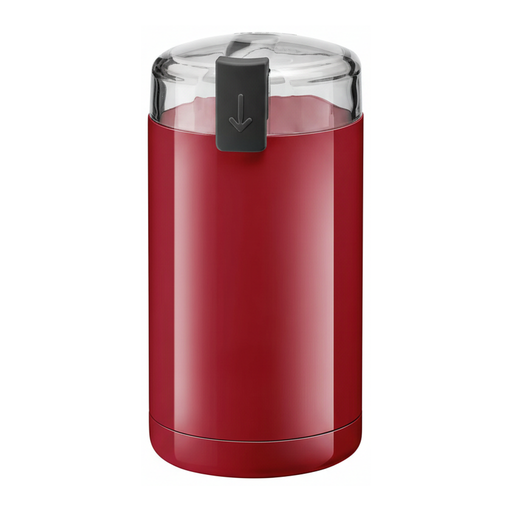
Why this product fits the profile: This compact machine works with a 75 g capacity and is operated via the lid and safety switch. For households looking for a simple electric coffee grinder for home use, the technical specs are easy to understand.
The specifications clearly state the burr type, capacity and safety feature. It doesn’t boast a large number of grind settings that the machine, according to the product data, doesn’t actually have.
180 W motor, 75 g capacity, compact dimensions and lid safety system according to the product description.

Why this product fits the profile: This model is aimed at users who want to make espresso and pour-over with fine adjustment and prefer a metal housing and conical burrs.
The product data mentions a stepless adjustment, a 55 mm conical burr set and a removable grinding chamber. This makes the relevant features more concrete than a simple wattage rating.
55 mm titanium alloy conical burrs, stepless fine adjustment and removable chute according to the product description.
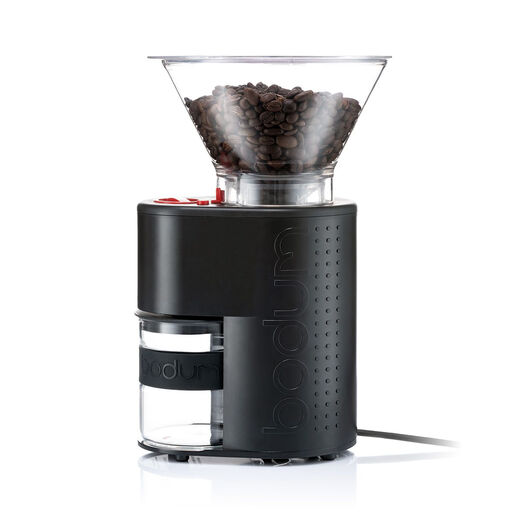
Why this product fits the profile: The stated capacity of 220 grams is suitable for households with several coffee drinkers or for office use. The timer supports repeatable grinding.
The large container is specified with a concrete gram weight. Additionally, the grind adjustment and timer are described, rather than just claiming general versatility.
Conical burrs, 220 g capacity, timer and borosilicate glass catch container according to the product description.

Why this product fits the profile: This manual coffee grinder doesn’t need electricity and can be used at home, in the office, for camping or while travelling. Its format is designed for smaller portions.
The power source and capacity are clearly stated. Anyone looking for a portable coffee grinder won’t confuse this model with a mains-powered machine for large quantities.
20 g capacity, stainless steel burrs, adjustable grind size and dual ball bearings according to the product description.
We’ve put together a complete, regularly updated list of products that fully meet these strict selection criteria and the safety regulations in force in the EU.
For espresso, an adjustable conical or flat burr set and a fine, as repeatable as possible adjustment range are important. A simple blade grinder can chop beans, but often doesn’t offer fixed grind settings. Also check whether the grinder is suitable for your portafilter or the desired dose.
It’s not possible to give a reliable general lifespan. It depends on how often you use it, the amount of beans, cleaning and the design of the burr set. Only use the machine for dry coffee beans, don’t exceed the stated capacity, and unplug it before every clean. This will help avoid unnecessary strain on the motor and burrs.
The actual consumption depends on the motor power and running time. Since a grinding cycle is usually very short, the running time is what determines the cost. A 180 W machine that runs for a few seconds per portion uses significantly less energy per cycle than a machine with the same or higher power that runs for longer. For an accurate estimate, you can use the running time and your household electricity tariff.