
Lieferung heute & morgen

Qualitätsgarantie

Willkommens-Angebote freischalten: KOSTENLOSE Lieferung | Bis zu 80 % RABATT | Kostenlose 30-Tage-JoyPlus-Testphase
App herunterladen
Freshly ground coffee beans do not require a large appliance at home. An electric coffee grinder can be compact, quick to use and suitable for everyday use. However, models vary considerably in terms of their grinding mechanism, capacity and controls. If you only focus on the wattage or a glossy casing, you may end up buying a device that does not suit your preferred brewing method.
The power rating – for example, on a 180 W coffee grinder – describes the motor power, not the consistency of the ground coffee. Blade or impact grinders chop the beans in short intervals. This can result in particles of different sizes. Depending on your expectations, that may be sufficient for filter coffee or a cafetière; for precisely prepared espresso, a more finely graded setting may be more suitable.
Advertising often uses terms such as “aromatic” or “aroma-preserving” without specifying a standardised testing method. It is therefore important to look for clear, verifiable details: grinder type, operating time, grind-size adjustment and the ability to measure out the right amount of beans. With a blade grinder, the fineness can often be influenced by the duration and use of short pulses – rather than by a clearly defined setting.
An electric coffee-bean grinder should not automatically be used as a spice grinder. Coffee oils can leave behind odours and flavours in the container. Conversely, hard or damp spices can put strain on an appliance if the manufacturer has not designed it for this purpose. Always check the permitted food types and cleaning instructions.
With a coffee grinder with stainless steel blades, the grounds are chopped by rotating blades. The appliance is often operated using a push button. Short grinding intervals help you achieve the desired consistency gradually. A conical or flat-burr grinder, on the other hand, works with two grinding surfaces. Models with several settings, such as 14 or 30 adjustments, offer more choice for different brewing methods.
When choosing, consider the following:
A capacity of 50 to 75 g is enough for several cups, depending on the dosage. A small container is practical for a single portion, while households or offices with several coffee drinkers may benefit from a larger capacity. A compact coffee grinder fits more easily into kitchen cupboards, but should still be placed securely on a non-slip surface.
Also look out for:
A lid contact or safety switch prevents some appliances from operating if the lid is not positioned correctly. This is particularly important for an electric coffee grinder with sharp stainless steel blades. For mains-powered appliances, the voltage and frequency must be compatible with the German power supply; product details often specify 220–240 V and 50–60 Hz.
For battery-operated grinders, check the battery type, what is included and the cleaning restrictions. An electric salt and pepper grinder with a ceramic grinding mechanism is generally designed for dry, granular ingredients. Damp salt, water or hard foreign objects can damage the mechanism.
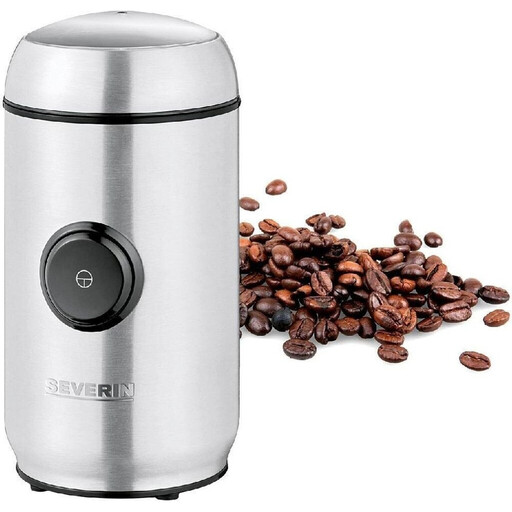
Why this product suits this profile: The 150 W grinder features simple push-button operation, a transparent lid and a capacity of around 50 g. It is suitable for users looking for an uncomplicated electric coffee grinder for smaller quantities.
The product details clearly state the grinding mechanism, power and capacity. Short pulses allow for manual control, rather than promising an automatic level of grind-size precision that is not defined in more detail.
150 W, stainless steel casing, 50 g capacity and cable winder.
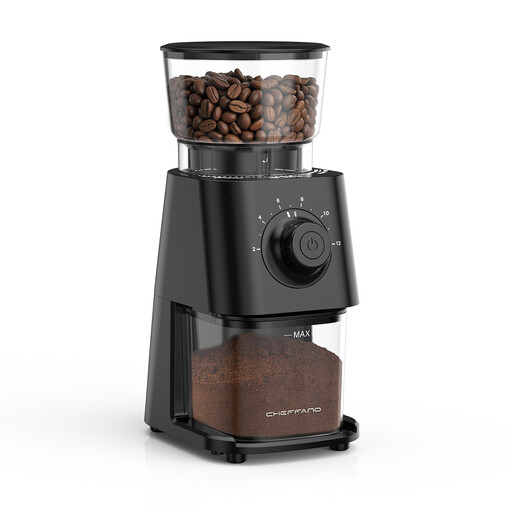
Why this product suits this profile: The conical grinding mechanism and 30 specified grind-size settings are aimed at users who want to adapt their coffee preparation more precisely to different brewing methods.
The grind size is selected using specific settings. This means users do not have to control the fineness solely by holding down the button for different lengths of time.
Conical grinding mechanism, 30 grind-size settings and a design suitable for up to 12 cups according to the product description.
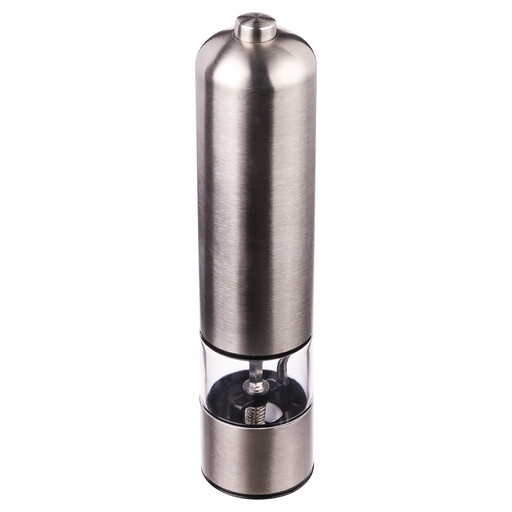
Why this product suits this profile: This battery-operated grinder is designed for dry spices such as peppercorns and coarse salt. Its adjustable ceramic grinding mechanism and LED light are ideal for households that want to season food directly at the table.
The usage limits are clearly stated: only dry, granular ingredients and no damp food. This prevents it from being used incorrectly as a coffee-bean grinder.
Ceramic grinding mechanism, adjustable coarseness, LED light and a capacity of 30 g of pepper or 60 g of salt.
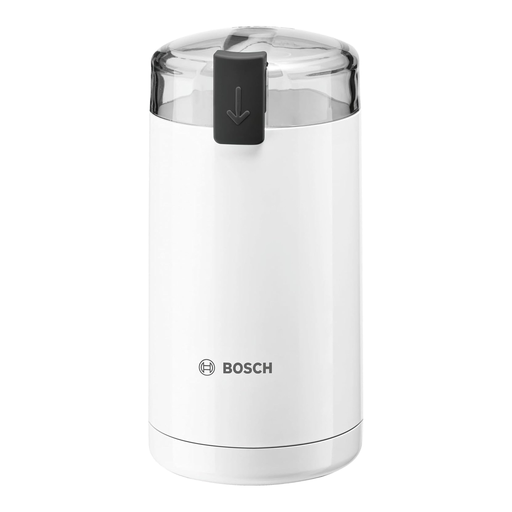
Why this product suits this profile: With a bean capacity of 75 g, 180 W of power and compact dimensions, this model is designed to grind several portions in one go.
The capacity is specified as 75 g, and the lid must be correctly positioned for the appliance to operate. This makes key details about quantity limits and user safety clear and verifiable.
180 W, 75 g capacity, stainless steel blades and a safety switch that operates when the lid is closed.
We have put together a complete, regularly updated list of products that fully meet these strict selection criteria and the safety regulations applicable in the EU.
The ongoing costs of an electric coffee grinder mainly consist of electricity, batteries where applicable and wear parts. With short grinding cycles, electricity consumption is usually a minor everyday expense. Battery-operated models, on the other hand, regularly require new AA batteries or recharging. For rechargeable appliances, check the charging connection and battery capacity in the product details.
The following points are important for a longer service life:
This depends on the brewing method. A coarser grind is generally used for cafetière coffee, a medium grind for filter coffee and a finer grind for espresso. With a blade grinder, the fineness is often controlled using shorter or longer pulses. Models with fixed grind-size settings offer a more repeatable adjustment.
There is no standard operating time that applies to every model. The instructions supplied with the appliance are the deciding factor. As a general rule, small blade grinders should be used in short intervals with cooling breaks. If the appliance becomes hot, unusually loud or starts to smell as though it is overheating, stop grinding and unplug it.
Only if the manufacturer expressly states that it can be used for this purpose. An electric spice grinder described as a coffee and spice grinder may be suitable for dry spices. It is not automatically designed for damp ingredients, coarse wet salt or very hard materials. Always check the relevant usage instructions before use.