
Lieferung heute & morgen

Qualitätsgarantie

Willkommens-Angebote freischalten: KOSTENLOSE Lieferung | Bis zu 80 % RABATT | Kostenlose 30-Tage-JoyPlus-Testphase
App herunterladen
The path to aromatic coffee doesn't start at the coffee machine, but with the bean. A crucial factor in the quality of the final product is the consistency of the coffee grounds. An uneven grind can lead to an unbalanced extraction, where the coffee tastes simultaneously watery and bitter. This article serves as a guide to selecting a suitable electric conical burr coffee grinder. We will introduce objective criteria and present a selection of models that cover a range of different needs.
The decision to buy a coffee grinder should be based on clearly defined technical features. Here are some key aspects that play a role in the selection process.
The heart of any grinder is its burr set. A conical burr grinder, often simply called a burr grinder, consists of two conical grinding components that crush coffee beans uniformly and gently. Compared to blade grinders, which shatter the beans, a conical burr grinder produces more consistent grounds and generates less heat, which helps preserve the coffee's aroma.
An adjustable coffee grinder with fine increments is essential for precisely matching the grind size to the specific brewing method. A grinder for espresso or a grinder for portafilters requires a very fine and exact grind size, whereas a French press needs a coarse grind and a grinder for pour-over requires a medium grind. The more grind settings a grinder offers, the more versatile it is.
A powerful motor that operates at a low speed is advantageous. It ensures an efficient grinding process with minimal heat generation and reduces operating noise.
Modern coffee grinders also offer useful additional features. An anti-static coffee grinder reduces the static charge of the coffee grounds, which leads to less mess and a cleaner workspace. Features like timed grinding allow for a reproducible amount of coffee with every grind, further enhancing consistency. Compatibility with various portafilter sizes (e.g., 51mm, 54mm, 58mm) is another practical aspect for owners of espresso machines.
Based on the criteria mentioned, we have compiled a selection of models from the HiBREW coffee grinder brand, which differ in their technical specifications and range of functions.

What sets it apart: The HiBREW G7 is distinguished by its digital operation via a touchscreen, which allows for intuitive control of grinding modes and settings. With 48 grind settings, it offers a wide range for various preparation methods. The timed grinding function, with an accuracy of 0.1 seconds, supports precise dosing. Another key feature is its direct compatibility with 51mm, 54mm, and 58mm portafilters.
Advantages:
Who it's for: This model is designed for users who value modern, digital controls and high precision. Its direct compatibility with common portafilter sizes makes it particularly appealing to espresso machine owners.

What sets it apart: The HiBREW G5 features a robust aluminium alloy housing and a CNC-machined 48mm conical burr set. It offers 36 grind settings and a special feature: the choice between two grinding speeds (400 RPM and 500 RPM). The slower speed is designed to further reduce heat generation, thereby preserving the coffee's aroma. An anti-static coating on the outlet and a powder knocker are intended to minimise the accumulation of coffee grounds.
Advantages:
Who it's for: The G5 is aimed at coffee enthusiasts who want precise control over the grinding process, including the grinding speed. Its robust construction and features for reducing coffee ground retention will appeal to users who value durability and clean operation.
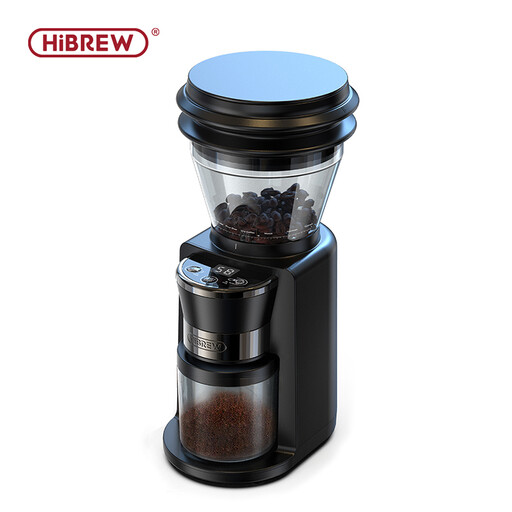
What sets it apart: The HiBREW G3 is an electric coffee grinder that provides a solid foundation for various coffee preparations with its 34 grind settings. It features quantitative dosing for one or two cups and a visible bean hopper with a 210g capacity. According to the manufacturer, a built-in negative ion generator is designed to reduce static in the grounds. A dual air blower also helps to clear residual powder from the grinding chamber.
Advantages:
Who it's for: This model represents a functional option for home use. It is suitable for users looking for a reliable grinder with sufficient adjustment options and practical features for dose control and cleaning.
The right grinder is only one piece of the puzzle. If you are also looking for the right brewing method to fully unlock the potential of your freshly ground beans, you might find it helpful to look at our selection of pour-over coffee makers. There you will find equipment designed for manual coffee preparation.
A conical burr grinder crushes coffee beans between two conical burrs. This process is gentler compared to blade grinders, which shatter beans, and it produces coffee grounds with a more uniform particle size. A uniform grind is the prerequisite for a balanced extraction, where water flows evenly through the coffee grounds and optimally dissolves the flavours.
Espresso requires a very fine grind size, with a consistency reminiscent of powdered sugar or fine salt. The exact grind setting depends on the specific espresso machine, the type of coffee, humidity, and other factors. A grinder for portafilters should therefore allow for very fine, micrometric adjustment steps to precisely control the water's extraction time (typically 25–30 seconds for a double espresso).
During the grinding process, friction creates static electricity. This causes the fine coffee grounds to cling to the grinder's outlet and the collection bin, scattering uncontrollably ("coffee chaff"). An anti-static coffee grinder uses techniques to reduce this charge. This can be achieved through special materials, coatings, or, as with some models, through built-in ionisers. The result is a cleaner work environment and less loss of coffee grounds.