
Lieferung heute & morgen

Qualitätsgarantie

Willkommens-Angebote freischalten: KOSTENLOSE Lieferung | Bis zu 80 % RABATT | Kostenlose 30-Tage-JoyPlus-Testphase
App herunterladen
An electric cooking pot can be a practical addition to halls of residence, small flats, offices or camping trips. It heats water and food without relying on a fixed hob and, depending on its design, can function as an electric multicooker, electric hot pot, pasta cooker or soup maker.
However, product descriptions and marketing claims do not always lead to the right buying decision. The key factors are the technical specifications, the actual capacity and the safety features.
A 1.6-litre pot does not automatically hold 1.6 litres of boiling soup. Liquids need a little room for splashes and rising steam. For a portable cooking pot for one person, 1.6 litres may be sufficient. For several people, however, you should allow for a more generous usable capacity.
“Multifunction” may mean boiling, steaming and slow cooking, but it does not necessarily mean high-temperature frying. A 600-watt appliance is better suited to smaller portions and gentle heating. For larger quantities or faster boiling, models with 1,000 to 1,500 watts are more practical. However, wattage alone does not indicate the actual cooking speed, as the shape of the pot and the amount of food also play a role.
A non-stick cooking pot can make it easier to remove food. However, metal utensils may scratch the surface. In addition, the electrical part of many appliances must not come into contact with water. Removable inner pots, steaming trays and power cables make cleaning and storage much easier.
The space required on your worktop also matters. An appliance may look compact, but its lid, handle or steaming trays may require additional room. Removable or foldable components are useful in halls of residence and small kitchens.
Power consumption is measured in watts. Small appliances with around 600 watts are designed for limited quantities. Models with 800 to 1,000 watts offer more capacity for cooking pasta, soups and hot pot. Larger 1,500-watt appliances can heat greater quantities of liquid more quickly, but they require a suitable socket and sufficient clearance from heat-sensitive objects.
A simple two-stage control is enough for boiling and keeping food warm. Stepless adjustment or several programmes give you more control when braising and slow cooking. If you are looking for a slow cooker, rice cooker or multifunction cooker, you should also check that the desired function is actually covered in the operating instructions.
Look for clearly described features such as:
Automatic shut-off does not replace supervision during use. Hot surfaces, liquids and steam can cause burns. After cooking, the appliance should be unplugged and allowed to cool down completely.
With a non-stick coating, only wooden, plastic or silicone utensils should be used. The housing, plug and connector must not be immersed in liquid. If you plan to use the appliance while travelling in Germany, you should also check compatibility with 220–240 V and 50–60 Hz.

Why this product suits this profile: Its compact size and 600 watts are aimed at individuals, students and small kitchens. The appliance supports ramen, pasta, soup and shabu-shabu, among other dishes.
The capacity and compact design are clearly stated. Automatic shut-off and boil-dry protection are specified as safety features.
1.6-litre capacity, 600 watts, non-stick interior and ergonomic handle.

Why this product suits this profile: This portable induction hob offers ten power levels, six functions and touch controls for users who want to use their cookware flexibly.
It is not limited to use with a fixed inner pot. Boil-dry protection and a child lock are explicitly specified.
2,000 watts, ten power levels, six programmes and a slim glass surface.
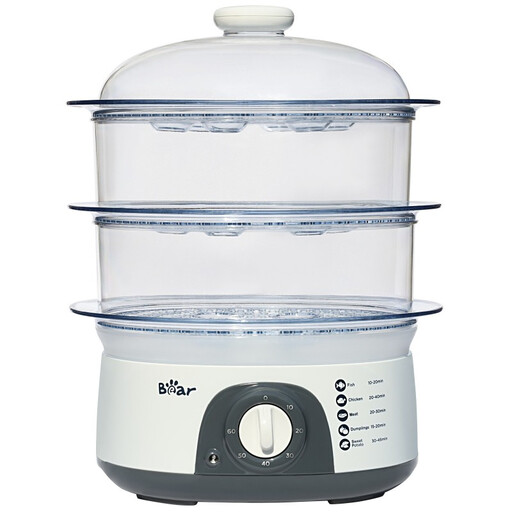
Why this product suits this profile: Three stackable tiers and a 60-minute timer are ideal for families, preparing several side dishes and regular use.
The design is clearly intended for steaming rather than universal frying. Removable parts make cleaning easier.
10-litre capacity, three tiers, 650–775 watts and a 60-minute timer.

Why this product suits this profile: The 5-litre capacity and 1,500 watts are designed for family meals, hot-pot gatherings, braising and keeping food warm.
The larger capacity means you do not have to cook for several people in small batches. Stepless power adjustment supports different cooking methods.
5 litres, 1,500 watts, four specified cooking modes, glass lid and boil-dry protection.
We have put together a complete, regularly updated list of products that fully meet these strict selection criteria and the safety regulations applicable in the EU.
Before using the appliance for the first time, the inner pot, lid and accessories should be cleaned according to the operating instructions. The housing should normally only be wiped with a damp cloth. With appliances that have a non-stick surface, avoid abrasive sponges and metal utensils.
You can estimate electricity costs roughly as follows: Power in kilowatts × operating time in hours × electricity price per kilowatt-hour. A 600-watt appliance running for half an hour uses 0.3 kilowatt-hours in theory. In practice, an appliance with a thermostat or timer may switch off temporarily. For a fair comparison, the actual amount of use matters rather than just the maximum wattage.
Yes, provided that the house rules, fire safety regulations and electrical facilities allow it. The appliance should be placed on a stable, heat-resistant surface. Extension leads and multi-socket adaptors must not be overloaded.
Its service life depends on the build quality, frequency of use, cleaning and how the coating is treated. Using suitable cookware carefully, allowing the appliance to cool completely before cleaning and observing the maximum fill level can reduce wear. If the coating is damaged or the cable is faulty, the appliance should no longer be used.
An electric cooking pot is often designed for soups, noodles, hot pot and simple one-pot meals. A mini rice cooker or rice cooker with food steamer focuses more on rice programmes, keeping food warm and steaming. When choosing between them, your most important everyday dish should therefore be the deciding factor.