
Lieferung heute & morgen

Qualitätsgarantie

Willkommens-Angebote freischalten: KOSTENLOSE Lieferung | Bis zu 80 % RABATT | Kostenlose 30-Tage-JoyPlus-Testphase
App herunterladen
An electric cool box can make it much easier to store drinks and food while travelling than a traditional insulated cooler. However, unclear temperature specifications, missing adapters or an unsuitable cooling system often lead to poor purchases. This buying guide from the Joybuy Product Recommendation Officer explains what drivers, campers, motorhome owners, truck drivers, boat owners and festivalgoers should consider in 2026.
With thermoelectric models, cooling performance often depends on the ambient temperature. A specification such as “up to 18–22°C below ambient temperature” is therefore not a permanently guaranteed refrigerator temperature. If the vehicle is parked in the sun during summer, the interior may remain considerably warmer than expected.
For perishable food, the cooling technology is therefore crucial. A compressor cool box operates with an adjustable target temperature and is better suited to both cooling and freezing. Thermoelectric appliances, by contrast, are generally lighter, more compact and often equipped with a warming function.
A 12V car cool box is designed for a cigarette lighter socket or a comparable 12-volt outlet. For use at home, in a holiday property or at a campsite, you will also need a 230V adapter. Some models include one, while others require it to be purchased separately.
Before buying, check the following:
A portable cool box can drain a vehicle battery if it continues running after the engine has been switched off. Models with battery and low-voltage protection generally offer several protection levels for this purpose. However, this feature does not replace checking the vehicle socket or ensuring that the onboard battery has sufficient capacity, particularly during longer stops.
For a car, motorhome or boat, the instruction manual should clarify whether the appliance may remain connected to a 12-volt power supply continuously. For overnight use, a model with adjustable battery protection or a separate leisure battery is a sensible choice.
A thermoelectric portable cool box uses a semiconductor element. It can often cool and warm, but it creates a temperature difference relative to the ambient temperature rather than maintaining a freely adjustable refrigerator temperature. This is convenient for drinks, snacks, lunch boxes and food that has already been chilled.
Depending on the model, a compressor cool box can reach temperatures of approximately -20°C to +20°C. This makes it a portable car refrigerator, mobile freezer or cool box for a motorhome or boat. The compressor requires more power when starting up, but provides more precise temperature control.
The stated capacity in litres should be compared with the genuinely usable interior space. Some of the volume may be taken up by the walls, lid, baskets or separate cooling zones. For individual journeys, 5 to 10 litres may be sufficient, while families, longer camping trips or multiple users will generally need between 18 and 50 litres.
Practical guidelines:
Also pay attention to the external dimensions. A large cool box will not automatically fit beneath a camping table, inside the boot or between the seats.
Thermoelectric appliances often operate with fans. The models mentioned here, for example, are specified at approximately 40 dB. Depending on the design, compressor appliances can also operate within a range suitable for many everyday situations. Actual noise levels vary according to the surroundings, positioning and operating mode.
The ventilation openings must not be obstructed. Leave the clearance recommended by the manufacturer around the cool box and place it on a stable, level surface. An ECO mode can reduce consumption, while MAX mode may cool the contents more quickly. Actual runtime depends on the ambient temperature, load, frequency of opening and available power supply.
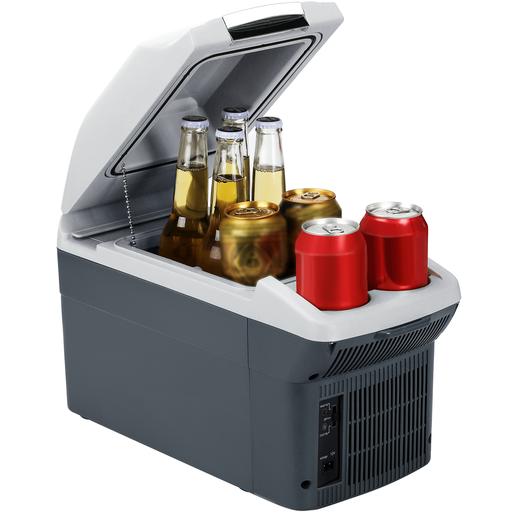
Why This Fits Their Persona: For drivers and short camping trips where a compact electric cool box with a small footprint is the priority. This model is designed for 12V and, depending on the version, also supports 220–240V.
The product specifications list cooling and warming functions, along with a cooling temperature of approximately 4°C. As this is a thermoelectric system, performance remains dependent on the ambient temperature.
9-litre capacity, integrated cup holders and operating noise of approximately 40 dB according to the product description.
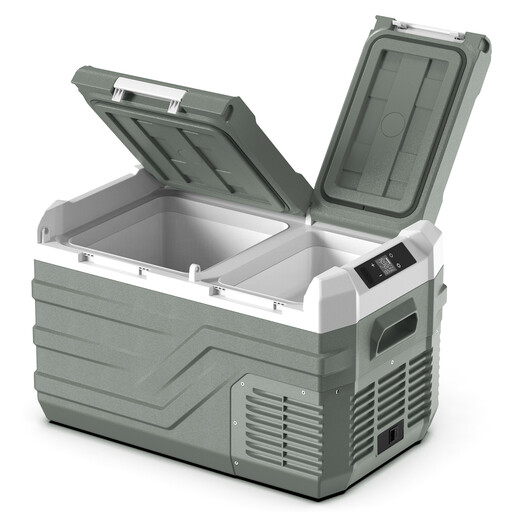
Why This Fits Their Persona: For travellers who need adjustable cooling in a car, motorhome or boat, as well as separate compartments for different types of food.
The compressor system is specified with an adjustable range from -20°C to 20°C. Three battery protection levels help adapt the vehicle’s power supply to the way the appliance is used.
23.3-litre total capacity, two zones, 12/24V DC and 100–240V AC; USB connection according to the product data.
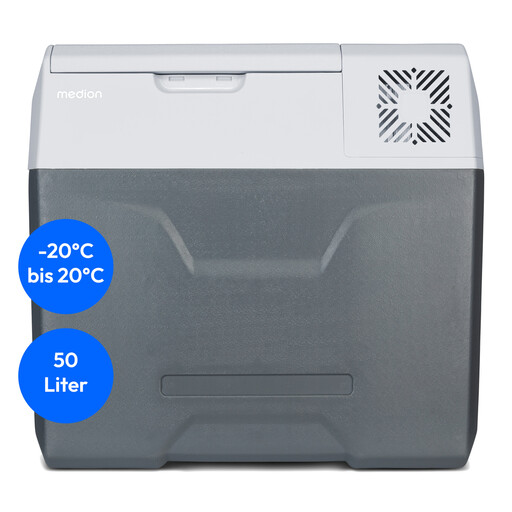
Why This Fits Their Persona: For families, truck drivers, caravan users and longer stays that require generous storage capacity. The connections cover vehicle, truck and household use.
The stated range of -20°C to 20°C sets this appliance apart from a warming-only box. Before buying, check the available space, as the unit weighs 13.5 kg.
50-litre stated capacity, or 47 litres of usable space; 230V, 12V and 24V adapters plus USB connection according to the product description.
Position the appliance securely with sufficient ventilation. In a car, route the cable so that it cannot come into contact with the pedals, seat rails or sharp edges. Whenever possible, cool warm food before placing it inside. Otherwise, the cool box will take longer to reach the desired temperature.
With a 12V 230V cool box, always use the appropriate original adapter. In a motorhome, caravan or boat, also check that the socket, fuse and onboard battery are rated for the stated power consumption. Water, rain and blocked ventilation openings can damage electrical appliances.
Consumption depends on the cooling technology, ambient temperature, insulation and operating mode. At a stated power draw of 45 watts, one hour of continuous operation corresponds to 0.045 kWh. However, a compressor does not necessarily run continuously. To calculate the cost, multiply the actual consumption by your electricity tariff.
This is advisable only if the power supply is designed for it. With the engine switched off, a 12-volt cool box can drain the starter battery. If available, use the battery protection function and check the cut-off voltage. For longer stops, a suitable leisure or auxiliary battery is the more practical solution.
Service life depends on the compressor or fan, seals, cables, cleaning and transport conditions. Avoid severe impacts, moisture and direct sunlight. Check the lid seal regularly and keep the ventilation areas clear. For frequent use in a motorhome or boat, robust construction, spare-parts availability and warranty terms are important selection criteria.
Browse the relevant Joybuy category for a complete, up-to-date selection of additional appliances. Before buying, check the capacity, connections, cooling technology and included accessories there.