
Lieferung heute & morgen

Qualitätsgarantie

Willkommens-Angebote freischalten: KOSTENLOSE Lieferung | Bis zu 80 % RABATT | Kostenlose 30-Tage-JoyPlus-Testphase
App herunterladen
An electric fan heater can warm individual rooms temporarily without requiring a fixed heating system. For bedrooms, studies, offices or smaller living areas, wattage is not the only factor that matters. The right power settings, clear temperature control and effective safety features are equally important.
A 2000W fan heater can warm the air quickly, but at full power it also uses 2 kWh per hour of operation. Assuming an electricity price of 0.35 euros per kWh, that works out at around 0.70 euros per hour. A fan heater with a thermostat or ECO mode can reduce running time, but it does not automatically lower consumption while actively heating.
Some appliances describe their noise levels using marketing language only. A specific measurement in dB is more meaningful. For bedrooms or offices, models rated at around 25 to 50 dB may be more comfortable than appliances without a stated figure. However, perceived noise also depends on the fan setting, distance and room acoustics.
An electric room heater should have at least overheat protection. A tip-over protection feature or tip-over switch can switch the appliance off if it falls over. However, these features do not replace safe positioning: the fan heater must not be covered and should be placed a safe distance from curtains, furniture, paper and textiles.
For small, well-insulated rooms, an appliance rated at 1,000 to 1,500 W may be sufficient. For larger areas or rooms that cool down more quickly, 1,800 to 2,000 W may be more suitable. Actual suitability also depends on ceiling height, insulation, outdoor temperature and the desired heating time. Manufacturers’ room-size recommendations should therefore be treated as guidance rather than a guarantee.
A ceramic fan heater, also known as a PTC fan heater, uses a ceramic heating element. Product descriptions for these appliances often mention rapid heat output and multiple power settings. PTC stands for “Positive Temperature Coefficient” and describes a heating element whose electrical resistance increases as its temperature rises.
Infrared heaters primarily warm the surfaces and areas they are directed at, whereas conventional fan heaters distribute warm air around the room. For flexibly warming a small indoor space, a PTC fan heater is often more practical. For permanent room heating, however, you should consider using the existing heating system or opting for a professionally planned solution.
A fan heater with thermostat can monitor the set room temperature and adjust the heating output accordingly. Other practical features include:
The term “energy-saving fan heater” should not be assessed in isolation. The lowest power setting, precise control and the option to switch the appliance off automatically after a defined period are all relevant factors.
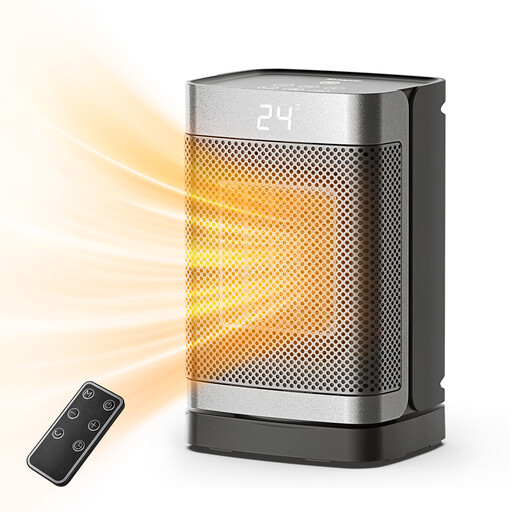
Why this product suits this profile: According to the product description, this compact PTC appliance features two heating levels, digital temperature control, a remote control and a timer of up to 12 hours.
The product details specify both overheat and tip-over protection. This makes it easier to assess the safety features before buying.
1500 W output, LED display, remote control, oscillation and a 12-hour timer.

Why this product suits this profile: This model is aimed at users who value low noise levels, adjustable power and comprehensive controls and safety features.
Rather than simply claiming to be “quiet”, the product description specifies a noise range of 25 to 42 dB, as well as overheat and tip-over protection.
Temperature range of 5 to 35 °C, 12-hour timer, remote control, 70° oscillation and multiple layers of protection according to the supplier.

Why this product suits this profile: Four operating modes, ECO mode, a programmable 24-hour timer and a thermostat from 5 to 35 °C make it suitable for regular use in bedrooms and studies.
The noise level is specified as 38, 45 or 50 dB, depending on the setting. Overheat protection and a tip-over switch are also listed.
1800 W, remote control, oscillation, ECO mode, child lock and an adjustable thermostat.
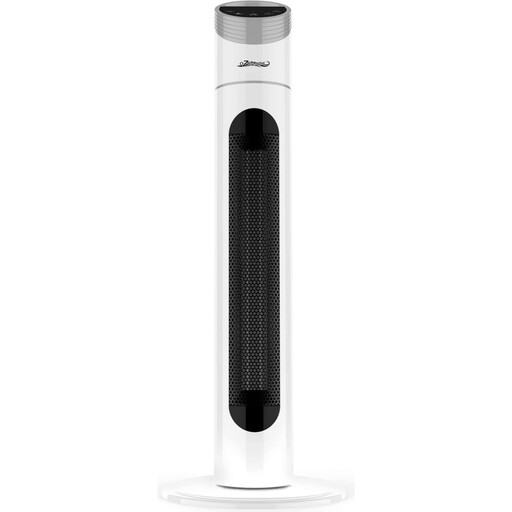
Why this product suits this profile: This portable PTC appliance is worth considering if you need higher output, compact dimensions and wide air distribution.
The specifications list two power settings, 120° oscillation, and tip-over and overheat protection. This makes key comparison points clear.
2000 W, PTC ceramic technology, 120° oscillation, portable design and stated quiet operation.
We have put together a complete, regularly updated list of products that fully meet these strict selection criteria and the safety regulations applicable in the EU.
Before switching it on, place the fan heater on a level, hard and stable surface. Carpets, duvets and upholstered furniture can block the air supply. Keep at least the distance from flammable objects specified in the instruction manual; around 1 metre is often recommended.
Please also note:
At full power, a 2000W fan heater uses 2 kWh in one hour. Costs are calculated as follows: power in kW × operating time × electricity price. A thermostat, lower heat settings and a timer can reduce the actual operating time.
For small, well-insulated rooms, an electric room heater may be suitable as a temporary or supplementary source of warmth. Its effectiveness depends on the room size, insulation, open doors and outdoor temperature. For permanent heating, the existing heating system should be used as the priority, and the instruction manual should be followed.
There is no standard service life that can be given for every appliance. It depends on operating time, exposure to dust, storage conditions and build quality. Keeping the appliance in a dry location, ensuring the ventilation slots remain clear and following the manufacturer’s instructions will support proper operation. Do not continue using the appliance if its cable or casing is damaged.