
Lieferung heute & morgen

Qualitätsgarantie

Willkommens-Angebote freischalten: KOSTENLOSE Lieferung | Bis zu 80 % RABATT | Kostenlose 30-Tage-JoyPlus-Testphase
App herunterladen
An electric fan heater can warm individual rooms quickly and offers flexible use. For bedrooms, studies, offices or smaller living areas, a portable fan heater is particularly practical when your existing heating system is temporarily not sufficient. However, models vary considerably in terms of noise levels, controls, safety features and power consumption.
If you focus only on a high wattage or advertising claims such as “particularly energy-efficient”, you can easily end up buying a product that does not meet your actual needs. The following criteria will help you assess technical specifications correctly.
A 2,000-watt fan heater can warm a room more quickly than a 1,000-watt model. However, maximum power says little about how evenly the heat is distributed or how precisely the room temperature can be maintained. For a small study, the highest setting may be unnecessary.
Several power settings, useful temperature control and – depending on the room – oscillation are therefore important. A fan heater with thermostat reduces or switches off the heating power once the target temperature has been reached. Compared with continuous operation at full power, this can reduce electricity consumption.
An energy-efficient fan heater does not automatically use little electricity. Electrical direct heaters essentially convert almost all the electricity they consume into heat. Running costs mainly depend on power, operating time and your electricity tariff.
The simple calculation is:
Electricity costs = power in kW × operating time in hours × electricity price per kWh
A 1,500-watt appliance therefore uses 1.5 kWh per hour when operating at full power. An ECO mode or thermostat can reduce the average operating time or power consumption, but it cannot replace using the heater according to your actual needs.
A fan heater with overheat protection should also have a tip-over safety switch. This cuts off the power supply if the appliance is knocked over. Overheat protection responds when the appliance temperature becomes too high.
CE marking and manufacturer information should be provided. However, the CE mark is not an independent quality seal. When buying, it is worth checking the complete instruction manual, the manufacturer’s address, the mains specifications for 220–240 volts and 50 Hz, and specific safety warnings. A GS mark can provide additional guidance for relevant products, but it should be verifiable in the product documentation.
Lower power settings are often sufficient for individual seating areas or small rooms. Medium-sized rooms require greater air circulation and a suitably positioned heat source. Manufacturers’ room-size recommendations always depend on insulation, ceiling height, outdoor temperature and the existing heating system.
A PTC fan heater, also known as a ceramic fan heater, uses a ceramic heating element with a positive temperature coefficient. This design is often combined with rapid heat output and several power settings. However, it does not make the appliance independent of electricity consumption: at the same power level, energy requirements remain comparable.
The decibel rating is relevant for bedrooms and offices. The stated figure should relate to normal operation, not just to a special quiet mode. Values of around 25 to 50 dB may be perceived differently depending on the fan setting.
Step-by-step temperature selection is more practical than a simple on/off switch. Models with a display, remote control and a fan heater with timer also allow you to limit operating time. However, a timer does not prevent the appliance from running unattended during the set period. The manufacturer’s safety instructions remain decisive.
An electric fan heater needs unobstructed air inlets and outlets. It should be placed on a stable, hard and dry surface. Curtains, furniture, bedding and other flammable materials must be kept at a sufficient distance. The appliance must not be covered or used to dry clothes.
A suitable wall socket is advisable for high-powered models. Extension leads and multi-socket adapters can heat up if they are not rated for the relevant power. Dust on the air inlets can restrict air circulation; before cleaning, the fan heater must be switched off, unplugged and allowed to cool completely.
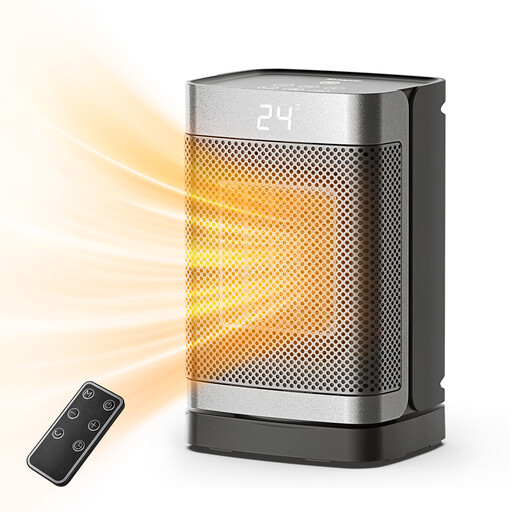
Why this product suits this profile: This compact PTC model offers two heating settings, digital temperature control, a remote control and a timer of up to 12 hours for bedrooms, offices or personal workspaces.
The power settings and shut-off timer limit operation more effectively than a basic on/off heater. Tip-over and overheat protection are specified.
PTC heating element, LED display, remote control, oscillation and 12-hour timer.

Why this product suits this profile: For medium-sized rooms, the manufacturer specifies 15–25 m², a temperature range of 5–35 °C and an operating noise level of 25–42 dB.
The stated noise level, temperature range and room size are more specific than vague claims about “quiet” operation or extensive coverage.
2,000-watt power, 70° oscillation, remote control, 12-hour timer and specified eight-part safety system.

Why this product suits this profile: Four operating modes, ECO mode, a 24-hour timer, remote control and a thermostat range of 5–35 °C offer plenty of flexibility for regular use.
The ECO mode and programmable timer make it easier to limit use to specific periods. According to the product specifications, overheat and tip-over protection are integrated.
1,800 watts, four modes, 24-hour timer, oscillation, child lock and 38–50 dB depending on the setting.
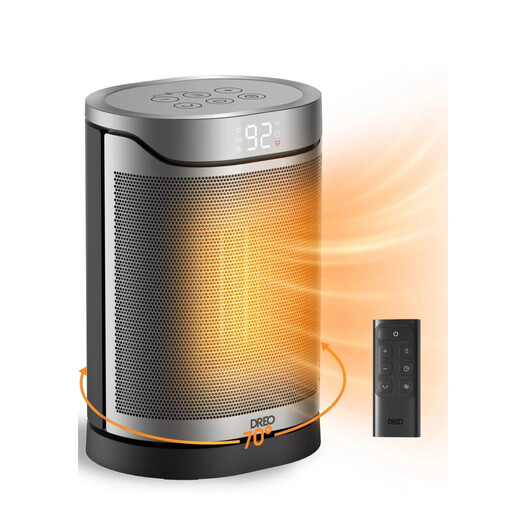
Why this product suits this profile: Its compact design, stated noise range of 25–42 dB and temperature control from 5–35 °C make it suitable for studies and bedrooms.
The low stated decibel range and graduated power settings help when choosing a heater for noise-sensitive rooms. A timer limits the operating time.
1,500-watt PTC system, 12-hour timer, 70° oscillation, remote control and specified safety features.
We have put together a complete, regularly updated list of products that fully meet these strict selection criteria and the safety regulations applicable in the EU.
This depends on the selected power setting and operating time. A 1,500-watt appliance uses 1.5 kWh during one hour of continuous operation. A thermostat, ECO mode and timer can limit the average operating time. The exact cost can be calculated using your own electricity price.
A fan heater should not be operated unattended unless the instruction manual expressly permits this for the particular use case. Even models with overheat and tip-over protection must not be covered or placed close to textiles. Before going to bed, it is safer to warm the room in advance and then switch the appliance off.
Its service life depends on operating time, exposure to dust, storage conditions and build quality. Regularly cleaning the air inlets, storing the appliance in a dry place and following the manufacturer’s instructions can help maintain its performance. If the cable is damaged or you notice an unusual smell, smoke, sparks or unusual noises, switch the appliance off immediately and disconnect it from the mains.