
Lieferung heute & morgen

Qualitätsgarantie

Willkommens-Angebote freischalten: KOSTENLOSE Lieferung | Bis zu 80 % RABATT | Kostenlose 30-Tage-JoyPlus-Testphase
App herunterladen
An electric fan heater can warm rooms quickly without the need for a fixed heating system. This is practical for bedrooms, home offices, offices and smaller living areas. However, models vary considerably in terms of heating technology, noise levels, controls and safety features.
If you focus solely on a high wattage or eye-catching advertising claims, you may end up buying a model that is too noisy for everyday use, consumes more electricity than necessary or is difficult to regulate. This guide explains what households in the UK should consider before buying.
A 2000-watt fan heater can produce heat quickly when running at full power. At the same time, electricity consumption increases accordingly. The maximum output should suit the room size, insulation and desired heating speed. A 1200- or 1500-watt model may be sufficient for a small workspace, while poorly insulated medium-sized rooms may require more power.
Important: wattage indicates power consumption, not necessarily the actual room temperature. An energy-saving fan heater does not automatically use less energy for the same heating output. The main opportunities for saving come from thermostat control, ECO mode, selecting the appropriate heat setting and using a timer.
A fan heater produces noise from both the motor and the airflow. Claims such as “particularly quiet” should therefore ideally be supported by a specific decibel rating. A quiet fan heater producing around 38 to 50 dB may be more suitable for an office or bedroom than a more powerful but noticeably louder model. Perceived noise also depends on distance, room acoustics and the operating setting.
Overheating protection and tip-over protection are important features, but they cannot prevent every instance of misuse. A heater must not be covered, placed directly next to curtains or operated on a bed, sofa or soft furnishings. Several of the models mentioned specifically require a distance of around one metre from flammable objects. Extension leads and unsuitable multi-way adaptors can also be problematic when using high-powered appliances.
A convection heater warms the room air mainly through natural air circulation. According to the product information, the Aigostar convection heater uses natural convection and iron-aluminium heating wires. This can provide even heat distribution with minimal draughts, although it takes slightly longer than a fan heater.
A ceramic fan heater, also known as a PTC fan heater, uses a ceramic heating element and a fan. PTC stands for a temperature-dependent electrical resistance. These appliances often offer several heat settings, oscillation and rapid warm-air distribution. When choosing a model, the lowest heat setting and a well-regulated thermostat are just as important as the maximum output.
A mobile oil radiator such as the Midea NY2009-24UR operates without a rapid stream of warm air. After it is switched off, the stored heat can continue to be released for a while. The trade-off is that the appliance is heavier and less convenient to move around than a compact fan heater.
Manufacturers’ recommended coverage areas are indicative only. Aigostar specifies 20 to 25 m² for its 1800- to 2000-watt model, while DREO gives a coverage range of 15 to 25 m² for the Solaris 628. These figures depend on ceiling height, the size of the windows, insulation standards and outdoor temperature.
Look for:
Approximate running costs can be calculated using this formula:
Power in kW × operating time in hours × electricity price per kWh
A 2000-watt appliance is equivalent to 2 kW. If it runs for two hours, it theoretically uses 4 kWh when operating continuously at full power. A thermostat can reduce the actual running time once the target temperature has been reached. The specific electricity tariff you pay is decisive when calculating the cost.

Why this product suits this profile: Four operating modes, including 750 watts, 1500 watts, ECO and fan-only ventilation, allow you to adapt the heater to smaller rooms, workspaces and personal heating zones. The remote control and LED display make it easy to use.
The lower heat setting and ECO mode mean the appliance does not have to run exclusively at full power. The timer can be set from 1 to 12 hours.
PTC ceramic heating element, four modes, oscillation, overheating protection and tip-over protection according to the product description.

Why this product suits this profile: This model combines 2000 watts, a thermostat ranging from 5 to 35 °C, 70-degree oscillation, a remote control and a specified noise range of 25 to 42 dB.
Specific details about noise levels, temperature range and room size make it easier to assess the model. The product description also lists several layers of protection, including overheating protection and tip-over protection.
PTC heating element, 5–35 °C thermostat, 24-hour timer and operating noise of 25–42 dB according to the manufacturer.
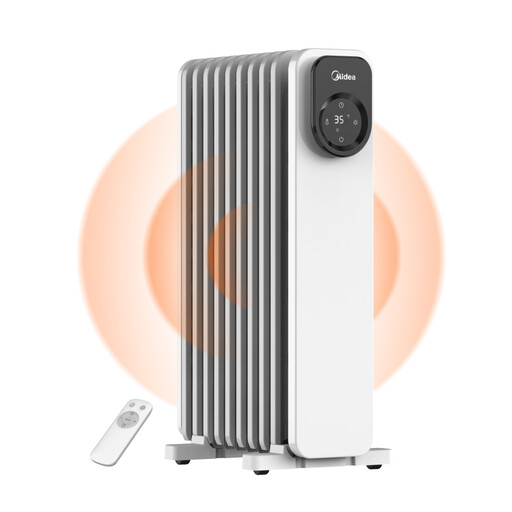
Why this product suits this profile: As a mobile nine-fin radiator, this oil-filled heater is suitable for supplementary warmth in well-insulated rooms or occasional use. It operates without the typical flow of warm air produced by a fan heater.
The product description explicitly recommends well-insulated rooms or occasional use. This makes the appliance’s limitations clearer rather than suggesting that it is suitable for every room.
2000 watts, thermostat, remote control, LED touchscreen, plus overheating protection and tip-over protection according to the product information.
We have put together a complete, regularly updated list of products that fully meet these strict selection criteria and the safety regulations applicable in the EU.
A 1500-watt appliance theoretically uses 1.5 kWh when operating at full power for one hour. At 2000 watts, the figure is 2 kWh per hour. A thermostat, ECO mode and timer can limit the effective running time. To calculate the cost, multiply the energy used by your electricity tariff’s unit price per kilowatt-hour.
This depends on the manufacturer’s specifications and how the appliance is used. A timer, overheating protection and tip-over protection improve operational safety, but they do not replace supervision. The fan heater must be positioned in an unobstructed location, must not be covered and should not be used near bedding, curtains or other textiles. Always follow the operating instructions.
Its service life depends on operating time, dust exposure, storage and build quality. Clean the air inlets as instructed, unplug the appliance before cleaning and only move it once it has cooled down. If the cable is damaged or you notice an unusual smell, smoke or visible damage, stop using the appliance.