
Lieferung heute & morgen

Qualitätsgarantie

Willkommens-Angebote freischalten: KOSTENLOSE Lieferung | Bis zu 80 % RABATT | Kostenlose 30-Tage-JoyPlus-Testphase
App herunterladen
An electric fan heater can warm bedrooms, home offices or small living areas quickly and temporarily. The choice may seem simple at first: choose the power rating, position the appliance and switch it on. In practice, however, some common buying decisions can lead to unnecessary costs, disruptive operating noise or safety issues.
A 2000 W fan heater produces more heat than a 1500 W model, but at full power it also uses more electricity accordingly. A higher wattage therefore does not automatically mean more efficient operation. What matters is whether the appliance has a thermostat, multiple heat settings or an Eco mode, as well as how well the room is insulated.
For guidance:
Manufacturers’ recommended room sizes are guidelines. Ceiling height, window area, insulation and outdoor temperature can all have a significant impact on the result. An appliance marketed as a room heater for 20 to 25 m² may perform differently in a well-insulated room than in a draughty room in an older building.
For smaller, well-insulated rooms, a 1500 W fan heater is often sufficient. For larger areas or faster air circulation, a 2000 W fan heater may be more suitable. However, it is not a replacement for a permanently planned central heating system.
A remote control, LED display and oscillation make an appliance easier to use. For everyday operation, however, overheating protection, tip-over protection, a stable base and an easy-to-understand timer are more important. A fan heater with remote control is convenient when the appliance is positioned in a bedroom or workspace. It should still be possible to switch it off directly on the appliance.
A ceramic fan heater usually operates with a PTC heating element. PTC stands for “Positive Temperature Coefficient”: the material’s electrical resistance changes as its temperature rises. The product description should nevertheless specify clear power settings, such as 750 W and 1500 W or 1000 W and 2000 W.
A ceramic fan heater can heat up quickly and distribute warmth using a fan. A convector, on the other hand, works mainly through natural air circulation and may be suitable for longer periods of even heating. An oil-filled radiator releases heat more slowly, but operates without the typical noise of a fan.
A fan heater with thermostat allows you to select a target temperature. Check whether the temperature can be set in individual stages or in small increments. A range of 5 to 35 °C, as offered by several appliances in the selection, provides flexible control for offices, bedrooms and living areas.
A fan heater with timer switches off after a preset period. Depending on the model, settings of 12 or 24 hours may be available. The timer does not replace supervision and should not encourage you to operate the appliance unattended near textiles.
Oscillation distributes the warm airflow across a wider angle. Specifications such as 70° or 90° provide objective points of comparison. They improve heat distribution but do not increase the appliance’s heat output.
For bedrooms and home offices, a quiet fan heater is particularly important. Manufacturer specifications such as 25 to 42 dB or 34 dB should be understood as the manufacturer’s measurement or product specification; the perceived noise level also depends on the room acoustics and fan setting.
You should also note the following:

Why this product suits this profile: This model combines 750 W and 1500 W settings with ECO mode, an LED display, remote control and a timer from 1 to 12 hours. This makes it suitable for smaller rooms, home offices and individual seating areas.
The multiple operating modes mean you do not have to heat continuously at 1500 W. Overheating protection and tip-over protection are specified in the product description.
PTC ceramic heating, oscillation, remote control and a 12-hour timer.

Why this product suits this profile: For medium-sized rooms, the manufacturer states a heating coverage of 15 to 25 m², temperature control from 5 to 35 °C, remote control and 70° oscillation.
According to the manufacturer, the stated noise level is 25 to 42 dB. Overheating and tip-over protection, as well as automatic temperature control, are also specified.
2000 W, PTC heating element, 12-hour timer and eight specified protection levels.
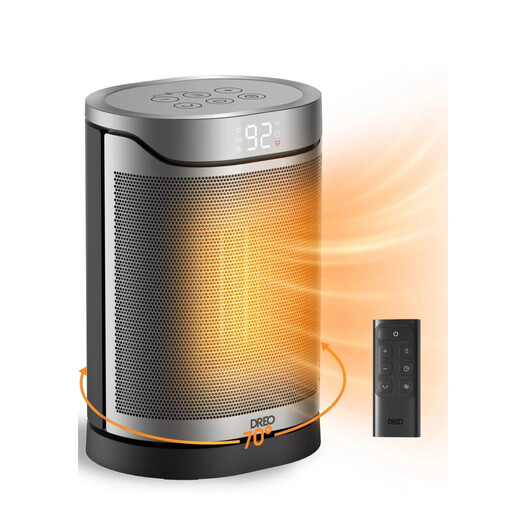
Why this product suits this profile: According to the manufacturer, this compact model is designed for 10 to 20 m² and offers 1500, 1300 and 900 W settings, 70° oscillation, remote control and a 12-hour timer.
The stepped power modes allow you to adapt the output to the room size and how you use it. A thermostat range of 5 to 35 °C, along with overheating and tip-over protection, is specified.
Compact dimensions, a manufacturer-stated noise level of 25 to 42 dB and multiple safety features.
We have put together a complete, regularly updated list of products that fully meet these strict selection criteria and the safety regulations applicable in the EU.
Position the electric fan heater away from walls and textiles. An ordinary room heater is generally not designed for bathrooms or other damp areas. Always check the appliance’s IP rating and instructions for use. Unplug the appliance before cleaning, moving or storing it. If you notice an unusual smell, smoke, a damaged cable or repeated automatic shut-offs, stop using the appliance.
A fan heater is intended to provide short-term or supplementary warmth. For permanent room heating, compare the ongoing electricity costs, room insulation and a suitable electric heating system.
It depends on the power rating and how long it runs. A 1500 W appliance uses 1.5 kWh during one hour at full load, while a 2000 W model uses 2 kWh. A thermostat, timer and lower heat settings can reduce the actual running time.
A 1500 W fan heater may be sufficient for a small, well-insulated bedroom. In larger or poorly insulated rooms, a 2000 W model may provide warmth more quickly. The manufacturer’s stated room size should only be treated as a guideline.
Its lifespan depends on operating time, exposure to dust, storage conditions and correct use. Regularly cleaning the air inlets, keeping the airflow unobstructed and following the operating instructions can help ensure trouble-free operation. Technical safety features do not prevent wear and tear.