
Lieferung heute & morgen

Qualitätsgarantie

Willkommens-Angebote freischalten: KOSTENLOSE Lieferung | Bis zu 80 % RABATT | Kostenlose 30-Tage-JoyPlus-Testphase
App herunterladen
An electric fan heater can quickly warm up a bedroom, office or smaller living area. At the same time, unclear power ratings, missing safety features and unsuitable locations often lead to disappointment. That is why our selection is not based on eye-catching design or sweeping marketing claims, but on clear criteria such as heating performance, controls, noise level, safety features and intended use.
An electric heater rated at 2000 W can provide heat quickly, but at full power it uses around 2 kWh per hour of operation. The actual cost depends on your individual electricity tariff:
Consumption per hour = power in kW × electricity price per kWh
A 1500 W appliance therefore uses around 1.5 kWh per hour at full power. A thermostat, several heat settings or an ECO mode can reduce the operating time or power consumption. However, they do not automatically make the appliance an “energy-saving fan heater” in absolute terms.
Noise levels depend on factors including the fan motor, airflow and operating setting. Claims such as “Silent” or “low noise” should be supported by a specific decibel rating. For comparison, the product details for the DREO Atom 416 state a range of 25 to 42 dB. The Adler AD 7727 is listed at under 51 dB. Figures like these are more useful than pure marketing terms, although they can vary depending on the measurement method.
A portable fan heater for indoor use is not automatically suitable for a balcony or patio. Moisture, rain, dust and outdoor installation all create specific requirements. For an infrared patio heater, the stated IP rating is therefore crucial. According to the product details, the Komodo Flores is described as having IP65. This means protection against dust and water jets, but not suitability for immersion. By contrast, an indoor appliance such as the Ozeanos fan heater must not be used in damp areas or outdoors, according to its product description.
For small, well-insulated areas, an appliance rated at 1200 to 1500 W may be sufficient. Larger or less well-insulated rooms are often served by models rated at 2000 W. The stated room size is only a guideline: ceiling height, window area, outdoor temperature and insulation can all have a significant impact on the result.
Look for:
Extension leads and multi-way adaptors can be problematic at high power. Always follow the relevant instruction manual.
A ceramic fan heater with a PTC heating element warms the air passing through it. These appliances are usually compact and distribute heat with the help of a fan. PTC technology alone does not guarantee a particular room temperature or energy saving.
A convector mainly works through natural air circulation and can operate without a powerful fan. This may be attractive for noise-sensitive work or sleeping areas, although the heat is distributed differently.
An infrared appliance primarily heats illuminated surfaces and areas occupied by people directly. This is particularly suitable for creating a targeted warm zone on a patio or terrace. Its range and effectiveness depend heavily on distance, angle of installation and wind.
A fan heater should be placed on a stable, dry and non-flammable surface. Useful features include:
A function described as a fan heater with oscillation distributes the airflow across a sweeping range. It does not replace sufficient heating performance and should not cause warm air to be directed straight at flammable objects.
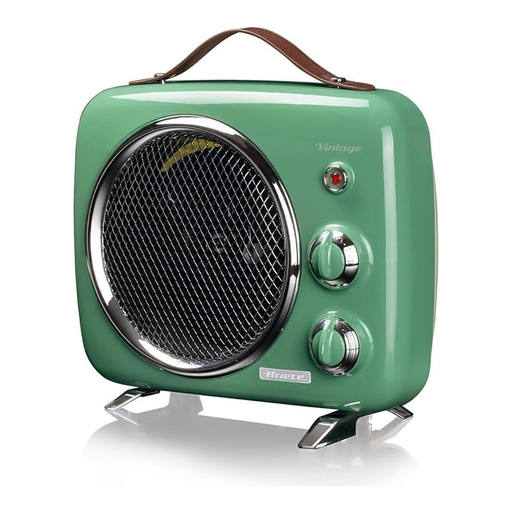
Why this product suits this profile: This compact 2000 W fan heater offers two speeds, an adjustable thermostat and both warm and cool air. The integrated carry handle makes it easy to move between small indoor spaces.
The heating performance, two speeds and thermostat are clearly specified. This makes it easier to choose than appliances promoted with vague “fast heat” claims.
2000 W, adjustable thermostat, two functions and carry handle.

Why this product suits this profile: For bedrooms, offices or studies, the manufacturer specifies a power rating of 1500 W, a thermostat range of 5 to 35 °C and a noise range of 25 to 42 dB.
The noise level is given in specific decibel figures rather than simply described as “quiet”. Tip-over protection and overheat protection are also listed.
1500 W PTC ceramic heating, 12-hour timer, remote control and stated CE and CB certification.
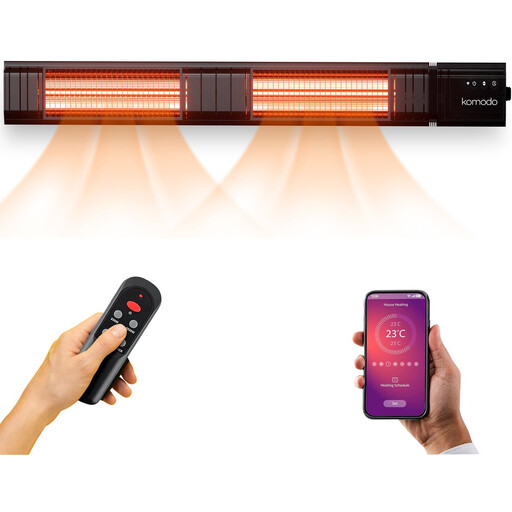
Why this product suits this profile: This infrared heater is specified for indoor and outdoor areas and, according to the product details, offers 3000 W, nine heat settings, remote control, app control and 180-degree oscillation.
The IP65 rating makes the intended level of protection clearer. However, the appliance must not be immersed and requires a secure, stable installation.
3000 W, nine heat settings, 24-hour timer, IP65, plus remote control and app.
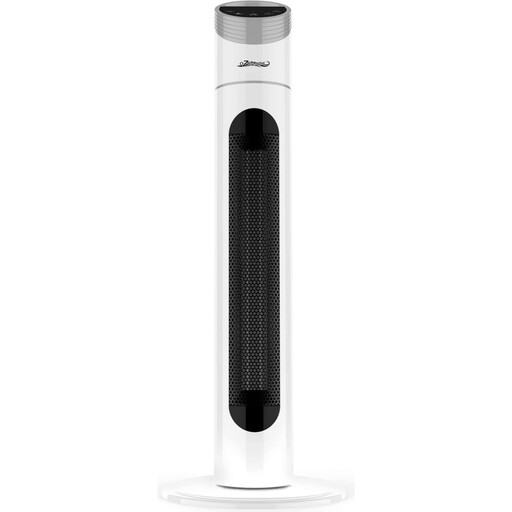
Why this product suits this profile: This compact ceramic fan heater is designed for indoor spaces such as home offices and living areas. It features 120-degree oscillation and two power settings.
The manufacturer explicitly lists tip-over protection and overheat protection. At the same time, use in bathrooms, damp rooms and outdoor areas is discouraged.
2000 W, PTC ceramic technology, 120-degree oscillation, compact design and stated quiet operation.
We have put together a complete, regularly updated list of products that fully meet these strict selection criteria and the safety regulations applicable in the EU.
Place the fan heater at least the distance specified in the instructions from curtains, furniture and other flammable materials. Never cover the appliance or use it to dry clothes. Before cleaning, moving or storing it, unplug the appliance and allow it to cool down completely.
Do not place a fan heater immediately next to a bath, shower, washbasin or swimming pool unless a specifically suitable IP rating is stated. Do not leave the appliance unattended while it is operating, and keep children and pets away from hot surfaces and the air outlet.
A 2000 W appliance uses around 2 kWh per hour at full power, while a 1500 W appliance uses around 1.5 kWh. The thermostat, heat setting and actual operating time determine the real consumption. For an accurate calculation, multiply the consumption by your electricity price.
A quiet fan heater with a thermostat, timer and tip-over protection may be suitable for short, supervised heating periods. Check the stated noise level and place the appliance in a clear, stable position. For overnight use, follow the manufacturer’s instructions and safety guidance.
Its lifespan depends on operating time, exposure to dust, storage conditions and build quality. Clean the air vents regularly, avoid moisture and do not use an appliance with a damaged cable, plug or casing. If you notice an unusual smell, smoke or sparks, stop using the appliance immediately.