
Lieferung heute & morgen

Qualitätsgarantie

Willkommens-Angebote freischalten: KOSTENLOSE Lieferung | Bis zu 80 % RABATT | Kostenlose 30-Tage-JoyPlus-Testphase
App herunterladen
An electric food chopper can make chopping onions, herbs, vegetables and meat much easier. However, models vary considerably in terms of bowl capacity, blades, controls and the ingredients they can process safely. If you focus only on wattage or extravagant product claims, you may easily end up with a machine that does not suit your everyday kitchen needs.
This buying guide explains which technical specifications really matter and which electric chopper, mini food processor or electric meat grinder is best suited to different types of user.
Motor power is an important indicator, but it is not the only measure of chopping performance. The blade design, bowl capacity, operating time and suitability for particular foods are also crucial. A 240-watt appliance may be sufficient for herbs, sauces and small portions, while an electric meat grinder for fibrous meat requires a different design.
Also check whether the manufacturer distinguishes between rated power and maximum power. An advertised peak output does not necessarily describe the continuous power available during normal operation.
Manufacturers often refer to the total volume of the bowl. However, it should not be filled to the brim if you want consistent results. With a 0.5-litre bowl, the amount that can be processed comfortably is lower than the stated capacity. For families or meal prep, a 0.83-, 0.9- or 2-litre bowl may therefore be more practical.
Smaller bowls also have advantages in compact kitchens: they take up less storage space and are ideal for garlic, onions, herbs or individual portions.
Choppers with stainless-steel blades are suitable for many kitchen tasks. Even so, bones, ice cubes, very hard frozen foods or dry grains should only be processed if the instructions expressly permit it. A vegetable chopper can also become overloaded if it is overfilled or used with unsuitable ingredients.
The blades should be removable. This makes cleaning easier, but also increases the risk of injury when fitting and removing them. The motor housing must never be immersed in water.
Glass bowls are transparent and absorb fewer odours, but they can be heavier. Plastic bowls are generally lighter. With either option, check that the information about BPA-free materials and suitability for food contact is clearly stated.
One-button or push-down lid controls are straightforward to use. Two speed settings and a pulse function, on the other hand, give you greater control over the consistency. Short pulses are often better for roughly chopping onions or vegetables than running the appliance continuously for a long period.
With manual models, a pull-cord mechanism replaces the motor. A manual food chopper works without electricity and can be used flexibly. The fineness of the chop depends more heavily on the number of pulls and the quantity in the bowl.
Removable, dishwasher-safe parts can reduce the daily effort involved. Check carefully which components can actually go in the dishwasher. With many models, the mechanically operated lid and motor unit must be cleaned by hand or wiped with a damp cloth.
Also pay attention to the maximum operating time. When processing larger quantities, breaks may be necessary. These specifications are more important for the motor’s service life than wattage considered in isolation.
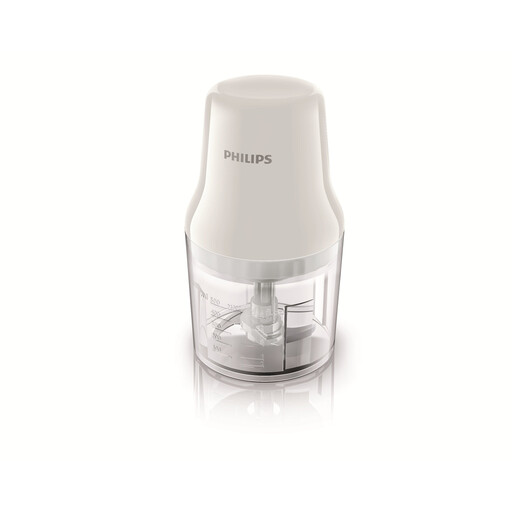
Why this product suits this profile: This compact electric chopper offers 450 watts, a 0.7-litre bowl and simple push-down lid operation. It is therefore suitable for typical everyday kitchen tasks.
The product information clearly states the motor power, bowl capacity and stainless-steel blade. According to the supplier, the removable parts are dishwasher-safe.
450 watts, 0.7-litre capacity, a stainless-steel blade and one-button operation.
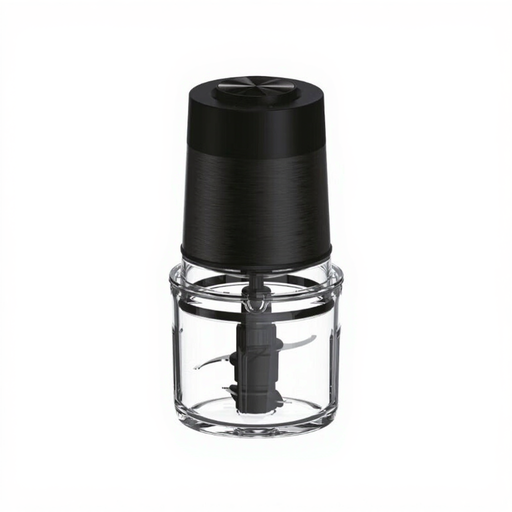
Why this product suits this profile: This model combines a 0.5-litre glass bowl with 550 watts, four stainless-steel blades and two speed settings with a pulse function.
The glass bowl lets you see how far the ingredients have been processed. The two speed settings allow more precise control than a basic one-button food chopper.
0.5-litre glass bowl, four stainless-steel blades, 550 watts, and a dishwasher-safe bowl and blades according to the product information.
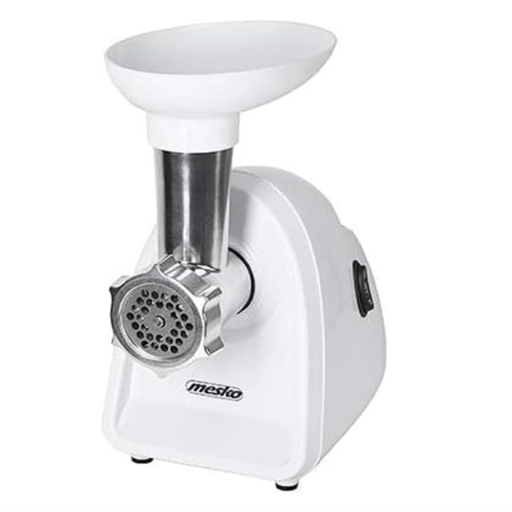
Why this product suits this profile: This electric meat grinder is designed for minced meat and sausage making. Three perforated discs with 3, 5 and 7 millimetre holes offer different grinding sizes.
The accessories include specific perforated discs, a sausage filler and a food pusher. This makes it easier to check the accessories and intended use before buying.
350 watts rated power, a stated processing capacity of up to 1 kg per minute, three perforated discs, plus forward and reverse functions.
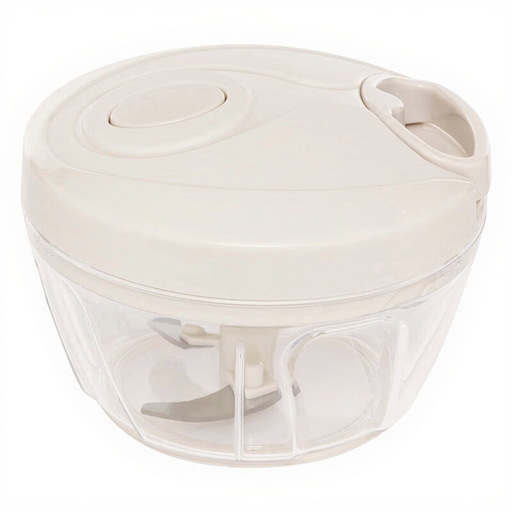
Why this product suits this profile: This manual food chopper works without a cable or power connection. It is designed for herbs, garlic, onions, nuts and small quantities of sauces or baby food.
The manual design eliminates power consumption and motor cooling breaks. The transparent bowl and stainless-steel blades make it easy to see how it works.
No power connection required, compact design, transparent BPA-free bowl and stainless-steel blades according to the product description.
We have put together a complete, regularly updated list of products that fully meet these strict selection criteria and the safety regulations applicable in the EU.
For herbs, onions, soft vegetables and dips, compact models with around 240 to 450 watts may be sufficient. For frequent meat processing or larger quantities, the motor, accessories, operating time and suitable perforated discs are more important than wattage alone.
It is not possible to give a generally applicable service life. It depends on how often the appliance is used, the ingredients processed, the breaks between operations and how it is cleaned. Following the maximum filling level and operating time, and handling the blades carefully, helps reduce avoidable strain.
For short processing times, electricity consumption is usually modest. Running costs depend on the power rating and operating time: a 450-watt appliance running for two minutes uses 0.015 kilowatt-hours in theory. The exact cost depends on your electricity tariff. For occasional short tasks, a manual garlic and onion chopper can be an electricity-free alternative.