
Lieferung heute & morgen

Qualitätsgarantie

Willkommens-Angebote freischalten: KOSTENLOSE Lieferung | Bis zu 80 % RABATT | Kostenlose 30-Tage-JoyPlus-Testphase
App herunterladen
An electric food chopper can process onions, garlic, herbs, vegetables, fruit, nuts or meat in next to no time. But not every appliance is right for every household. In everyday use, it is often not just the wattage or number of blades that matters, but also the capacity, operating time, cleaning requirements and the ingredients the appliance is actually designed to handle.
When comparing product descriptions, you should therefore avoid three common buying mistakes.
A motor with a high wattage may sound powerful at first. However, this figure alone says little about how long the appliance can be used continuously or which foods it is designed for. Even an electric meat mincer or kitchen chopper can have a limited pulse or operating time despite its powerful motor.
You should therefore check:
A two-litre container is practical for families and larger portions. However, the actual filling quantity depends on the ingredient, the position of the blades and the recommended maximum fill level. When using a vegetable chopper, ingredients should also be cut into suitable pieces so that the blades can work more evenly.
For individuals or small quantities, a mini food processor with a capacity of around 0.5 litres may be a sensible choice. A larger bowl takes up more space and is not always efficient for small portions.
With an onion chopper or garlic chopper, the blade material is crucial. 304 stainless steel is specified for the blades or bowls of several of the appliances listed here. Even so, you should check whether the container, lid and drive unit are suitable for your cleaning routine too.
Other important features include:
Two speed settings make it easier to adjust the appliance to different ingredients. According to the product information, the lower setting is typically suitable for soft foods such as fruit, garlic and onions. The higher setting is intended for meat, carrots and firmer vegetables.
The operating time should not be overlooked. For example, the Bear QSJ-D03W5 is specified for a maximum of 40 seconds of continuous operation, followed by a break of at least two minutes. After three such cycles, the appliance should be left to cool for 15 minutes. The IAGREEA MS-25JM08 is specified with a pulse duration of up to 30 seconds per cycle.
These instructions protect the motor from overheating and are an important part of using the appliance correctly.
Containers measuring around 1.8 to 2.5 litres are practical for family meals, minced-meat fillings or larger quantities of vegetables. A 0.5- to 0.6-litre container is better suited to a compact vegetable chopper for dips, herbs, garlic or small portions.
Glass containers allow you to monitor the contents directly. Stainless-steel containers are generally resistant to discolouration and can be nested inside one another to save space. Whether a container is dishwasher-safe must be stated in the relevant product information and should not be assumed as a general rule.
Multiple blades positioned at different levels can help distribute ingredients throughout the container. However, the number of blades alone does not guarantee a particular result. Blade shape, blade height, filling quantity and the size of the prepared pieces are also important.
Sharp blades should only be fitted, removed or cleaned when the appliance is unplugged. The motor housing must not be immersed in water. Any lid lock should not be bypassed. If you notice unusual noises, a burning smell or visible damage, switch the appliance off immediately.
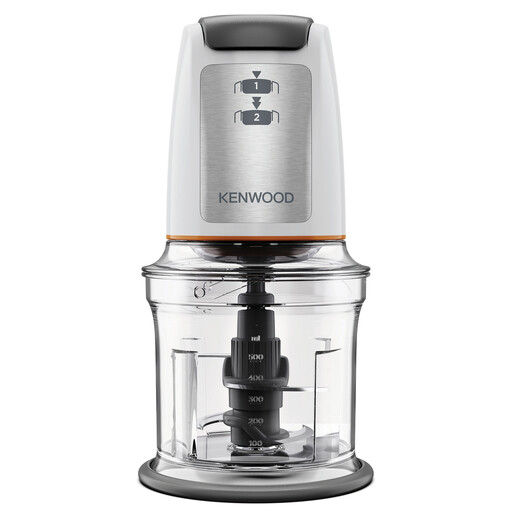
Why this product suits this profile: This electric mini chopper offers two speed settings, a 0.5-litre processing bowl and a stated power rating of 500 watts. Its compact format is ideal for smaller kitchens and occasional food preparation.
The clearly stated working capacity prevents a compact bowl from being mistaken for a family-sized model.
Compact 0.5-litre bowl and two speed settings.

Why this product suits this profile: Two glass bowls with capacities of 2 litres and 0.6 litres, together with two sets of blades, allow you to process smaller and larger quantities separately.
The separate bowls help prevent flavours from mixing. The product information also specifies a safety lock and a non-slip base.
Two glass bowl sizes, two sets of blades and dishwasher-safe glass bowls according to the product description.
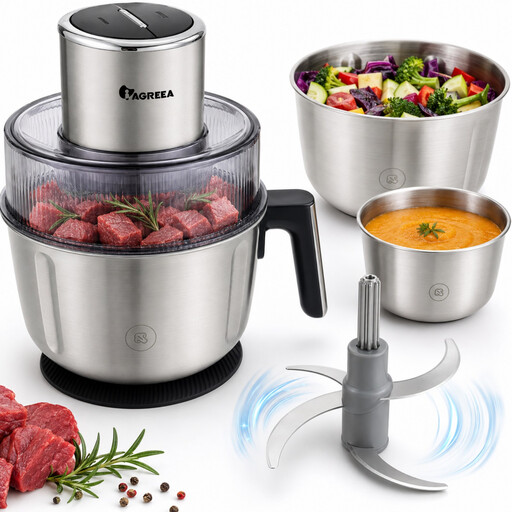
Why this product suits this profile: Three nestable stainless-steel bowls with capacities of 2.5, 2.2 and 1.8 litres cover a range of portion sizes and preparation tasks.
The product description specifies a pulse duration of up to 30 seconds per cycle, avoiding vague claims about continuous operation.
350-watt motor, three 304 stainless-steel bowls and a triple-curved blade system.
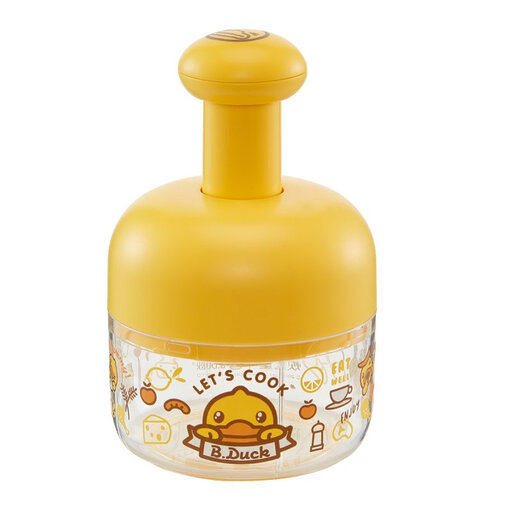
Why this product suits this profile: This manual chopper has a 220-ml container, requires no electricity and is suitable for small quantities of onions, herbs, garlic, fruit or nuts.
The small container makes its limited capacity clear. At the same time, there is no need to find a socket or deal with a cable.
220-ml format and manual operation for small portions.
An electric food chopper saves manual effort when preparing larger quantities and can be used as a meat chopper, vegetable cutter or onion chopper. However, it requires electricity, storage space and regular breaks. A manual chopper is quieter, easy to store and sufficient for small portions, but it requires repeated pulling or pressing.
For specific tasks, individual tools still make sense. A potato cutter creates evenly sized chips, a box grater is suitable for cheese, chocolate or nuts, and a traditional peeler can cut vegetables into thin strips. An electric appliance does not replace these tools in every household.
We have put together a complete, regularly updated list of products that fully meet these strict selection criteria and the safety regulations applicable in the EU.
For individual ingredients and small households, 0.5 to 0.6 litres is often sufficient. Families or users who regularly prepare meat, vegetables and fillings may prefer a model with a capacity of around two litres or several bowls.
Its service life depends on the materials, how it is used, cleaning and whether the recommended operating intervals are followed. Overloading, unsuitable hard ingredients and prolonged continuous operation can put strain on the motor and blades. The relevant manufacturer’s instructions are the deciding factor.
The actual cost depends on the rated power and operating time. As these appliances usually run for only a few seconds or minutes per processing cycle, the total energy used per preparation is generally limited. For a precise estimate, you can calculate the power in kilowatts multiplied by the operating time and your electricity tariff.