
Lieferung heute & morgen

Qualitätsgarantie

Willkommens-Angebote freischalten: KOSTENLOSE Lieferung | Bis zu 80 % RABATT | Kostenlose 30-Tage-JoyPlus-Testphase
App herunterladen
An electric food slicer can cut bread, cold meats, cheese, meat and vegetables evenly. However, models vary considerably in their construction, motor control and safety features. A low price alone says little about how well a machine will perform in everyday use.
If you’re a discerning home cook or keen hobby chef, there are three common pitfalls to watch out for before buying:
You should be able to set your preferred cutting thickness precisely and consistently. An adjustable food slicer with continuously variable thickness settings gives you more control than models with just a few fixed settings. Different settings are useful for finely sliced foods, bread and thicker slices.
The ritter serano⁷ is specified as having a cutting thickness of up to 23 mm. Its removable carriage has a 24 cm cutting travel. This is particularly useful if you plan to slice larger loaves, pieces of ham or blocks of cheese. Before buying, check that the dimensions are suitable for the size of food you typically handle at home.
Motor power shouldn’t be considered in isolation. What matters is how consistently the blade runs with different foods, and whether you can control its speed. Electronic speed control can be useful when switching between soft foods and firmer products.
According to the product information, the ritter serano⁷ uses a DC motor with electronic speed control. This allows you to adjust the operating speed to suit the task. No specific wattage is given in the information available. Rather than relying on marketing claims such as ‘powerful motor’, check for clear technical specifications and read the operating instructions.
A full-metal food slicer can provide a sturdy foundation for regular use. Metal components usually add to the weight and purchase price, though. It’s important to check which parts are actually made of metal and whether the carriage, blade and cutting-thickness adjustment are stable.
The model described here has a full-metal construction and an angled design. According to the product description, it comes with a serrated blade and a smooth slicing blade. This combination is useful for households that want to slice both bread and cold meats with the same machine.
Other features include a safety switch, a removable carriage and a collection tray for sliced food. Before using the machine for the first time, follow the manufacturer’s guidance on finger protection, cleaning, changing the blade and leaving the machine unattended. Keep electric food slicers out of children’s reach, and only use them on a dry, stable work surface.
The cards below match the available model to different usage scenarios, making it easier to decide whether its features suit your needs.
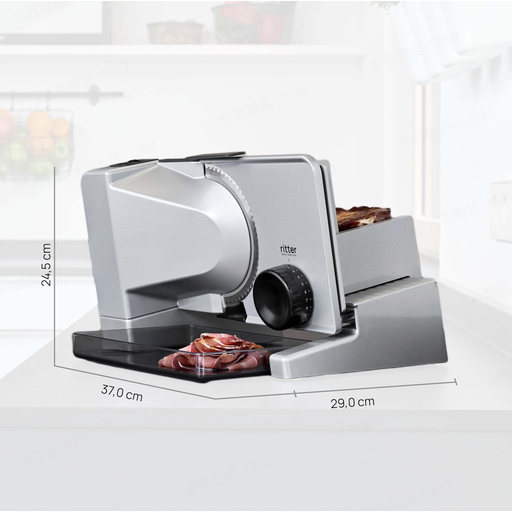
Why it suits this profile: If you’re looking for a machine to slice bread and the occasional cold meat, this model gives you two blades and an adjustable cutting thickness. That could save you from having to buy a second appliance.
It’s not limited to a single blade. The cutting thickness, carriage and collection tray are all listed as specific features.
Serrated and smooth blades; cutting thickness up to 23 mm; removable carriage.
Why it suits this profile: Its full-metal construction, angled design and electronic speed control will appeal to users who prioritise materials and control over a compact footprint.
The machine’s construction is described in concrete terms, including its full-metal build, motor type, speed control and carriage dimensions, rather than just its design.
Full-metal construction; DC motor; electronic speed control; described as Made in Germany in the product information.
Why it suits this profile: For frequent slicing of bread, cold meats, cheese or firmer foods, two blades, a long carriage travel and variable electronic speed control can all come in handy.
The 24 cm cutting travel addresses the common limitation of smaller carriages. The second blade also means you’re not reliant on just one type of cutting edge.
24 cm cutting travel; two blades; collection tray; removable carriage for cleaning.
We’ve put together a complete, regularly updated list of products that meet these strict selection criteria and the safety regulations in force in the EU.
That depends on the foods you slice regularly. A compact carriage is enough for standard loaves and smaller pieces of cold meat. If you slice large loaves, ham or cheese, check the usable cutting travel. The ritter serano⁷ is specified as having a 24 cm cutting travel.
Consumption depends on the motor power, how long the machine is used and how it’s operated. As food slicers usually run for just a few minutes at a time, the actual operating time is what matters for running costs. You can only make a reliable estimate once you know the specific model’s power consumption.
There’s no reliable way to give a single figure for its lifespan. It depends on the quality of the materials, how often it’s used, how it’s cleaned and how the blade is handled. Look for replacement blades, repair options, safe cleaning instructions and a clear user manual. Models with a removable carriage and interchangeable blades may be easier to maintain day to day.