
Lieferung heute & morgen

Qualitätsgarantie

Willkommens-Angebote freischalten: KOSTENLOSE Lieferung | Bis zu 80 % RABATT | Kostenlose 30-Tage-JoyPlus-Testphase
App herunterladen
An electric food slicer can cut bread, sausage, cheese, fruit, and vegetables far more evenly than an ordinary kitchen knife. At the same time, models vary considerably in terms of design, motor, cleaning, and operation. Focusing solely on wattage or a low price often means overlooking important details.
This guide from the Joybuy Product Recommendation Officer explains what households, home cooks, and small food-service businesses should consider when buying one.
Motor power is only one part of the product specification. Consistent slicing also depends on blade geometry, speed, material quality, and how securely the food is guided. A machine with a high power rating may still produce uneven results when slicing soft bread or cheese if the carriage is unstable.
The following features are therefore more important than a single wattage figure:
An electric bread slicer requires different features from an electric deli slicer designed for thin slices of sausage and cheese. Serrated blades are often suitable for bread and firmer foods. Smooth blades can be advantageous for certain types of cold cuts or softer foods.
Before buying, check whether the appliance is genuinely designed for the foods you want to prepare. With a vegetable cutter, the available slicing, julienning, or dicing functions may also vary depending on the design.
A difficult-to-access blade area, a non-removable carriage, or numerous exposed gaps can significantly increase cleaning time. For everyday use, an easy-to-clean food slicer is often more practical than a model with additional features that are rarely used.
You should also look for:
An adjustable slicing thickness is particularly useful when working with different foods. Bread is often preferred in thicker slices, while deli meats, cheese, or vegetables may need to be sliced more thinly. The maximum range is not the only factor that matters—the adjustment should also be stable and precise.
For the Ritter models featured here, the stated slicing thickness ranges from wafer-thin to approximately 20 or 23 millimetres. These figures are taken from the respective product descriptions and should be checked against the exact contents of the package before purchase.
A longer cutting stroke makes it easier to process large loaves of bread or longer ingredients. According to the product description, the Ritter Sono¹ has a cutting stroke of 18 centimetres. The Ritter serano⁷ is specified with 24 centimetres.
Also check whether the appliance includes a serrated blade, a smooth blade, or both. A replaceable-blade system can broaden its usefulness as both a bread slicer and a general food slicer.
Metal constructions can provide a stable foundation for frequent use. Depending on the food, an angled design can help guide it towards the blade. Glass surfaces are comparatively easy to access, but should be cleaned according to the manufacturer’s instructions.
Anyone looking for a food slicer Made in Germany should consider more than the stated country of origin. Spare-parts availability, repair options, and the actual manufacturing process are also important. The product descriptions for the Ritter Sono¹ and Ritter serano⁷ both state that the appliances are manufactured in Germany.
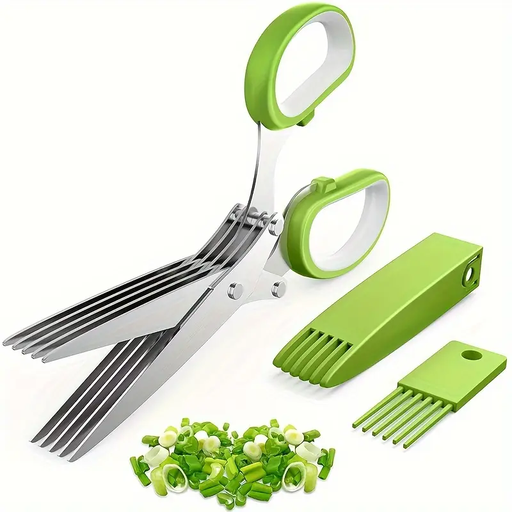
Why it is suitable: An option for households that primarily prepare vegetables and want an appliance that is simple to operate. The product name suggests a durable, environmentally conscious design; specific technical details should be checked before purchase.
Before ordering, check the available cutting functions, blades, dimensions, and cleaning options on the product page instead of relying solely on the term “food slicer”.
The product is positioned as a vegetable cutter for straightforward food preparation.
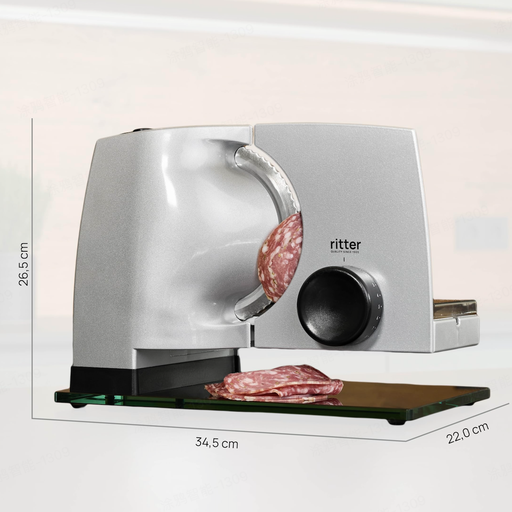
Why it is suitable: For users who want to process bread, fruit, and vegetables with a single appliance. According to the product description, the model features a suspended metal construction, a removable guide, and a slicing thickness of up to approximately 20 millimetres.
The removable food guide makes the appliance easier to access for cleaning. A safety momentary switch and a continuous-operation switch address different operating preferences.
The product description lists a safety-glass base, an 18-centimetre cutting stroke, and an ECO motor; manufacture in Germany is also specified.
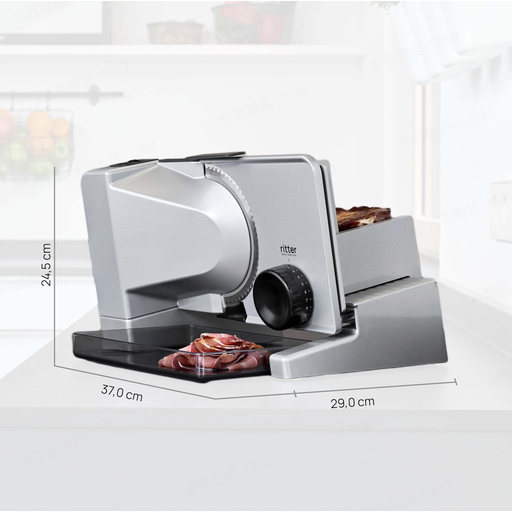
Why it is suitable: According to the description, this model is aimed at users with high expectations regarding cutting stroke, materials, and adjustability. Features include an all-metal construction, an angled design, and electronic speed control.
The product description lists a removable carriage, a collection tray, and two blades. These details make it easier to assess cleaning requirements and practical applications in advance.
The listed specifications include a slicing range of up to 23 millimetres, a 24-centimetre cutting stroke, smooth and serrated blades, and manufacture in Germany.
An electric food slicer generally runs for only a few minutes per use. Actual power consumption depends on motor output, operating time, and how the appliance is used. For a rough estimate, multiply the power consumption by the appliance’s daily operating time. A higher-powered model is not necessarily more expensive to run if it works faster; precise figures, however, can only be calculated using the relevant data sheet.
For a long service life, remove crumbs and food residue regularly and clean the appliance according to the manufacturer’s instructions. Blades should only be removed as specified in the manual. If you use the appliance frequently, it is also worth checking whether replacement blades and repair services are available.
That depends on the blade and the product’s intended use. A serrated blade is designed for many types of bread, while a smooth blade may be better suited to other foods. Before buying, check the specifications for the exact model and package contents.
A flexible setting ranging from very thin to substantially thicker slices covers a wide range of applications. Thicker slices are often useful for bread, while sausage, cheese, and vegetables generally call for thinner settings. It is important that the thickness remains stable once adjusted and that the carriage guides the food securely.
Switch off the appliance and unplug it from the mains. Then remove only the parts intended for removal, such as the carriage or blade, and clean them according to the instructions. Unless the manufacturer expressly permits it, do not hold the housing under running water.
Our overview features more products for electric vegetable and food preparation. Compare their cutting functions, dimensions, cleaning requirements, and package contents side by side.