
Lieferung heute & morgen

Qualitätsgarantie

Willkommens-Angebote freischalten: KOSTENLOSE Lieferung | Bis zu 80 % RABATT | Kostenlose 30-Tage-JoyPlus-Testphase
App herunterladen
An electric food slicer can cut bread, sausage, cheese, fruit and vegetables evenly, making food preparation in the kitchen easier. However, not every model makes the right purchase. Devices are often chosen for their striking design or high wattage, while important details such as cutting performance, cleaning and safe operation receive too little attention.
This buying guide from the Joybuy Product Recommendation Officer explains the key criteria objectively and shows which appliances suit different usage profiles.
A wattage rating alone says little about how suitable an appliance really is for everyday use. Power transmission, blade design, cutting speed and the way the food is guided are also important. A powerful motor is particularly relevant if you regularly slice bread, firm sausage or cheese. For occasional use, a less powerful specification may be sufficient.
Many buyers only look at whether an appliance can produce wafer-thin slices. In everyday use, it is just as important to know how thick the appliance can cut and whether the thickness can be adjusted continuously or in clearly defined steps. If you want to slice bread, cold meats and vegetables, look for a sufficiently wide adjustment range. Depending on the model, the appliances presented here can cut to approximately 20 or 23 millimetres.
A difficult-to-access blade mount or a non-removable carriage can make cleaning unnecessarily complicated. Residue on the blade, carriage or collection area can also affect kitchen hygiene. Removable components, easily accessible surfaces and a safety switch or comparable operating solution are therefore practical features. The appliance should always be disconnected from the mains before carrying out any work on the blade.
According to the product description, a serrated blade is particularly suitable for bread and various firm foods. A smooth blade can offer different cutting characteristics when slicing delicate sausages or cheeses. For versatile use, it is therefore important to check which blades are included and whether they can be changed.
Also check:
A precision food slicer should guide the food evenly without requiring excessive pressure or repeated repositioning.
A metal food slicer can be a durable option for regular use. However, metal construction does not automatically make an appliance easier to maintain or necessary for every household. The workmanship, stability and carriage design are what really matter.
Glass can also offer advantages in everyday kitchen use: depending on the design, a safety glass plate is easy to wipe clean and also serves as a stable base. When it comes to plastic components, buyers should look for solid workmanship and easily accessible contact surfaces.
Check the appliance dimensions, available cutting length and position of the controls. A longer cutting length makes it easier to process large loaves of bread or longer pieces of sausage. A secure stance is especially important if you regularly work at a higher speed.
The following points are also relevant for household use:
Depending on the retailer, the terms electric food slicer, bread slicer or electric slicing machine may refer to appliances with different specifications. Always check the specific product details.
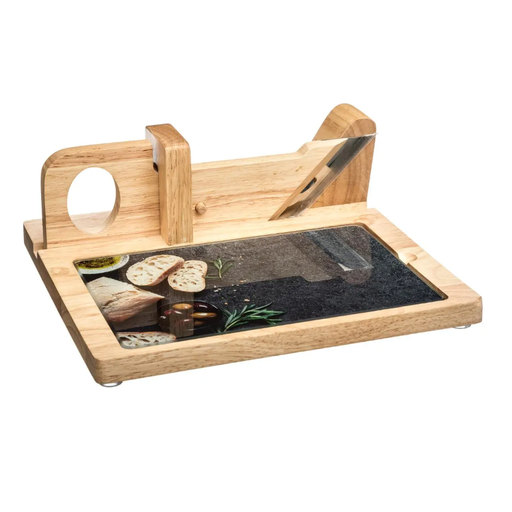
Why this product suits this profile: This manual solution combines a slicing attachment with a wooden board and is suitable for occasionally serving sausage, cheese and charcuterie. It is not an electric food slicer, but can be a compact alternative for beginners with limited requirements.
The product description clearly states the materials, cleaning requirements and usage restrictions. Frozen foods and bones are not suitable.
Integrated wooden board, stainless steel blade and compact design for slicing and serving.
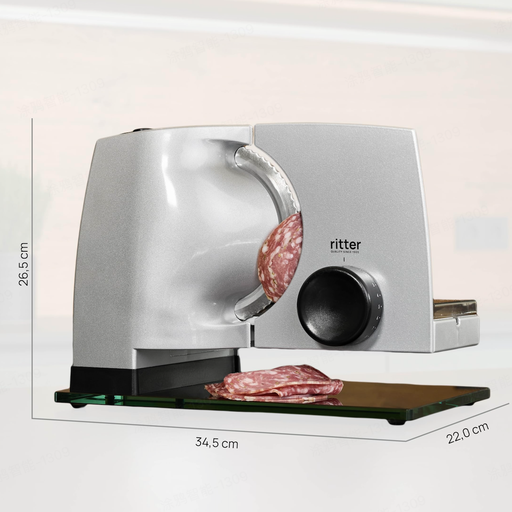
Why this product suits this profile: This electric food slicer is designed for households that want to process bread, fruit, vegetables and cold meats with one appliance while valuing a compact, functional design.
The removable food carriage makes cleaning easier. The product description also mentions a safety glass plate, an ECO motor, and momentary and continuous switches.
Cutting thickness of up to approximately 20 millimetres, an 18-centimetre cutting length and manufacture in Germany according to the product description.
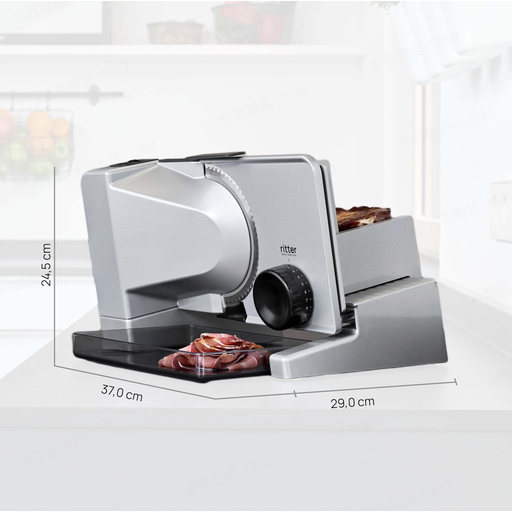
Why this product suits this profile: The combination of an all-metal construction, angled design and electronic speed control is aimed at users with frequent and varied slicing requirements.
The specification goes beyond a simple wattage rating: it includes electronic speed control, a removable carriage, a collection tray and a safety switch.
Two blades are specified: one serrated blade and one smooth blade. The cutting length is 24 centimetres, while the cutting thickness reaches approximately 23 millimetres.
We have put together a complete, regularly updated list of products that fully meet these strict selection criteria and the safety regulations applicable in the EU.
For both foods, an appropriate serrated blade, stable guidance and a sufficiently wide adjustment range are important. According to the product information, a serrated blade can be used for bread and various firm foods. For particularly versatile use, a model with an additional smooth blade may be a sensible choice.
Switch off the appliance, unplug it and follow the manufacturer's instructions. Removable carriages or collection components can make cleaning easier. The blade and contact surfaces should be cleaned with a suitable cloth or mild cleaning agent and then dried thoroughly. Handle the blade carefully and never touch the cutting edge directly.
Its service life depends on the quality of the materials, maintenance, level of use and correct operation. A metal housing alone does not guarantee a particular service life. It is sensible to look for clear information about spare parts, repair options and cleaning. When buying a bread slicer Made in Germany, buyers should also check the specific service and product information rather than treating the country of origin as the sole indication of quality.