Hosts serving crusty bread
If you want to cut a crusty loaf into even slices before a family visit, the blade and adjustable slice thickness are especially important. Graef specifically lists crusty bread as a suitable use for the SKS100.


For crusty bread, a food slicer with a serrated blade and adjustable slice thickness is a sensible starting point; Graef specifically recommends the SKS100 for this purpose. Also check that the loaf fits on the carriage, and that the guides, cleaning requirements and footprint suit your needs.
If you want to cut a crusty loaf into even slices before a family visit, the blade and adjustable slice thickness are especially important. Graef specifically lists crusty bread as a suitable use for the SKS100.
When slicing several portions, it’s important to guide the food in a controlled way and handle the blade and end pieces safely. Severin lists a finger guard and food holder for the AS 3915; always follow the instructions for your specific appliance to use it safely.
You need room for the loaf, but also want to be able to set up or store the appliance. So compare the appliance dimensions and information about guiding food through the slicer with your kitchen and the bread you usually buy.
Start with the blade and slice thickness you need for the crust. Then check the loaf guides, safe handling, cleaning and footprint to make sure they suit your needs.
| What matters | What to check when buying | Who should pay particular attention |
|---|---|---|
| Cutting crust and slice thickness | Check for a serrated blade and model-specific information on cutting crusty bread; compare the slice thickness range with the result you want. | If you’re preparing crusty bread to a particular thickness for a visit, the blade and settings come first. Around 36% of consumers prioritise cutting crust and slice thickness. |
| Safe food guidance | Check the carriage, finger guard and food holder, as well as the operating instructions for the specific model. | If you’re slicing several portions and want to guide the loaf or smaller end pieces in a controlled way, pay particular attention to how the appliance is handled. Around 29% of consumers prioritise safe food guidance. |
| Loaf fit and space | Compare the dimensions of your usual loaf with the information about the carriage; also consider the worktop space required and the appliance depth. | If the whole loaf needs to fit and your kitchen has limited worktop space, both dimensions matter. Around 21% of consumers prioritise loaf fit and space. |
| Cleaning after slicing | Check the instructions to see which parts can be removed and how the blade and carriage should be cleaned. | If you want to minimise the effort of clearing crumbs and food residue after a visit, look for easy-to-reach parts and clear cleaning instructions. Around 14% of consumers prioritise ease of cleaning. |
You can’t judge cutting performance from a single power rating. ETM TESTMAGAZIN highlights the blade, mechanism and carriage quality as important factors.
Check the blade type and information about its suitability for crusty bread. Any independent assessment must relate to the exact model.
The space it takes up doesn’t tell you whether your bread will fit on the carriage. For the Ritter E 16, the manufacturer gives a carriage travel of around 18 cm; this is different from the appliance dimensions.
Measure your usual loaf and compare its dimensions with the model-specific information about guiding food through the slicer.
Removable parts can make areas easier to reach, but they don’t automatically make handling the blade safe. Severin’s instructions say to unplug the appliance before cleaning.
Follow the cleaning and removal instructions for your specific appliance, and unplug it before cleaning.
Graef specifically lists crusty bread as a suitable use for the SKS100. An independent review of a different model can’t be applied to this appliance.
According to the manufacturer, the E 16’s specifications include a serrated blade, a collection tray, and momentary and continuous operation switches. The E 18 is a separate model that F.A.Z. Kaufkompass particularly recommends for left-handed users.
For the AS 3915, Severin describes a metal design with continuously adjustable slice thickness and removable blades. These features alone don’t prove that it cuts crusty bread better.
The options below are electric food slicers with information about cutting bread and adjustable slice thickness. For crusty bread, you should also check the blade type and how each model guides the loaf.
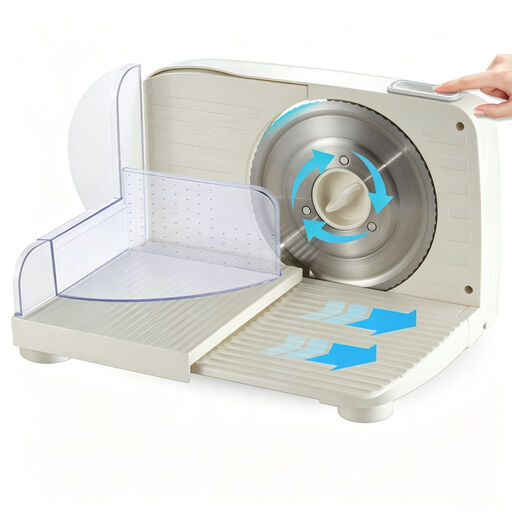
 No image available
Described as a food slicer for bread, with continuously adjustable slice thickness from 0 to 15 mm.
The product information lists a foldable design and a stainless steel blade.
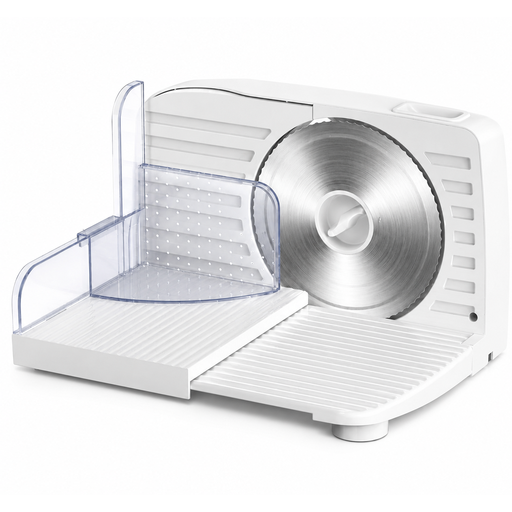
 No image available
Described as suitable for bread; according to the product information, the appliance has a 17-cm serrated blade and continuously adjustable slice thickness from 0 to 15 mm.
The description also lists a foldable design, safety switch and finger guard.
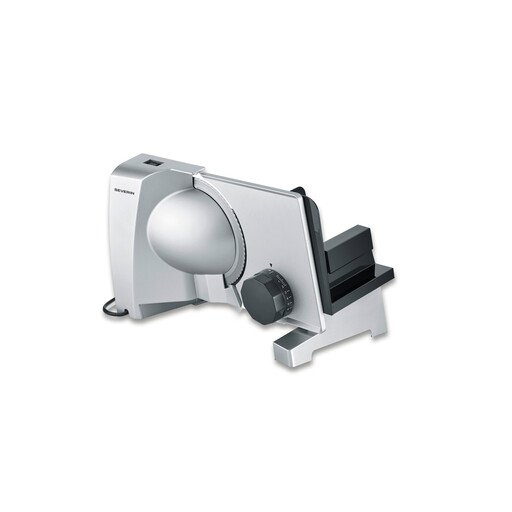
 No image available
Bread is listed as a food to slice; the product description specifies a 17-cm serrated blade for soft foods.
According to the description, slice thickness is adjustable from 0 to 15 mm. A finger guard, safety switch and removable parts are also listed.
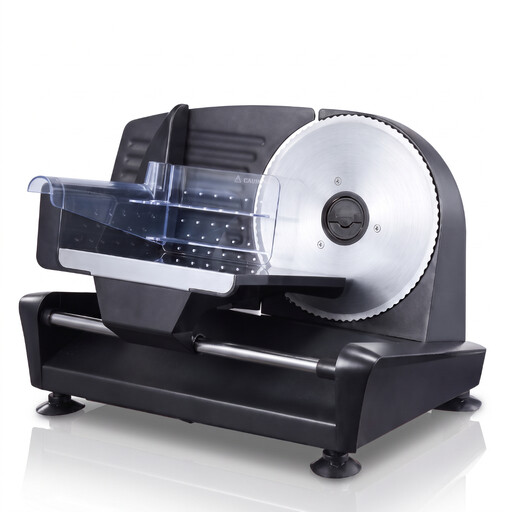
 No image available
Bread is listed as a food to slice; according to the product description, slice thickness is adjustable from 0 to 23 mm.
The blade and support table are described as removable and easy to clean.
 No image available
The product description lists a 19-cm serrated blade for bread and continuously adjustable slice thickness from 0 to 15 mm.
A food holder and removable carriage are also listed.
There’s no single slice thickness that suits every type of bread. Set the thickness you want on the specific appliance and check the first few slices. For example, Graef lists 0–20 mm for the SKS100 and Severin lists 0–15 mm for the AS 3915.
Place the appliance on a stable surface and guide the food using the carriage and, where provided, the food holder, following the instructions. Unplug it before cleaning; Severin’s instructions explicitly require this. Always follow the instructions for the model you’ve bought.
No. For a consumer purchase in Germany, the seller is responsible for statutory rights relating to faults. Verbraucherzentrale states that these rights generally apply for two years from delivery; a manufacturer’s guarantee is an additional voluntary service with its own terms and conditions.
Where the relevant harmonised EU rules require the appliance to carry the marking, the manufacturer uses it to declare that the product meets the applicable requirements. The European Union points out that CE is not a certificate issued by a central EU body. When considering a specific product, check that it has the required marking and review the information for that particular version of the appliance.