Fans of thinly sliced meat
If you want to slice cooked roast beef as thinly as possible, compare the blade type and what comes with the complete model variant. ritter describes its smooth slicing blade as suitable for thin slices of soft foods.


If you mainly want to cut thin slices of roast beef, first check the blade type and what comes with the exact model variant. According to ritter, a smooth slicing blade is designed for thin slices of soft foods, while a serrated blade can be used more widely. Then compare the carriage travel and support with the size of your joint, and check how the parts that come into contact with the meat can be cleaned and how the machine can be stored. The models mentioned have not been compared for their roast beef slicing performance.
If you want to slice cooked roast beef as thinly as possible, compare the blade type and what comes with the complete model variant. ritter describes its smooth slicing blade as suitable for thin slices of soft foods.
If you slice ready-to-eat meat after a shift, check which parts that come into contact with the meat can be cleaned according to the instructions. The Federal Institute for Risk Assessment recommends using separate kitchen utensils for raw and cooked foods.
If you want to put your food slicer away after use, compare its dimensions in use and when stored with the space available in your kitchen. A foldable design, such as the one SEVERIN lists for the AS 3912, is about storage and says nothing by itself about slicing performance or cleaning.
The Federal Institute for Risk Assessment recommends using separate kitchen utensils for raw and cooked foods. That makes cleaning the parts that come into contact with the meat, and guiding the joint safely, important points to check.
| What matters | What to check before buying | Who is it important to? |
|---|---|---|
| Thin slices of roast beef | Check whether the selected variant includes a smooth slicing blade and what thickness settings are available. | If I want to slice roast beef as thinly as possible, I check the blade and what comes with the exact variant. Around 31% of consumers are likely to consider thin slicing their top priority. |
| Cleaning after slicing | Check whether the blade, carriage and other surfaces that come into contact with the meat can be accessed and cleaned as instructed. | If I slice ready-to-eat meat, I want to be able to clean the parts it has touched according to the instructions. Around 25% of consumers are likely to consider cleaning their top priority. |
| Safe handling | Look for a suitable support, a stable base and an appropriate food holder; check that the carriage travel suits the size of your joint. | If I want to guide meat and small leftover pieces safely, I want to keep my hands well clear of the blade. Around 19% of consumers are likely to consider safe handling their top priority. |
| Storage space | Compare the space it takes up in use, its storage dimensions and the available space for the slices. | If my worktop space is limited, I need to be able to store the machine suitably after slicing. Around 13% of consumers are likely to consider storage space their top priority. |
| Versatility | Check which foods each blade type is suitable for and whether an additional blade is actually included. | If I want to slice bread as well as roast beef, I compare the blades provided and what comes in the box. Around 12% of consumers are likely to consider slicing different foods their top priority. |
GRAEF specifically lists the additional smooth blade for the G52 TWIN. The G52 name alone does not confirm that it is included.
Before buying, compare the full model name and the blades actually included.
Carriage travel and support also affect how you guide the food. For the E 18, ritter lists a carriage travel of around 15 cm and a short-time operating period of 5 minutes. These details do not show how well a particular machine will slice your roast beef.
Check that the joint and the amount you plan to slice are a good match for the carriage, support and operating instructions for the exact model.
A folding function affects storage; it does not automatically mean the machine takes up less room while slicing or that parts that come into contact with the meat are easy to reach.
Compare the dimensions in use, storage dimensions and cleaning steps separately.
The G52 range includes variants that may differ in what comes in the box.
The E 18 is a food slicer with a left-handed feed.
The AS 3912 and AS 3915 differ in their design and features, among other things.
The Home Line 200 PLUS is a domestic food slicer designed for a permanent spot on the worktop.
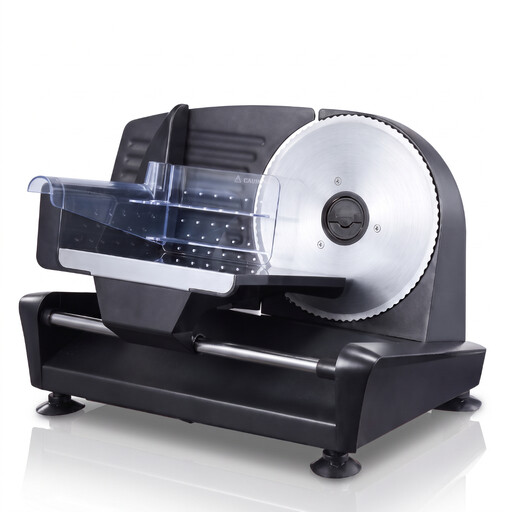
These Joybuy products are electric food slicers for slicing roast beef, including foldable machines and models with different blade types and adjustable slicing thickness.
 No image available
For anyone looking for adjustable slicing thickness and a foldable machine.
The product name lists a setting of 0–15 mm and a stainless steel blade. According to the product information, do not use it for frozen foods or bones.
 No image available
For anyone looking for a foldable machine with adjustable slicing thickness.
The product name lists 180 W, a setting of 0–15 mm and a 17 cm stainless steel blade.
 No image available
For anyone looking for a machine with a smooth blade and adjustable slicing thickness.
The product name lists 200 W, two 19 cm stainless steel blades and a setting of 0–15 mm.
 No image available
For anyone looking for a model with an angled design and removable carriage.
The product name lists a metal construction, an angled design and electronic speed control.
 No image available
For anyone who wants access to the carriage area after slicing.
The product name lists a removable carriage and a shatter-resistant glass base.
No. ritter describes a smooth slicing blade as particularly suitable for thin slices of soft foods, and a serrated blade as versatile for both hard and soft foods. This is a guide to choosing a blade, not proof that every roast beef and machine will produce the same result.
Clean the parts of the machine that come into contact with the meat according to the instructions for the model, and use separate kitchen utensils for raw and cooked foods. The Federal Institute for Risk Assessment recommends cooling hot food quickly to below 7 °C for longer-term storage, and keeping perishable foods in the fridge at 2 °C to no more than 7 °C.
Check whether suitable replacement blades are available and what service terms apply to the exact model. Your statutory rights if a product is faulty are separate from any additional guarantee offered. The Verbraucherzentrale describes a general two-year statutory warranty period in Germany and notes that rules are changing for purchase contracts from 31 July 2026; the rules that apply to your contract are the ones that matter.
A CE marking is required if the machine is covered by harmonised EU rules that specifically require one. According to the European Union, the marking means the manufacturer declares that the product complies; it is not an independent product test. Check the information for the specific machine and listing.