Regular cheese slicers
If you often want evenly cut slices of hard cheese that is suitable for slicing, look for a suitable blade and adjustable slice thickness. ritter describes its serrated blade as suitable for hard and soft foods in general.


For regularly slicing hard cheese that is suitable for slicing, a stable food slicer with the right blade and adjustable slice thickness is a sensible choice. However, general claims about suitability for cheese do not guarantee a good result with every particularly hard cheese. In a shared kitchen, easy-to-reach, cleanable contact surfaces, safe operation and enough room to set up and store the slicer also matter. If you want to split Parmesan rather than slice it, a cheese knife designed for the job is a more suitable tool.
If you often want evenly cut slices of hard cheese that is suitable for slicing, look for a suitable blade and adjustable slice thickness. ritter describes its serrated blade as suitable for hard and soft foods in general.
If several people use the appliance, it’s important that contact surfaces are easy to reach and clean after use. The German Federal Institute for Risk Assessment recommends using separate kitchen utensils for raw and cooked foods.
If the slicer can’t stay on the worktop permanently, make sure you plan for both storage and enough room to set it up and use it safely. Severin describes the AS 3912 as having a foldable base plate.
First, check that the blade and guide are suitable for your cheese and the type of cut you want. Then consider cleaning, safe operation and the space available.
| Consideration | What to check before buying | Who is it important to? |
|---|---|---|
| Evenly cut cheese slices | Check the blade type, carriage guide and adjustable slice thickness on the specific model. | If I want to cut hard cheese that is suitable for slicing into even slices regularly, the right blade is essential. Around 31% of consumers put this consideration first. |
| Cleaning between uses | Check the manual to see which parts can be removed and how to clean the blade, stop plate and platform. | If several people or different foods are going to be using the appliance, I want to be able to clean the contact surfaces thoroughly between uses. For around 31% of consumers, cleaning is a priority. |
| Safe use by several people | Check the food holder, switch, stability and operating instructions for the specific model. | If different people use the slicer, I look for clear controls and instructions on how to use the carriage and food holder. Around 25% of consumers prioritise safe operation. |
| Worktop space and storage | Compare the dimensions for storage and use, and allow enough room to guide the food through the slicer. | If I need to clear the worktop after slicing, I also want to know how easy the appliance is to store. Around 13% of consumers put space requirements first. |
The percentages indicate how these buying considerations rank for this topic; they are not measured market shares.
A general claim that a slicer is suitable for cheese doesn’t tell you whether it can cut every particularly hard cheese into intact slices. A test with soft cheese won’t answer that question either.
Check the manufacturer’s guidance for the specific type of cheese and cut you have in mind. If you want to split Parmesan, a cheese knife designed for the job may be a better choice than an electric food slicer.
The Graef G52 TWIN is listed with an additional smooth blade; the G52 model name alone doesn’t confirm that this is included.
Compare the full model name, what’s included and blade compatibility for the specific offer. You may need to buy an additional blade separately.
A foldable appliance still needs a suitable worktop and enough room to guide the cheese safely while slicing. The folding feature doesn’t prove a particular level of performance with hard cheese.
Allow space for storage as well as setup, use and cleaning, and check that your usual pieces of cheese will fit on the carriage.
According to Graef, the G52 TWIN is a freestanding slicer supplied with an additional smooth blade for different slicing tasks.
The ritter E 16 is a metal freestanding slicer with a serrated blade and a removable carriage.
The AS 3917 and AS 3912 have different strengths: ease of cleaning and compact storage, respectively.
The MA 3585 is a metal food slicer with a serrated blade, food holder and angled support.
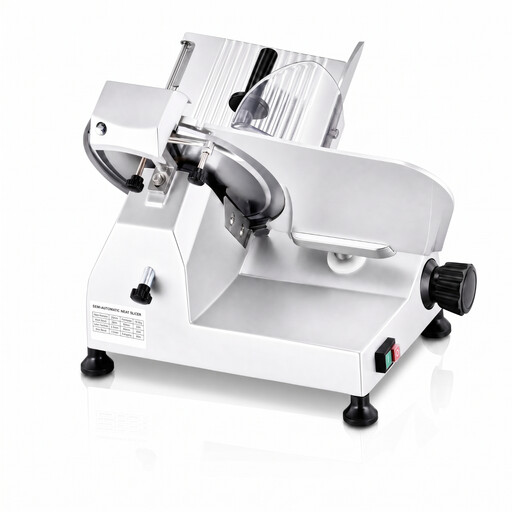
This selection includes electric food slicers with adjustable slice thickness for cheese, including foldable models that can be put away after use.
 No image available
Adjustable slice thickness and a foldable design make this a good fit for a kitchen where the slicer needs to be stored after use.
Slice thickness: 0–15 mm; stainless steel blade; foldable design.
 No image available
The product listing says it can slice hard cheese and has removable parts, which may be useful when cleaning it between uses.
Power: 240 W; 25.4 cm diameter carbon steel blade; slice thickness: 0–12 mm. According to the description, the blade, food pusher and deflector are removable.
 No image available
This foldable model is an option if you need to put the slicer away after use; the product listing says it can slice hard cheese.
17 cm stainless steel serrated blade; slice thickness: 0–15 mm. The listing also describes removable parts, non-slip feet and a safety switch.
First, check the manual for the specific appliance and consider the shape of the cheese. ritter describes its serrated blade as suitable for hard and soft foods in general, while the manufacturer recommends its smooth slicing blade mainly for soft foods. This doesn’t guarantee that it will cut every type of hard cheese into slices. If you want to split Parmesan, a cheese knife designed for the job is another tool to consider.
Agree to clean it after every use, especially when switching between raw and ready-to-eat foods. Switch off the appliance and unplug it before cleaning. Follow the model’s instructions for removing the blade and any other cleaning steps. The German Federal Institute for Risk Assessment recommends using separate utensils for raw and cooked foods to avoid cross-contamination.
If there’s a fault, distinguish your statutory rights against the seller from any voluntary guarantee. The Verbraucherzentrale (German consumer advice service) identifies repair or replacement as the first step in bringing a product into conformity. Check the guarantee terms and availability of spare parts for the specific appliance separately.
Check that the product and manufacturer are clearly identified and that German instructions and warnings are provided. Germany’s 1. ProdSV applies to electrical equipment within the scope of 50 to 1,000 volts AC. The requirements that apply in each case depend on the specific product; the CE marking is a declaration by the manufacturer, not an independent quality mark.