
Lieferung heute & morgen

Qualitätsgarantie

Willkommens-Angebote freischalten: KOSTENLOSE Lieferung | Bis zu 80 % RABATT | Kostenlose 30-Tage-JoyPlus-Testphase
App herunterladen
An electric food steamer can cook several ingredients at once, making it a good fit for family households and kitchens where you want to steam vegetables, fish, meat, rice or desserts separately. But choosing one isn’t just about wattage and capacity. The water supply, tier layout, materials, cleaning and the space it takes up all matter.
A 2000 W food steamer can heat water quickly and produce plenty of steam. But that alone doesn’t tell you how evenly heat is distributed, how easy the appliance is to use or how much energy each cooking session will use. For home use, it’s the balance between power, capacity and cooking time that counts.
A model advertised as holding 14 litres may offer less usable space than you expect because of dividers, water collection trays or an awkward shape. So check the internal dimensions of the tiers. Rectangular steaming containers are often more practical than small round inserts for a whole fish, several dishes or long vegetables.
With some basic models, you may need to remove the lid and top up the water during longer cooking times, letting steam escape. A food steamer with an external water tank, on the other hand, lets you check and refill it from the outside. Look for a clearly visible water-level indicator, an easy-to-reach filling opening and an automatic shut-off if the water runs low.
A compact model may be enough for one person or smaller portions. Families are more likely to benefit from a family food steamer with two or three tiers. A 14-litre food steamer gives you room to prepare several parts of a meal at once. Check whether the tiers can be removed individually and whether plates or dishes will fit inside.
A two-tier food steamer is particularly easy to organise when you want to keep ingredients with different cooking times separate. You can arrange fish, vegetables and side dishes on different tiers. Also check whether condensation from the upper tier can drip onto the food below.
Power consumption is measured in watts. A 2000 W model may make sense if it has a large cooking capacity, but it will use more electricity at full power. As a simple guide, running costs are calculated as follows:
Power in kW × operating time in hours × electricity price per kWh = electricity cost.
A food steamer with a timer makes it easier to plan ahead and helps prevent it running for longer than necessary. However, automatic programmes are best used as a guide. The actual cooking time depends on the quantity, starting temperature, size of the pieces and type of food.
With a food steamer with stainless steel containers, heat-resistant, removable inserts are a practical advantage. Stainless steel stands up well to many cooking ingredients and is easy to clean when properly designed. Check whether the lid, drip tray and steaming containers are dishwasher-safe. The main unit, cable and controls must not be immersed in water.
If you’re using the appliance in Germany, you should also check that it has a suitable mains voltage and plug, German-language instructions, and details of the manufacturer and responsible person. Steam, hot surfaces and condensation are all part of normal operation. Place the appliance on a stable, heat-resistant surface with good ventilation.
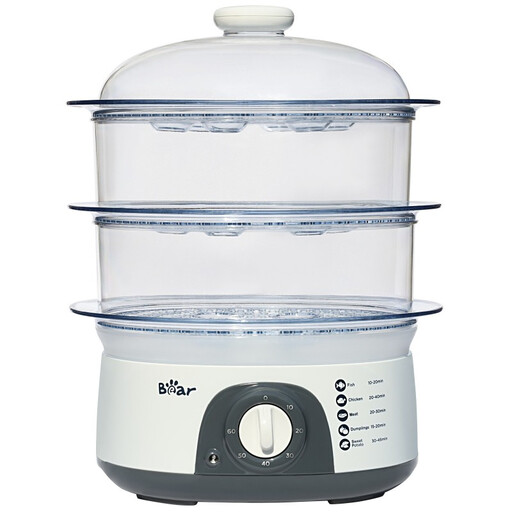
Why this product suits this profile: With a 10-litre capacity, three stackable tiers and a 60-minute timer, this appliance is well suited to regular meals in smaller households.
The transparent containers make it easy to keep an eye on your food. Removable parts and a separate drip tray help cut down on cleaning.
Three tiers, a 10-litre capacity and a 60-minute timer, plus removable parts that are dishwasher-safe according to the product description.
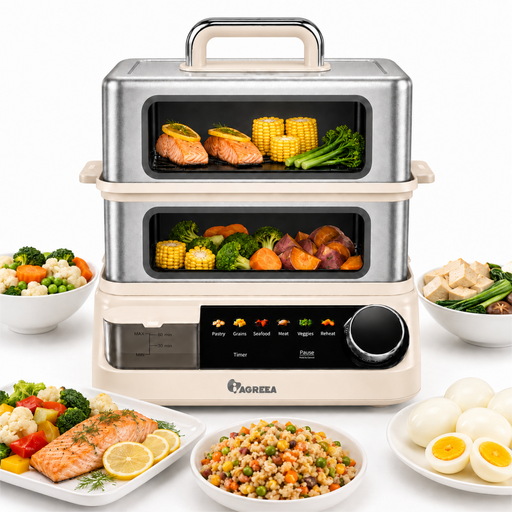
Why this product suits this profile: Two stainless steel containers, a 14-litre capacity and an external 2.5-litre water tank make it well suited to larger portions and meals with several components.
The visible external tank makes it easier to check the water level. Viewing windows let you keep an eye on your food without repeatedly opening both tiers.
According to the product description: 2000 watts, two stainless steel trays, six programmes, plus timer and pause functions.
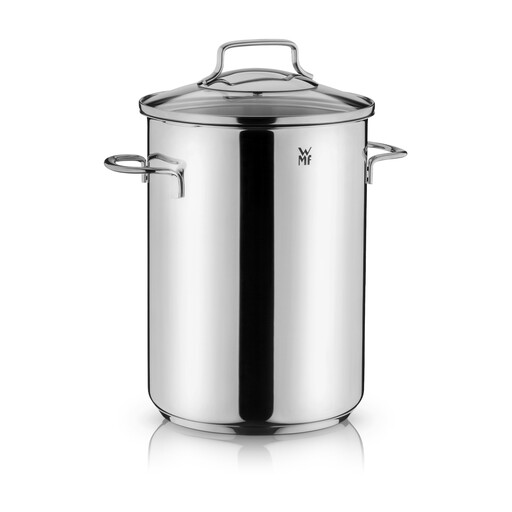
Why this product suits this profile: This isn’t an electric food steamer, but a tall pot with an insert for use on induction and other types of hob. It’s suitable for individual long ingredients and traditional hob cooking.
The product type is clear: if you don’t need an electric steamer, this is a hob-based alternative with a visible cooking area.
Cromargan stainless steel, a glass lid, a wire basket insert and compatibility with various types of hob, according to the product details.
We’ve put together a complete, regularly updated list of products that meet these strict selection criteria and fully comply with the safety regulations in force in the EU.
It depends on the tank size, cooking time and amount of food. Fill the tank only up to the marked maximum level. An external tank with a visible indicator makes it easier to check. After use, empty any remaining water and let the appliance cool down.
There’s no reliable one-size-fits-all answer. Its lifespan is affected by how often it’s used, limescale build-up, cleaning and storage. Use only the type of water recommended by the manufacturer and follow the descaling instructions. Don’t continue using the appliance if its cable, seals or containers are damaged.
Running costs depend on the wattage, how long it’s used for and your electricity tariff. At full power, a 2000 W food steamer would use 2 kWh per hour in theory. In practice, depending on the model and temperature control, the heating element may switch off at intervals. A timer and appropriately sized portions can help avoid unnecessary running time.