For cooks with limited worktop space
You want to steam squash electrically, while also making room for the appliance and the clearance it needs to operate.


First, measure the available space, allowing for the operating clearance required by the model. Then compare the usable internal dimensions of the basket with your usual portion of squash. Separate cooking compartments can work well for cooking squash alongside a side dish, while stackable inserts can make storage easier. Before buying, also check the set-up instructions and the labelling on the specific appliance.
You want to steam squash electrically, while also making room for the appliance and the clearance it needs to operate.
You want to cook pieces of squash and another dish at the same time, in separate compartments or on several levels.
You put your steamer away after use and want a convenient way to store its containers.
A good fit if: You want to cook squash and a side dish at the same time, with different cooking times for each. WMF specifies two cooking compartments of 2,15 l each for the KÜCHENminis.
Consider: Capacity figures don’t tell you how much continuous space there is for your pieces of squash. Make sure you measure the footprint, too.
A good fit if: You want to adjust the number of baskets to suit the portion. Steba specifies a capacity of 3–6 l and dimensions of 33,5 × 22 cm (width × depth) for the DG 2.
Consider: The Steba DG 2 instructions require at least 10 cm of clearance all around the appliance. They also specify a 30-minute timer.
A good fit if: You want to consider cupboard space as well as worktop space. Tefal says the VC1451 containers can be stacked on a 24 cm-diameter base for storage.
Consider: The 24 cm measurement refers to the base used for storage, not the full operating clearance required by the appliance.
A good fit if: As well as steaming squash, you want to prepare other foods or use the rice and hot pot functions listed by the manufacturer. The KeMar KFS-3000 is described as having three stainless steel steaming baskets.
Consider: F.A.Z. Kaufkompass describes this model as wider and bulkier than most of the other models tested.
| What matters | What to check before buying | Who it matters most to |
|---|---|---|
| Footprint and operating clearance | Compare the width and depth with the space available, and follow the set-up instructions for the specific model. The Steba DG 2 instructions specify at least 10 cm of clearance all around. | If I’m using the steamer on a narrow worktop, I need to allow for both its base and the clearance it needs to operate. Around 36 % of consumers say available space is their top priority. |
| Space for your squash portion | Compare the internal dimensions and layout of each basket with your pieces of squash. The total capacity doesn’t show how much usable space there is in an individual basket. | I want to be able to arrange my prepared pieces of squash without relying on the litre capacity alone. Around 29 % of consumers say portion fit is their main concern. |
| Storage and cleaning | Check how the containers can be stored and which individual parts the manufacturer says are dishwasher-safe. | If I put the appliance away after steaming, cupboard space and cleaning the baskets both matter to me. Around 21 % of consumers say storage and cleaning are their top priorities. |
| Setting the cooking time | Check that the cooking time and timer suit your routine. WMF specifies separately adjustable cooking times; Steba lists a 30-minute timer for the DG 2. | I want to be able to adjust the cooking time for my pieces of squash, rather than assuming one setting works for everyone. Around 14 % of consumers say control over cooking time is their top priority. |
The Steba DG 2 instructions also require at least 10 cm of clearance all around the appliance. Measuring its width and depth alone won’t tell you whether it will fit in the intended spot.
Before deciding, measure the available space in line with the set-up instructions for the specific model.
The stated capacities for WMF, Steba and Tefal are spread across separate compartments or several baskets. They don’t tell you whether your pieces of squash will fit on a single level.
Compare the internal dimensions of each basket with your usual portion, and check whether it can be spread across several levels.
F.A.Z. Kaufkompass describes the KeMar KFS-3000 as wider and bulkier than most of the other models tested. A test rating doesn’t automatically tell you whether the appliance will fit on your worktop.
Measure the intended space, including operating clearance, regardless of the test rating.
The KÜCHENminis is described as having two cooking compartments with separate time settings.
The DG 2 has two baskets and an adjustable cooking capacity.
The VC1451 is described as having two stainless steel containers and a space-saving storage solution.
Braun says the FS 3000 has stackable baskets and separate drip trays.
The KFS-3000 may suit households looking to use the rice and hot pot functions described by the manufacturer as well as steaming.
The following product options at Joybuy range from multi-tier steamers to egg cookers with a steaming function. Compare the stated cooking area and the space required with your usual portion of squash and the intended location.
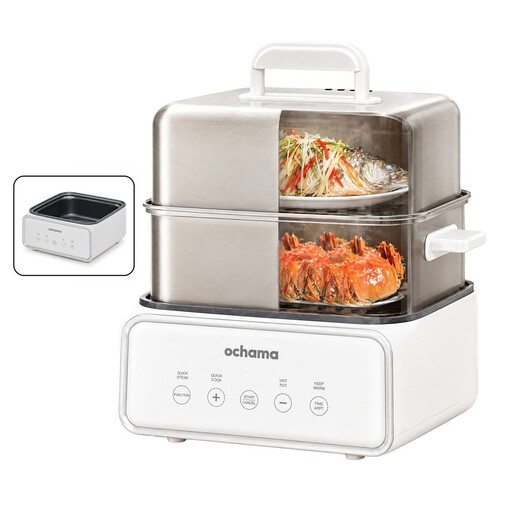 No image available
The description specifies two tiers that can be used separately or combined to create a larger cooking space.
It lists a capacity of 12 l, plus timer and delay-start functions. The steam valve and inner pot get hot, according to the safety information. Use the appliance on a flat, heat-resistant surface.
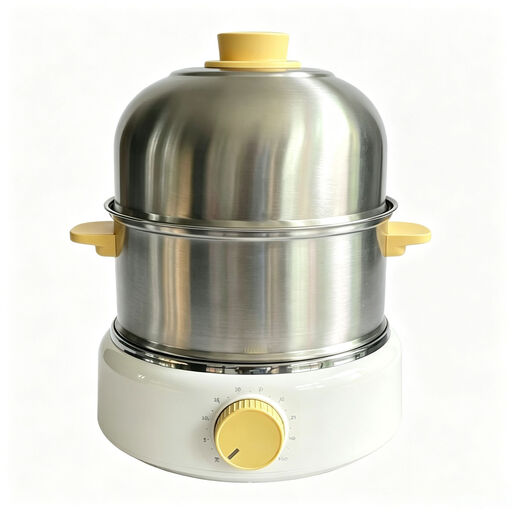 No image available
The product description lists vegetables as suitable for steaming. Compare the usable area of the insert with your portion of squash.
The appliance dimensions are listed as approximately 13,5 × 13 × 18,5 cm. The safety information warns of hot steam and hot surfaces.
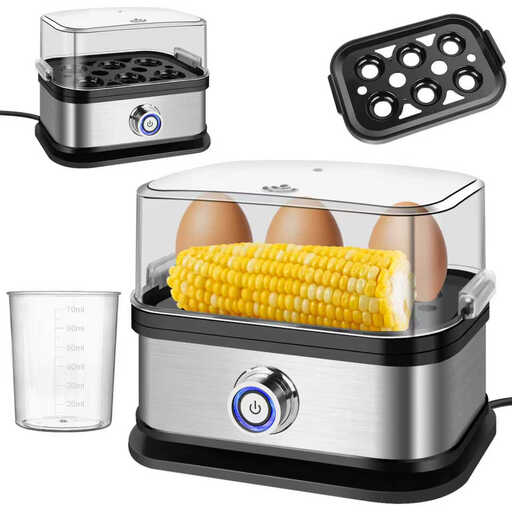 No image available
The product description lists a steaming function for vegetables and removable parts.
A 45-minute timer and automatic shut-off are specified. The safety information warns that accessible surfaces may get hot during use.
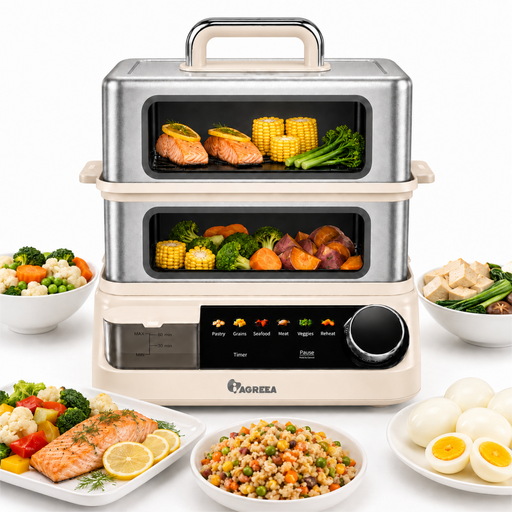 No image available
The two removable stainless steel trays are each listed as 300 × 230 mm, so you can compare these dimensions directly with your portion of squash.
Other features listed include a 2,5-l water reservoir, six programmes and a timer. The safety information requires the appliance to be placed on a flat, heat-resistant surface with good ventilation. Accessible surfaces may get hot.
 No image available
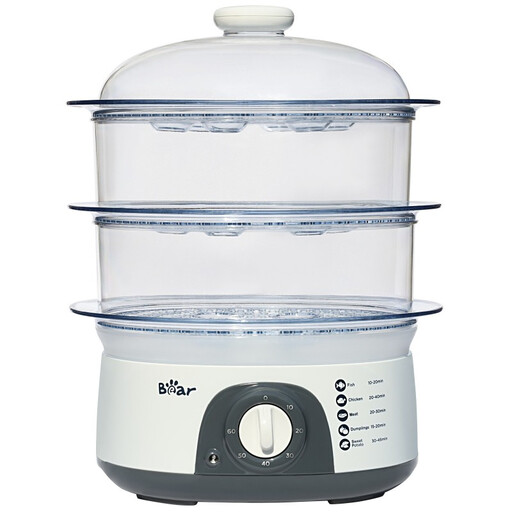
The model is described as having three flexible tiers and a capacity of 10 l. Its dimensions are listed as 295 × 255 × 375 mm.
A 60-minute timer and removable parts are listed. The instructions say steam escapes through openings in the lid; the appliance needs a flat, stable surface.
Compare the internal dimensions of a single basket with your prepared portion. The capacity in litres for the whole appliance won’t answer this question. A WMF recipe gives a cooking time of around 10–15 minutes for Hokkaido squash wedges over boiling water, until they reach the desired texture. This timing applies to the preparation described in that recipe; it isn’t a definitive guide for other sizes of piece or other appliances.
That depends on the set-up instructions for the specific model and where the steam escapes. The Steba DG 2 instructions require at least 10 cm of clearance all around the appliance. You can’t assume the same distance applies to other models.
Check the care instructions for the baskets, lid and drip tray individually. Tefal describes the accessories, rice insert, lid and drip tray for the VC1451 as dishwasher-safe. This doesn’t mean the electrical base can go in the dishwasher, too.
No. Your statutory rights for faulty goods are against the seller; a guarantee is an additional voluntary promise with its own terms and conditions. When buying replacement baskets, also check the exact model name: Steba lists spare parts for the DG 2.
For mains-powered appliances covered by the EU Low Voltage Directive, CE marking is one of the applicable conformity requirements. Check the labelling on the specific appliance: it is the manufacturer’s declaration, not independent EU approval.