Cooking without a finished kitchen
If you need a standalone cooking station during your renovation, first check that the socket, cable route and stable surface are suitable for the specific appliance.


If you have a safely usable socket and a stable place to set it up during your kitchen renovation, choose an electric frying pan based mainly on the cooking area you need and the space available. Smaller pans are easier to fit on a limited worktop, while larger ones give you more room to cook several portions at once but take up more space. Wattage and the stated maximum temperature alone don’t guarantee even browning or crispy bacon.
If you need a standalone cooking station during your renovation, first check that the socket, cable route and stable surface are suitable for the specific appliance.
If you want to fry several rashers side by side, the available cooking area matters more than a capacity in litres or an advertised maximum temperature.
If you’re happy to cook portions one after another, a more compact pan may be worth considering. Also check the care instructions for the pan and temperature control.
First, check that the socket and space are suitable for using the appliance. Then make sure the cooking area, appliance dimensions and cleaning requirements work for your temporary kitchen.
| What to consider | What to check before buying | Who it matters most to |
|---|---|---|
| Safe connection and stable positioning | Check the rated power and connection details, that the socket is suitable for use, that the surface is level, and that the cable won’t be pulled or create a trip hazard. | If I’m cooking without a hob during the renovation, my temporary cooking station needs to be safe to use. Around 33% of consumers put connection and stability first. |
| Cooking area for portions | Compare the cooking area’s diameter and usable flat surface. Don’t estimate how many rashers will fit from the diameter or capacity alone. | If I want to cook several rashers at once, I look at the cooking area rather than just the capacity in litres. Around 25% of consumers prioritise space for cooking several portions at once. |
| Fat and cleaning | Check the coating, care instructions and guidance on removing the temperature control for the exact model. | If I need to clear away fat after cooking, I want to know how the instructions say to clean the pan. Around 25% of consumers put easy cleaning first. |
| Setup and storage space | Allow for the external dimensions, including handles, as well as room for the lid and cable. The pan diameter and external dimensions are not the same thing. | If my worktop is temporary or short on space, I need an appliance that fits there safely, and I can plan to cook in several batches instead. Around 17% of consumers prioritise a small footprint. |
Capacity and cooking-area diameter describe different features. Tristar lists the PZ-2964 as having a capacity of 3 l and a cooking-area diameter of 40 cm.
To cook rashers side by side, compare the usable cooking area and measure the space where you plan to set up the appliance.
A detachable cable doesn’t mean the pan can go in the dishwasher. Tristar states that the PZ-2964 is not dishwasher-safe.
Before buying, read the cleaning instructions for the specific model and let the appliance cool down before cleaning it.
The German Federal Institute for Risk Assessment notes that PTFE-coated cookware can release harmful fumes when heated to 360 °C or above while empty. This doesn’t tell us the precise composition of every coating mentioned here.
Follow the instructions for the pan you choose, and don’t assume the advice about PTFE applies to models with different coatings without checking.
A large pan may be impractical on the worktop you have left or in temporary storage. CASO lists the external dimensions of the Profi Partypfanne 1491 as 490 × 160 × 430 mm.
Check the space, cable route and suitable socket separately before choosing a model.
The PP 3401 is a compact, shallower option, while the PP 3570 C offers greater depth.
The PZ-2963 and PZ-2964 come in different sizes, offering a compact or larger cooking area.
The Profi Partypfanne 1491 is a larger option, so its external dimensions are important in a cramped temporary kitchen.
The 162367 Multi Wonder Chef Pro is a deeper multi-purpose pan for cooking dishes beyond bacon.
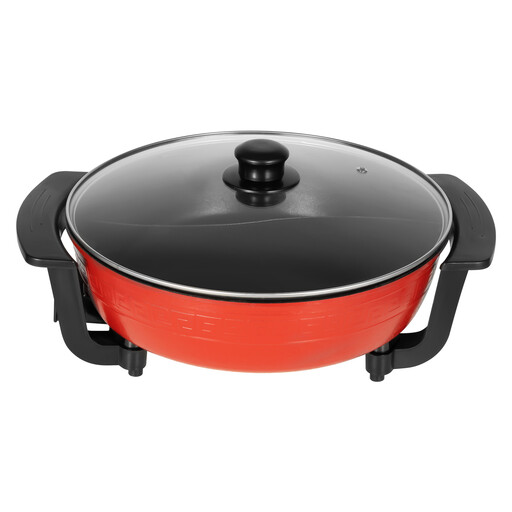
Electric pan for cooking without a hob – an option for a temporary kitchen, as long as the space and connection are suitable for the appliance.
 No image available
This could work as an electric cooking station without a hob if a pan with a 31 cm diameter fits your chosen space; the product description specifically mentions frying.
Aluminium pan with non-stick coating; five temperature settings; 1360 W; 220 V EU plug.
No, being able to reach the socket isn’t enough. Check that it’s safe to use while the work is under way, and compare the appliance’s connection and power details with the socket you plan to use and any other appliances running at the same time. If you’re unsure about the installation, ask a qualified electrician to check it. According to its instructions, CASO requires the Profi Partypfanne 1491 to be connected to a properly installed protective earth system.
You can’t reliably work this out from the diameter or capacity in litres alone. Compare the usable flat area of the specific model with the number of rashers you want to cook side by side, and check its external dimensions against the space available.
A detachable cable doesn’t mean the pan is dishwasher-safe. Tristar explicitly states that the PZ-2964 is not dishwasher-safe; follow the care instructions for other models. Unplug the appliance and let it cool before cleaning.
Multiply the rated power in kilowatts by the operating time in hours to get the energy use in kilowatt-hours. At 1500 W, running continuously for 30 minutes would work out at 0.75 kWh. This calculation uses the rated power; it isn’t a measurement of actual energy use, which may vary as the temperature is regulated.
Follow the instructions for the specific model, and don’t heat a PTFE-coated pan to a high temperature while it’s empty. The German Federal Institute for Risk Assessment notes that PTFE-coated cookware can release harmful fumes in these conditions at 360 °C or above; this doesn’t establish the exact coating used on other models.