
Lieferung heute & morgen

Qualitätsgarantie

Willkommens-Angebote freischalten: KOSTENLOSE Lieferung | Bis zu 80 % RABATT | Kostenlose 30-Tage-JoyPlus-Testphase
App herunterladen
An electric grill can replace charcoal and gas when you want straightforward cooking in the kitchen, at the dining table or on a suitable balcony. However, it is worth taking a close look at the design and features before buying. Wattage, non-stick coatings and automatic programmes often sound convincing in product descriptions, but on their own they say little about how practical a grill is for everyday use.
This selection from the Joybuy Product Recommendation Officer explains which features really matter and which appliance category is right for different households.
A high power rating can help the grill heat up quickly. However, it does not guarantee an even temperature or a sufficiently large grilling surface. Heat distribution, the plate design and the ability to adjust the temperature are also important.
For one or two people, a compact contact grill with 800 to 1,600 watts may be sufficient. Families or people preparing larger portions should look for a larger cooking surface and at least around 2,000 watts. The electrical installation must be suitable for the stated power rating.
A coating can make it easier to remove food. However, it should not be treated with metal utensils or abrasive cleaners. It is equally important to check whether the plates are genuinely removable and, according to the manufacturer, dishwasher-safe.
A dishwasher-safe electric grill reduces the cleaning effort, particularly when both the plates and the drip tray can be removed. The main appliance, cable and plug must never be immersed in water.
A multifunctional electric grill can often be used as a contact grill, tabletop grill or plancha. This means the appliance needs enough room to open fully. Before buying, check the dimensions when open as well as where it can be stored.
The grilling surface determines how many portions can be prepared at the same time. Small plates are suitable for sandwiches, panini or individual portions. For several people, surfaces of around 600 cm² or more are more practical.
An 8-person raclette grill is not the same as a traditional contact grill: here, the number of pans is just as important as the upper grilling plate. Eight pans allow everyone to eat together, but they require more table space and a longer preparation time.
Variable or multi-stage temperature control is useful when preparing different types of food. Vegetables, fish, bread and meat do not necessarily require the same heat. An electric grill with temperature control offers more control than an appliance with a fixed temperature.
Automatic programmes can make operation easier. However, they do not replace control over cooking time, thickness and the quantity of food being grilled. For appliances with manual settings, the temperature range should be listed in the technical specifications.
Look for removable plates, a drip tray and clear care instructions. Ribbed surfaces create a classic grill pattern, while smooth areas are more suitable for vegetables, eggs or sandwiches. Reversible plates can broaden the range of possible uses.
An indoor grill should be placed on a stable, heat-resistant surface with sufficient clearance from flammable objects. Even with reduced smoke production, good ventilation is advisable. For outdoor use, follow the relevant manufacturer’s instructions.
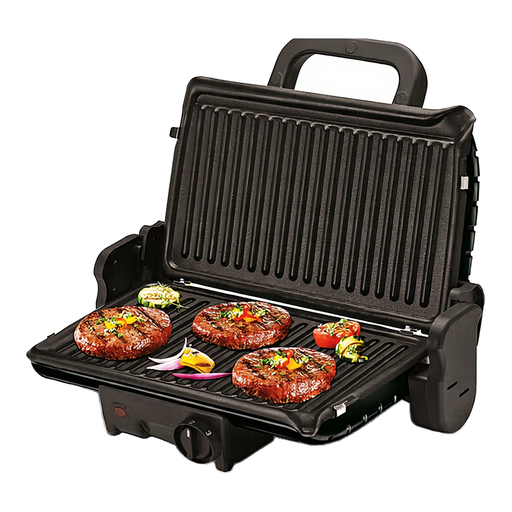
Why this product suits this profile: The 1,600-watt model is designed for sandwiches, panini and smaller grilled portions, and can be folded away neatly to save space.
The technical specifications state a fixed temperature of around 200 °C and a surface area of 30 × 17 cm. This makes it easier to assess what the grill is suitable for.
Removable, dishwasher-safe plates, a fat collection system and three operating positions.

Why this product suits this profile: This appliance combines a contact grill with a fully opened indoor grill, offering nine automatic programmes and a stated power rating of 2,100 watts.
According to the product information, the automatic adjustment takes the thickness of the food into account. Manual controls also provide flexibility for different types of food.
According to the product description, the removable non-stick plates and juice collection tray are dishwasher-safe.

Why this product suits this profile: With contact grill, BBQ and oven positions, this appliance is aimed at households that want to use different cooking methods in a single electric grill.
The three grilling positions are clearly specified. This allows you to check before buying whether the appliance offers more than contact grilling alone.
2,200 watts, separate thermostats, a boost function and a grill thermometer included.
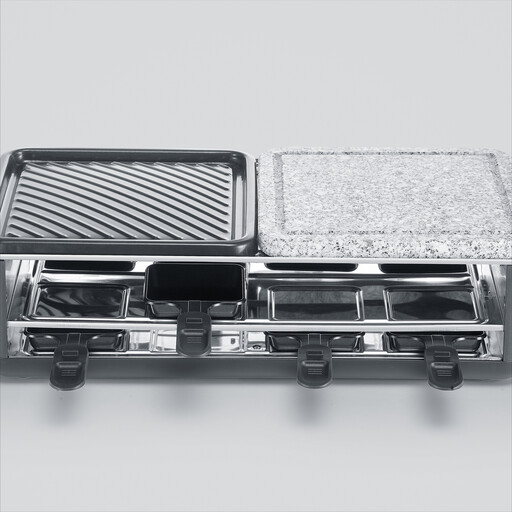
Why this product suits this profile: Eight pans, a ceramic-coated grilling plate and a natural grill stone support shared preparation at the table.
The capacity is clearly stated as eight pans. Adjustable temperature settings make it possible to adapt the heat to different ingredients.
Extra-deep 20 mm pans, a warming rack and click-in storage for the pans.
We have put together a complete, regularly updated list of products that fully meet these strict selection criteria and the safety regulations applicable in the EU.
Ongoing costs mainly depend on power rating, usage time and your electricity tariff. The simple calculation is:
Power in kilowatts × operating time in hours × electricity price per kilowatt-hour = running cost.
A 2,000-watt appliance theoretically uses 2 kWh when running at full power for one hour. In practice, the heating element switches off regularly depending on the temperature and thermostat. Preheating, portion size and an open lid affect actual consumption.
For a long service life, it is important to use a suitable power supply, ensure adequate ventilation and clean the appliance once it has cooled completely. Coated plates should not be treated with sharp or metal objects. If the cable, plug or housing shows visible damage, stop using the appliance.
For small portions and sandwiches, 800 to 1,600 watts may be sufficient. Families and people preparing meat or several portions will often benefit from 2,000 watts or more. Wattage should always be assessed together with the grilling surface, temperature control and heat distribution.
An appliance specifically designed for indoor use can be used in the home. It should be placed on a stable, heat-resistant surface and never left unattended while operating. Good ventilation is advisable, as grilling can still produce odours and vapour despite the drip tray.
It is not possible to give a reliable fixed lifespan for all models. This depends on how often the appliance is used, how well it is cared for, the coating, heating system and storage conditions. Removable plates, available spare parts and clear manufacturer maintenance instructions can make long-term use easier.