
Lieferung heute & morgen

Qualitätsgarantie

Willkommens-Angebote freischalten: KOSTENLOSE Lieferung | Bis zu 80 % RABATT | Kostenlose 30-Tage-JoyPlus-Testphase
App herunterladen
An electric heater can be used flexibly in rented flats, living rooms, offices, bathrooms or on the patio. The range extends from compact fan heaters and ceramic fan heaters to infrared heaters for indoor and outdoor use. However, high wattages, app control and terms like “Eco” do not automatically mean you are getting a suitable or cost-effective heating device.
Before you buy, it is worth avoiding three common pitfalls:
Power consumption is given in watts. A fan heater with 2,000 watts running at full power for one hour theoretically uses 2 kWh. The actual cost is calculated as follows:
Power in kW × operating time in hours × electricity price per kWh
A device with multiple power levels can adapt its usage more effectively. For example, the Komodo Cozi+ offers 750, 1,500 and 2,000 watts. A heater with a thermostat switches off the heating function once the target temperature is reached, or reduces it – depending on the design. This can limit consumption compared to continuous operation at the highest setting, but it does not replace a concrete cost calculation.
An “energy-saving fan heater” should therefore not be chosen based on marketing claims alone. Check whether Eco mode, thermostat, timer and multiple power levels are actually present.
A classic fan heater warms the room air using a fan. It is particularly suitable for quick, short-term heating. Ceramic fan heaters combine a ceramic heating element with a fan. Pay attention to noise levels, air outlet and automatic shut-off.
An infrared heater emits heat radiation directly into the desired area. This is especially useful on a sheltered patio, balcony or in a well-defined seating area. The effect depends heavily on whether the people or surfaces to be heated are within the radiation range. An infrared heater does not automatically warm every corner of a large room evenly.
For outdoor use, IP rating, stability, cable routing and the manufacturer’s instructions are also crucial. A patio heater must not be covered and must be kept at a sufficient distance from furniture, curtains, wood, textiles and other flammable materials.
Useful features for everyday use include:
An electric fan heater with a remote control is convenient, but should not be left running unattended for long periods. The device must not be covered during operation. After use, it is advisable to switch it off and – if recommended by the manufacturer – disconnect it from the mains after it has cooled down.
The following recommendations assign specific models according to the intended use and the technical features stated.
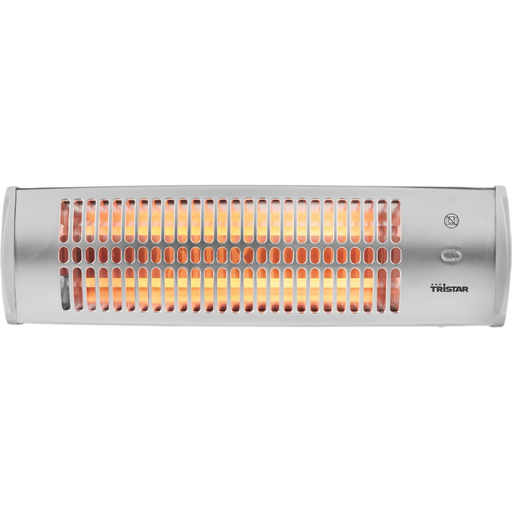
Why this product fits the profile: This 1,200-watt device is designed as a straightforward plug-in supplementary heater and is ideal for users who want simple operation without extensive extra features.
The clearly stated power output makes it easy to estimate consumption. The timer can enable automatic shut-off between 1 and 12 hours.
1,200 watts, compact design and automatic shut-off via timer.
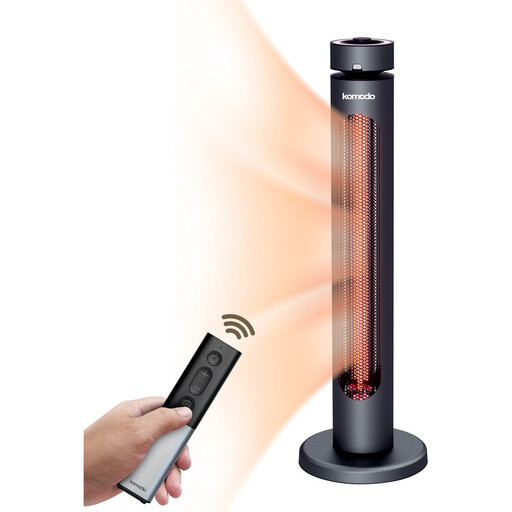
Why this product fits the profile: The infrared technology, eight heat levels, remote control, app control and 180-degree oscillation offer multiple adjustment options for indoor use and sheltered outdoor areas.
The stated coverage area of up to 35 m² should be treated as a guide. The safety features do not replace the required distance from water and flammable materials.
2,000 watts, 24-hour timer, 180-degree rotation plus remote control and app according to the product description.
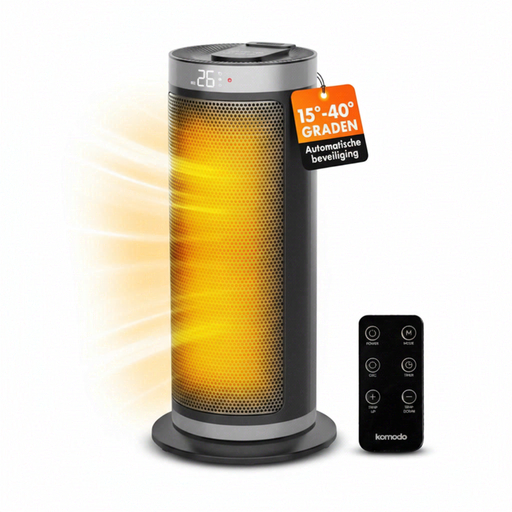
Why this product fits the profile: This ceramic fan heater combines three power levels with a thermostat, Eco mode, 90-degree oscillation and safety features. It is specified for rooms up to 25 m².
Multiple power levels mean you do not always need the highest setting. Overheat and tip-over protection are listed as safety features.
750/1,500/2,000 watts, adjustable thermostat from 15 to 40 °C, Eco mode and 90-degree oscillation.
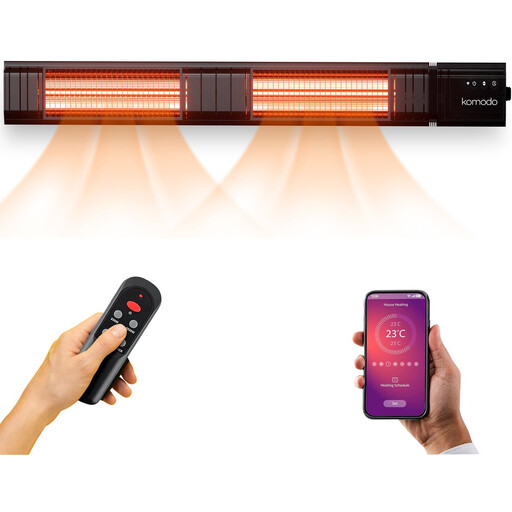
Why this product fits the profile: This infrared heater comes with nine settings, 180-degree oscillation, remote control and app, and is designed for larger, clearly defined seating areas.
The IP65 rating is explicitly stated as water and dust protected, but this is not a licence to submerge it. The device must stand freely and must not be covered.
3,000 watts, nine heat levels, 180-degree oscillation, LED display and 24-hour timer according to the product data.
We have put together a complete, regularly updated list of products that fully meet these strict selection criteria and the safety regulations in force in the EU.
Consumption depends on power output, running time and control. A 2,000-watt fan heater running at full power uses 2 kWh per hour of operation. A thermostat, timer and lower power settings can reduce the actual time spent running at high heat output. For an accurate estimate, multiply the consumption by the current price on your electricity bill.
This depends on the specific model and its IP rating. A stated IP classification describes the intended protection, but does not replace safety distances. Heaters must not come into contact with water, must not be placed directly next to a shower or bath, and must only be connected in accordance with the manufacturer's instructions. If in doubt, a model intended for damp rooms should not be used.
The lifespan depends on build quality, operating time, dust exposure, storage and proper use. Only clean the device when it is switched off and has cooled down, keep the air inlets clear and do not use it with a damaged cable. Without information from the manufacturer, it is not possible to give a reliable fixed lifespan.