
Lieferung heute & morgen

Qualitätsgarantie

Willkommens-Angebote freischalten: KOSTENLOSE Lieferung | Bis zu 80 % RABATT | Kostenlose 30-Tage-JoyPlus-Testphase
App herunterladen
An electric heater can warm individual rooms quickly and flexibly – whether it’s a bedroom, living room, home office or bathroom. However, not every appliance is suitable for every location. Focusing solely on wattage or overly ambitious claims often means overlooking important details.
Three common purchasing and marketing pitfalls are particularly relevant:
A fan heater or ceramic fan heater warms the air using a fan. This means heat is produced immediately at the outlet. PTC ceramic elements are often used in portable appliances. They are particularly suitable when you want to heat a room for a short period.
An electric convection heater generally warms room air more slowly and does not necessarily require a fan. This can be useful in home offices or bedrooms where quiet operation is a priority.
An infrared heater directs radiant heat towards nearby surfaces and people. An electric freestanding heater, on the other hand, is not a separate heating technology. The term usually refers to a freestanding, portable appliance. Before buying, you should therefore consider the heating method, output and actual room size together.
An electric heater with a thermostat can monitor the set target temperature and adjust the heating output accordingly. In everyday use, this is generally more convenient than an appliance that simply runs continuously at one fixed setting.
A fan heater with a timer switches off after a preset period. Depending on the model, settings such as 12 or 24 hours may be available. A remote control makes it easier to operate the heater from the sofa or bed, but it does not replace switching the appliance off manually when it is not needed.
Terms such as energy-saving electric heater should be assessed by checking the specific functions available: a low power setting, thermostat, Eco mode and automatic switch-off can make operation easier to control. However, the heater’s electrical output itself is measured in watts and will result in corresponding electricity costs when used for longer periods.
Important features include:
An oscillating fan heater distributes warm air around the room by swivelling from side to side. This can be helpful when there are several seating areas. For a bedroom or home office, the stated noise level is also worth considering. Some models, for example, specify values between 25 and 42 dB or around 50 dB. These manufacturer figures cannot necessarily be compared directly, as measurement conditions may differ.
A portable electric heater should not be covered or used to dry clothes, and it should be allowed to cool down completely after use. For a patio, you need a model specifically certified as suitable for outdoor use. In a bathroom, always check the product’s water-resistance information against the full instructions and local installation requirements.
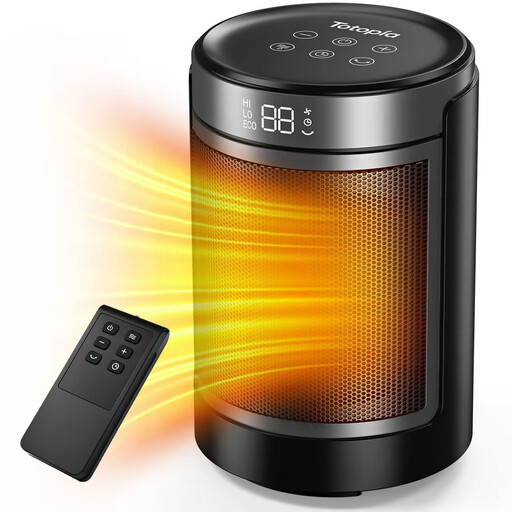
Why this product suits this profile: Four operating modes, including 750 W, 1500 W and ECO, provide a straightforward choice for smaller rooms, workspaces or bedrooms.
The low power setting and 1- to 12-hour timer help prevent the heater from running continuously at full power.
PTC ceramic element, LED display, remote control, plus overheating and tip-over protection according to the product description.

Why this product suits this profile: This model is aimed at households looking to combine temperature control, remote operation and a low stated noise level.
The adjustable range from 5 to 35 °C and several safety functions make operation more controllable than with a basic on-off heater.
2000 W maximum output, stated heating coverage of 15–25 m², 12-hour timer and stated noise level of 25–42 dB.
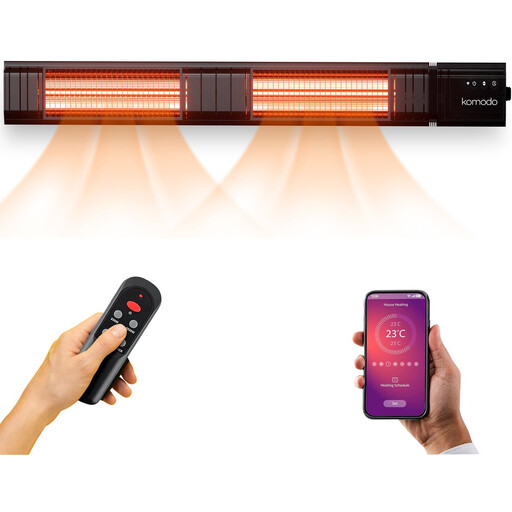
Why this product suits this profile: For a covered patio or larger outdoor area, infrared heat, nine power levels and a 180-degree oscillation function are important considerations.
The IP65 rating is not treated as equivalent to complete waterproofing: according to the description, the appliance must not be submerged.
3000 W, nine heat settings, remote control and app control, plus a 24-hour timer according to the manufacturer’s specifications.

Why this product suits this profile: This compact appliance is specified for smaller rooms measuring 10–20 m² and offers temperature control from 5 to 35 °C.
The stated noise range of 25–42 dB and maximum output of 1500 W offer more concrete comparison points than blanket claims such as “whisper-quiet” or “economical”.
PTC ceramic, remote control, 12-hour timer and several safety functions according to the product description.
We have put together a complete, regularly updated list of products that fully meet these strict selection criteria and the safety regulations applicable in the EU.
An appliance with an output of 2000 W uses around 2 kWh per hour when running at full power. A 1500-W fan heater mathematically uses around 1.5 kWh per hour. A thermostat, Eco mode and timer can reduce the actual running time. For an accurate calculation, multiply the output in kW by the operating time and your electricity price.
Compact ceramic fan heaters or convection heaters with a thermostat, timer and tip-over protection may be suitable for a bedroom. A low stated noise level can improve comfort. The appliance should stand on a firm surface, remain uncovered and have sufficient clearance from bedding, curtains and furniture.
Its lifespan depends on the heating technology, duration of use, exposure to dust, storage and maintenance. Regularly cleaning the air inlets, storing the appliance in a dry place and operating it according to the instructions can help maintain its performance. If the cable is damaged, an unusual smell develops or visible damage is present, stop using the appliance.