
Lieferung heute & morgen

Qualitätsgarantie

Willkommens-Angebote freischalten: KOSTENLOSE Lieferung | Bis zu 80 % RABATT | Kostenlose 30-Tage-JoyPlus-Testphase
App herunterladen
An electric heater can warm individual rooms quickly, such as a home office, bedroom or hobby room you rarely use. But choosing the right one involves more than looking at its wattage. Overblown marketing claims, vague room-size recommendations and missing safety details can all lead to a heater that’s too noisy, costly or impractical for everyday use.
A 2,000-watt fan heater can warm a room quickly. However, at full power it uses around 2 kWh for every hour it’s running. The actual cost depends on its power consumption, how long you use it and your electricity tariff. An ECO mode or thermostat can reduce the time the heater runs, but it won’t automatically lower its power consumption while heating.
Recommendations such as ‘up to 20 m²’ depend on factors including insulation, ceiling height, window area and outdoor temperature. An electric heater that works well in a well-insulated room may need to run for much longer in a draughty older property. For larger rooms that need heating regularly, an electric heater is usually best seen as an additional or occasional source of heat.
A heater with a thermostat, timer or remote control can make it easier to use. But it’s worth checking whether you can set the temperature precisely, whether the timer lets you programme the heater to switch off, and whether it shuts down automatically if knocked over. Check the noise level against where you plan to use it, too. A quiet fan heater for a bedroom needs to meet different requirements from one you’ll use briefly in a bathroom or hallway.
A ceramic fan heater, also known as a PTC fan heater, warms the air quickly and is suitable for short bursts of heat. Oscillation helps distribute the airflow around the room. The downside is that the fan can be audible and may stir up dust.
An oil-filled radiator gives off heat more slowly, operates without a fan and stays warm for a while after being switched off. It’s a good option as a portable heater for living rooms and workspaces, but its design means it needs more floor space.
A convector heater warms the air through natural or fan-assisted convection. It often operates without a powerful fan, but needs clear space for air to circulate.
An infrared heater, such as a heating panel, doesn’t rely primarily on an airflow to provide heat. When choosing one, consider where it will be installed, its dimensions and surface temperature, and whether it’s suitable for the room you have in mind.
Common power settings are 750, 1,000, 1,500 or 2,000 watts. Higher wattage means greater maximum electricity consumption, not necessarily better energy efficiency. A controllable 1,500-watt heater may be enough for a small home office, while a poorly insulated room may need more heating power.
Look for:
An electric room heater should be placed on a stable, dry and level surface. Overheat protection and tip-over protection with automatic shut-off are useful features. The casing and air outlet can get hot, so safety features don’t replace the need to keep an eye on the heater.
If you’re using the heater in Germany, bear in mind:
An IP24 rating doesn’t mean a heater can be used right beside a shower, bath or water source. Always follow the instruction manual and the manufacturer’s specific safety guidance.
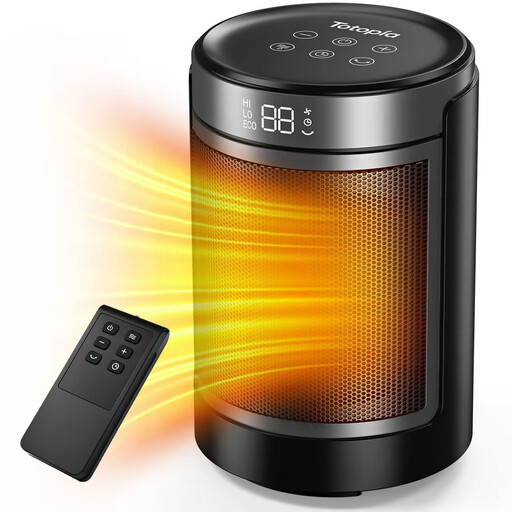
Why it’s a good fit: Four operating modes — fan only, 750 watts, 1,500 watts and ECO mode — let you tailor the heat to smaller rooms such as a home office or bedroom.
The different power settings and timer of up to 12 hours help prevent the heater from running unchecked at its highest setting.
PTC heating element, remote control, LED display, plus overheat and tip-over protection.

Why it’s a good fit: Designed for living rooms and home offices where precise temperature control, a remote control and relatively quiet operation are important.
The product details specify a noise level of 25–42 dB, temperature control from 5–35 °C and several safety features, rather than focusing on wattage alone.
2,000 watts, 70° oscillation, 12-hour timer, ECO control and a stated 8-layer safety system.
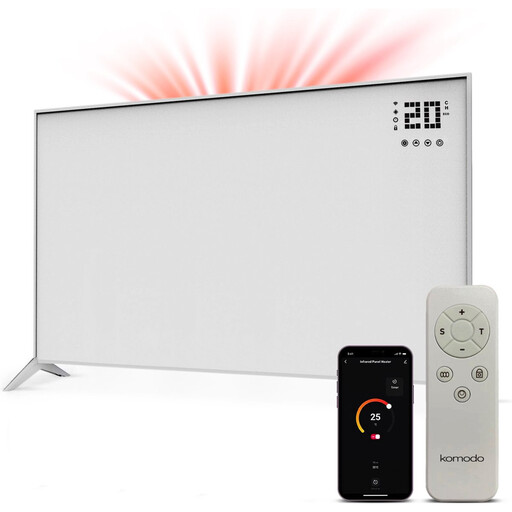
Why it’s a good fit: This panel is worth considering if you’d prefer an infrared heater that can be wall-mounted or freestanding and controlled via an app.
The choice of wall-mounted or freestanding operation, together with a thermostat and timer, makes it easier to suit the heater to your room. You should still check the IP24 rating against the instruction manual.
800 watts, app and remote control, Eco mode, overheat protection and a stated suitability for rooms up to 20 m².

Why it’s a good fit: This compact model is designed for smaller rooms, desks and sleeping areas, where quiet operation and precise temperature control matter.
The stated noise level of 25–42 dB, several power settings and a 12-hour timer make it easier to assess whether it’s suitable for longer, controlled use.
1,500 watts, PTC ceramic technology, remote control, tip-over protection and a thermostat range of 5–35 °C, according to the product details.
We’ve put together a complete, regularly updated list of products that meet these strict selection criteria and the applicable EU safety regulations.
A 2,000-watt heater uses around 2 kWh per hour when running at full power. A 1,500-watt model uses about 1.5 kWh under the same conditions. A thermostat, timer and lower heat settings can reduce the actual running time and, in turn, electricity use. The exact cost depends on your electricity rate and how you use the heater.
For a bedroom, you could consider a quiet fan heater, a ceramic fan heater with a lower power setting or an oil-filled radiator. Before buying, check the stated noise level, timer, tip-over protection and whether you can dim the display. Don’t leave the heater unattended or use it right beside bedding or curtains.
Only if the specific model is explicitly suitable for bathroom use and you follow the required IP rating and safety clearances. An IP24 rating indicates limited protection against splashing water, but it doesn’t automatically mean the heater can be used in every area of a bathroom. Always follow the instruction manual, positioning guidance and applicable installation rules.