
Lieferung heute & morgen

Qualitätsgarantie

Willkommens-Angebote freischalten: KOSTENLOSE Lieferung | Bis zu 80 % RABATT | Kostenlose 30-Tage-JoyPlus-Testphase
App herunterladen
An electric heater can be ready to use quickly in rented homes, home offices or as an additional source of warmth. However, not every model leads to the right purchasing decision. Many products advertise “energy saving”, “whisper-quiet operation” or particularly rapid heating without adequately explaining the key conditions for use.
As Joybuy Product Recommendation Officers, we therefore focus our selection on clear, verifiable criteria: heating output, temperature control, noise levels, placement, ease of use and safety features.
A 2000 W fan heater can warm a room quickly, but at full power it may use up to 2 kWh per hour of operation. Assuming an electricity price of 0.35 euros per kWh, that works out at around 0.70 euros per hour. A thermostat or ECO mode can reduce the operating time, but it does not automatically lower power consumption while the heater is actively running.
The key question is therefore whether the appliance can maintain the desired temperature afterwards and switch off automatically or reduce its heating output.
A small electric fan heater is mainly suitable for individual areas or well-insulated rooms. Open-plan living areas, high ceilings and poorly insulated rooms require greater heating output or a longer operating time. Oscillation distributes warm air more widely, but it does not replace correct sizing.
Not every electric heater may be used close to a shower, bath or washbasin. Check the manufacturer’s information on the IP rating, minimum distances and intended place of use. If there is no specific approval for damp areas, the appliance should not be used there.
A 2000 W fan heater provides high connected power for rapid additional warmth. For smaller rooms, 750 to 1500 watts may be sufficient, particularly where insulation is good. A fan heater with several settings is more practical than a model that operates exclusively at full power.
For larger rooms or spaces that need heating continuously, a convector heater may be the better choice. It works without a strong airflow and distributes heat through natural convection. For a permanent solution, a wall-mounted heater or permanently installed electric radiator may also be worth considering.
A fan heater with thermostat should offer a clearly adjustable target temperature. Models with a range of, for example, 5 to 35 °C allow more precise adjustment than appliances with just two fixed settings.
A fan heater with timer can limit the operating time, for example when you are falling asleep or working in a home office. A remote control makes it easier to operate the heater from the sofa or bed. It is important to remember that a timer and ECO mode are convenience features, not a guarantee of a specific level of electricity consumption.
For bedrooms and offices, a quiet fan heater with a documented decibel rating is worth considering. The noise you actually perceive depends on the fan setting, room acoustics and distance. Figures such as 34 or 42 dB should be understood as manufacturer values.
Regardless of the model:

Why this product suits this profile: Four operating modes, including fan, 750 W, 1500 W and ECO mode, offer flexibility for bedrooms, home offices or a single seating area.
The lower 750 W setting and ECO mode help avoid heating continuously at full power. A timer from 1 to 12 hours limits the operating time.
PTC ceramic heating element, LED display, remote control, oscillation, plus overheating and tip-over protection.

Why this product suits this profile: For bedrooms, offices and other quiet spaces, this model combines an adjustable temperature of 5 to 35 °C with documented noise levels of 25 to 42 dB.
The specific decibel range and stepped power settings of 900, 1300 and 1500 W make the specifications easier to assess than general advertising claims such as “quiet”.
Remote control, 12-hour timer, precise thermostat, oscillation and multi-layered safety features according to the manufacturer.
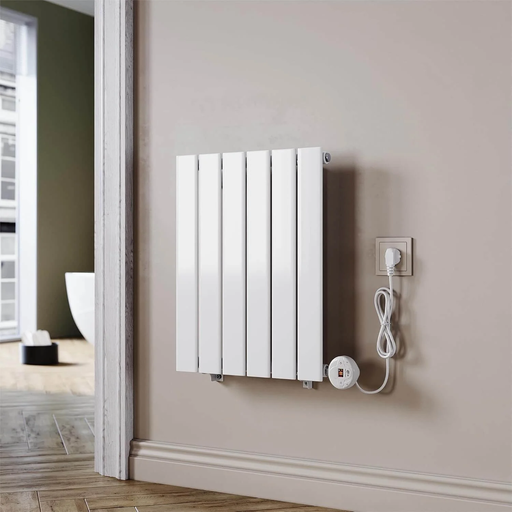
Why this product suits this profile: This permanently wall-mounted electric towel radiator is designed for bathrooms and towel warming, and features a programmable thermostat and timer.
Permanent installation reduces the risk of accidentally placing a portable fan heater too close to water. The specific installation and safety instructions in the manual must be followed.
Programmable thermostat, timer function, wall mounting and use as a towel warmer.
The basic calculation is:
Power in kW × operating time in hours × electricity price per kWh = running costs
A 1500 W fan heater is equivalent to 1.5 kW. If it runs continuously on the highest setting for one hour, it theoretically uses 1.5 kWh. A thermostat can reduce the actual operating time once the room reaches the target temperature. The level of saving depends on insulation, room size, outside temperature and how long the heater is used.
Claims such as “up to 40 per cent energy saving” should be understood as a manufacturer’s claim, not a general guarantee of energy consumption. Compare the operating settings, temperature control and timer function of each model instead.
We have put together a complete, regularly updated list of products that fully meet these strict selection criteria and the safety regulations applicable in the EU.
For small, well-insulated rooms, an appliance with 750 to 1500 watts may be sufficient. 2000 watts provide more heating capacity, but continuous operation at full power also increases consumption. Room size, insulation and the desired heating speed are the main factors.
Unattended continuous operation should generally be avoided. Only use appliances with suitable safety features, set a timer and follow the operating instructions. The appliance must be positioned in the open and must not be covered.
A model should be expressly approved for use in the intended damp area. Check the IP rating, installation distances and connection requirements. A standard electric fan heater without the appropriate marking must not be used near a shower, bath or washbasin.