
Lieferung heute & morgen

Qualitätsgarantie

Willkommens-Angebote freischalten: KOSTENLOSE Lieferung | Bis zu 80 % RABATT | Kostenlose 30-Tage-JoyPlus-Testphase
App herunterladen
An electric heater can warm individual rooms quickly when central heating is not sufficient or heat is only needed occasionally. Typical places to use one include bedrooms, living rooms, home offices, cellars and bathrooms. However, fan heaters, convector heaters and permanently mounted radiators differ considerably in terms of power, noise levels, operation and installation.
If you focus only on a high wattage or eye-catching advertising claims, you may end up buying a device that does not suit the room size or intended use in everyday life. The following points will help you avoid common mistakes.
A 2000 W fan heater can warm a room quickly. At full power, however, it uses 2 kWh of electricity per hour of operation. The actual cost depends on your electricity tariff and how long the heater runs. A 1500 W device uses correspondingly less energy over the same period, but it also delivers less maximum heating power.
An energy-saving fan heater does not fundamentally produce more heat from the same amount of electricity. However, features such as a thermostat, ECO mode and timer can prevent the heater from running for longer or at a higher output than necessary.
The required output depends on factors including room size, insulation, ceiling height, window area and the desired temperature. Manufacturer claims such as “up to 20 m²” should therefore be treated as guidance rather than a guarantee for every home.
A compact electric fan heater may be sufficient for a small home office area. In a poorly insulated cellar or living room, on the other hand, the building fabric and existing heating situation are crucial. A portable device also does not automatically replace permanent room heating.
A heater should not be used in the bathroom simply because it looks compact or splashproof. Check the specific IP rating, the instruction manual and the areas of use specified by the manufacturer. Water, sockets and hot surfaces require particular care.
A dedicated bathroom towel heater or a wall-mountable bathroom radiator must be assessed differently from a standard room heater. If the information is contradictory, follow the manufacturer’s safety instructions. Installation work on permanently installed devices should be carried out by qualified professionals.
Common power ratings include 750 W, 1200 W, 1500 W and 2000 W. Several heat settings are useful because they allow the heat output to be adjusted to the room and how you use it. A low setting may be enough for short periods of warmth at your desk. For larger rooms or faster heating, a higher output may be appropriate.
Check:
A ceramic fan heater generally uses a PTC ceramic heating element. A fan moves the air, distributing heat around the room quickly. This can be practical for short-term use, but depending on the model, it may produce noticeable operating noise.
Convector heaters warm the room air mainly through natural air circulation and are often quieter, but they may take longer to distribute heat evenly. A portable electric heater with a carry handle is suitable for use in different rooms, while a wall-mounted radiator saves space permanently.
A room heater with thermostat adjusts its heating output according to the selected target temperature. A timer can limit the operating time or trigger automatic shut-off. An electric heater with timer is particularly practical for heating the bedroom, home office or bathroom for a limited period.
Also look for:
A heater with remote control makes it easier to operate the device from the sofa or bed. However, it does not replace switching the heater off and disconnecting it from the mains when it will not be used for an extended period.

Why this product suits this profile: This compact device offers 750 W, 1500 W, a fan mode and an ECO mode. The remote control, LED display and 1- to 12-hour timer make it easier to use for limited periods in a home office or bedroom.
The multiple heat settings prevent you from having to heat a small room continuously at maximum power. The timer limits the operating time.
1500 W maximum output, ECO mode, oscillation, LED display and tip-over protection according to the product description.

Why this product suits this profile: According to the product information, this model is designed for 15 to 25 m² and combines 2000 W, 70° oscillation, temperature selection from 5 to 35 °C, a remote control and a 12-hour timer.
The stated room coverage and adjustable temperature help you choose based on specific room details rather than wattage alone.
2000 W, temperature control in 1-degree increments, a stated noise range of 25–42 dB, plus overheat and tip-over protection.
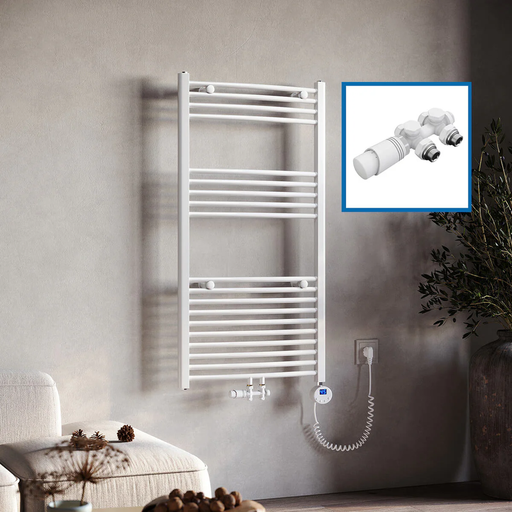
Why this product suits this profile: This white SPCC steel bathroom radiator is designed as an electric towel warmer with a central connection. It is aimed at households looking for a permanently installable solution for the bathroom.
Its intended bathroom use is more clearly defined than that of a standard fan heater. Before buying, check the connection type, dimensions and installation location.
115 cm × 60 cm, SPCC steel, central connection and a bathroom radiator/towel warmer design according to the product description.
We have put together a complete, regularly updated list of products that fully meet these strict selection criteria and the safety regulations applicable in the EU.
A 2000 W device uses 2 kWh per hour at full power. At 1500 W, it uses 1.5 kWh per hour. A thermostat, ECO mode and timer can reduce the actual operating time. Costs are calculated as consumption in kWh × your personal electricity price.
Its service life depends on operating time, exposure to dust, storage and build quality. Clean the air inlet and outlet as instructed, avoid moisture and only move the device once it has cooled down. If you notice an unusual smell, unusual noises, a damaged cable or visible damage, stop using it.
This depends on the specific protection rating and the manufacturer’s approval. A standard electric fan heater is not automatically suitable for damp rooms. Check the instruction manual, IP classification, minimum clearances and connection requirements. For a permanent solution, a bathroom radiator or towel heater specifically designed for this purpose may be more suitable.