
Lieferung heute & morgen

Qualitätsgarantie

Willkommens-Angebote freischalten: KOSTENLOSE Lieferung | Bis zu 80 % RABATT | Kostenlose 30-Tage-JoyPlus-Testphase
App herunterladen
An electric heater is quick to set up and flexible to use – for example, as supplementary heat in a home office, bedroom or infrequently used room. However, prominent wattage figures, supposed energy-saving claims and unclear room-size specifications often lead to poor purchasing decisions.
Three common buying misconceptions are particularly important:
Power consumption is stated in watts. An electric fan heater rated at 2,000 watts theoretically uses 2 kWh per hour of operation when running at full power. The simple calculation is:
Power in kW × operating time in hours × electricity price per kWh = running costs
At 1,500 watts, the consumption is 1.5 kWh per full hour of operation; at 2,000 watts, it is 2 kWh. A thermostat may switch the appliance off temporarily or reduce its power. Actual costs therefore depend on the room temperature, insulation, usage time and electricity tariff.
Look for realistic room-size specifications. The product data, for example, lists 10 to 20 m² for the DREO Atom 416 and 15 to 25 m² for the DREO Solaris SH628. These figures should be treated as a guide, not a guarantee for every home.
A ceramic fan heater, also known as a PTC heater, warms the air and distributes it with a fan. This usually provides noticeable warmth quickly and is suitable for short heating periods. One possible drawback is operating noise, which makes decibel figures relevant. According to the product specifications, the DREO Atom 416 operates at 25 to 42 dB; the DREO Solaris SH628 is also specified at 25 to 42 dB.
An electric radiator or oil-filled radiator works without a powerful airflow. It generally takes longer to heat up, but releases heat more evenly across its surface. The Midea NY2009-24UR is a mobile oil-filled radiator with 2,000 watts, nine fins, a thermostat, timer and remote control. According to the product description, it is intended for longer periods of occasional use in well-insulated rooms.
A convector heater warms the room air through natural or assisted convection. According to the product data, the Aigostar convector is designed for 20 to 25 m² and offers an adjustable temperature range of 5 to 35 °C.
An infrared heater primarily warms the surfaces and people in its path rather than heating the entire room evenly. This can be useful for seating areas or patios. According to the manufacturer’s specifications, the Komodo Flores offers 3,000 watts, nine heat settings, 180-degree oscillation, remote control and app control. The stated IP65 protection rating must still be used precisely as instructed: the appliance must not be submerged, and the permitted outdoor area must match the manufacturer’s guidance.
A suitable portable electric heater should be placed on a stable, level and non-flammable surface. Important minimum features include:
An outdoor heater is not automatically suitable for rain, moisture or every type of socket. Likewise, an ordinary fan heater must not be used in the immediate vicinity of a shower, bath or washbasin unless the manufacturer specifically states that it is suitable. Never cover appliances or use them to dry clothes.
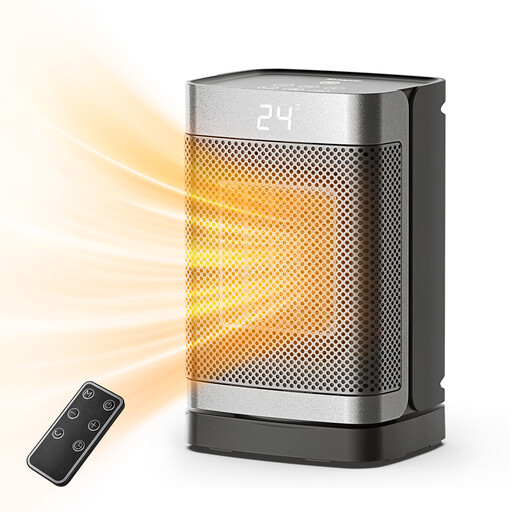
Why this product suits this profile: This compact appliance offers two heat settings, digital temperature control, a remote control and a 12-hour timer for bedrooms, offices or workspaces.
The stated 1,500-watt output is easier to assess alongside the two heat settings and timer than as an isolated maximum figure.
PTC heating element, oscillation, LED display, tip-over protection and overheat protection according to the product specifications.

Why this product suits this profile: Suitable for users looking for a quiet fan heater with a thermostat, remote control and precise temperature adjustment.
The product data specifies a noise range of 25 to 42 dB and a temperature range of 5 to 35 °C, rather than simply marketing the appliance as “quiet”.
1,500 watts, 12-hour timer, PTC technology, tip-over protection and eight stated safety features according to the supplier’s specifications.
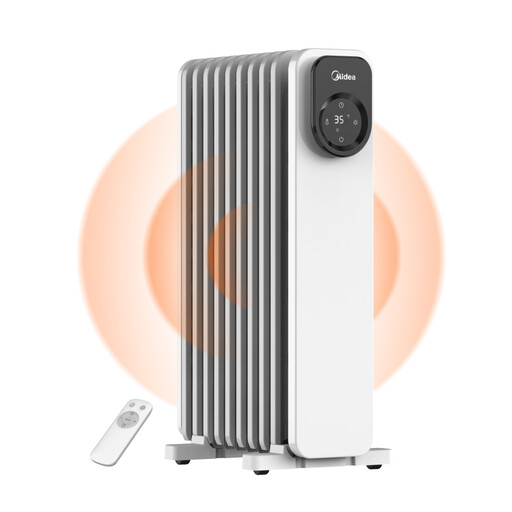
Why this product suits this profile: An option for users who prefer even heat, quiet operation and portability in a living room or home office.
Its design is clearly identified as an oil-filled radiator, so it should not be confused with a fan heater that warms up quickly.
2,000 watts, nine fins, four modes, remote control and LED touchscreen according to the product description.
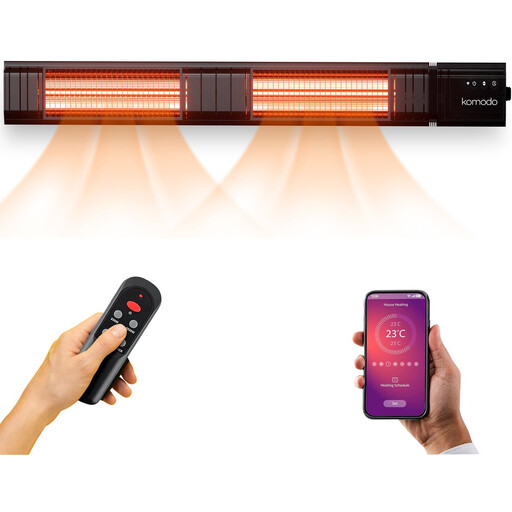
Why this product suits this profile: For covered outdoor areas or clearly defined seating areas where targeted infrared warmth is needed.
The stated IP65 protection rating and outdoor-use specification make its limits of use clearer; complete submersion remains prohibited.
3,000 watts, nine heat settings, 180-degree oscillation, 24-hour timer, plus remote control and app according to the product data.
We have put together a complete, regularly updated list of products that fully meet these strict selection criteria and the safety regulations applicable in the EU.
Before using the appliance for the first time, read the instruction manual and check your electrical infrastructure. An appliance rated at 1,800 or 2,000 watts should be connected directly to a suitable wall socket. Depending on their design, multi-socket adaptors and extension leads may be unsuitable.
Maintain the clearance specified by the manufacturer around the appliance, do not block any air vents, and never place portable appliances on a bed, sofa or soft carpet. A fan heater with a timer can limit the operating time, but it should not be treated as a substitute for safety checks. If you notice an unusual smell, smoke, a damaged cable or repeated automatic shut-offs, switch off the appliance and disconnect it from the mains.
This depends on the power rating and electricity tariff. A 2,000-watt appliance uses 2 kWh per hour when operating at full power. At an assumed tariff of 0,35 Euro per kWh, that would be 0,70 Euro. Thermostat operation and lower power settings can reduce actual consumption.
For short heating periods, consider a quiet fan heater or PTC heater with a thermostat and timer. For longer, quieter use, an electric radiator may be more suitable. Pay attention to the stated room size, noise level and the stability of the surface where it will be placed.
Its service life depends on build quality, exposure to dust, operating time and proper use. Regularly removing dust from the air inlet and outlet, ensuring unrestricted air circulation and following the instruction manual can help maintain performance. If the appliance has visible damage or a faulty cable, it must not be used.