
Lieferung heute & morgen

Qualitätsgarantie

Willkommens-Angebote freischalten: KOSTENLOSE Lieferung | Bis zu 80 % RABATT | Kostenlose 30-Tage-JoyPlus-Testphase
App herunterladen
Long workdays at a desk often lead to neck and back tension. One way to integrate more movement into your workday is by alternating between sitting and standing. An electric height-adjustable desk makes this change in position possible at the touch of a button, contributing to a more ergonomic work environment.
This article serves as a guide. It explains which functional features to look for when making your choice and presents various desk models for different needs and room layouts.
The decision for a new office desk depends on several practical factors. The following points will help you find a model that suits your workspace and work habits.
The size of the desktop determines how much space you have for your work equipment. Consider how many monitors, laptops, and documents you need at the same time. Common dimensions for a home office desk, for example, are 120 x 60 cm or 140 x 70 cm.
Equally important is the frame's load capacity. This indicates how much weight the desk can safely lift and hold. Add up the weight of your entire setup to ensure the desk remains stable, even when fully loaded. The manufacturer's specified maximum load capacity is the crucial figure here.
The height range defines the minimum and maximum height the desk can reach. A good sit-stand desk should accommodate both a comfortable sitting height and an ergonomically correct standing height for your body. As a rule of thumb, your forearms should rest on the desktop at an approximately 90-degree angle, whether sitting or standing.
Operation is usually handled via a simple control panel. Models with a memory function offer added convenience: you can save your preferred sitting and standing heights and recall them at the touch of a button.
An ergonomic desk must be stable at every height setting and should not wobble. Stability is largely determined by the frame's construction. Frames made of robust steel are a common solution here. Some models feature two motors (one per leg), which often contributes to a smoother and quieter lift compared to models with only one motor.
The choice of the right desk depends heavily on individual needs. Here, we present three models that focus on different priorities—from dynamic height adjustment and maximum storage to space-saving solutions.
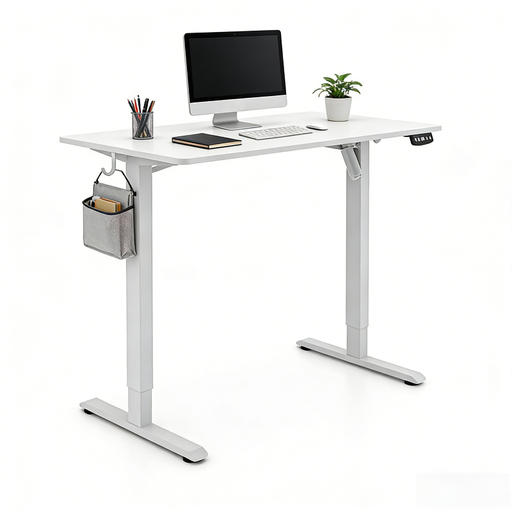
Why it stands out: This model focuses on the core function of an electric standing desk: the simple and quiet transition between different working heights. Its minimalist white design blends seamlessly into modern office or home environments.
Advantages:
Who is it for? For users looking for a functional electric standing desk to actively change their working position and integrate more movement into their day. It is well-suited for standard home office setups.
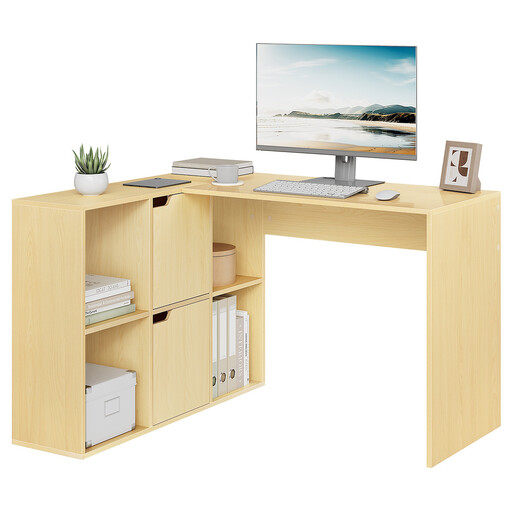
Why it stands out: This desk is designed to make optimal use of room corners. The L-shape creates a generous work surface, while the six integrated compartments keep things organised. This is a fixed-height model.
Advantages:
Who is it for? For individuals who need a large, fixed workstation with plenty of storage and want to efficiently use a corner of their office or study. It is an alternative when height adjustment is not a priority.
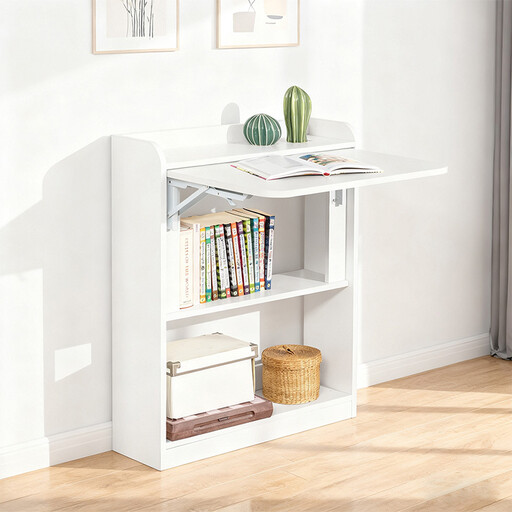
Why it stands out: This model is a solution for apartments or rooms with limited space. The desktop can be easily folded away when not in use, turning the desk into a slim wall shelf.
Advantages:
Who is it for? For users in small apartments, student dorms, or multi-purpose rooms where a permanent desk won't fit.
If your requirements call for a larger, fixed workstation, for instance for complex setups or team workspaces, a commercial L-shaped desk could be a suitable solution. These models are often designed for heavy loads and intensive use.
Discover more models and configurations in our selection.
As a general recommendation, you should change your position every 30 to 60 minutes. The goal is not to stand for hours on end, but to integrate regular posture changes into your workflow to reduce static strain.
The ideal height depends on your body height. Both when sitting and standing, your elbows should form an approximately 90-degree angle, with your forearms resting relaxed and parallel to the floor on the desktop. Your shoulders should remain relaxed.
Modern models are generally designed for quiet operation. The motor's noise level is often specified by the manufacturer in decibels (dB) and is typically below 50 dB. This is roughly equivalent to a quiet conversation or a quiet library and is unlikely to be disruptive in an office environment.