
Lieferung heute & morgen

Qualitätsgarantie

Willkommens-Angebote freischalten: KOSTENLOSE Lieferung | Bis zu 80 % RABATT | Kostenlose 30-Tage-JoyPlus-Testphase
App herunterladen
Preparing traditional herbal decoctions is often a time-consuming process that requires constant supervision. An electric herbal pot promises a solution: it automates the brewing process and is designed to gently extract valuable compounds. However, the market is saturated with devices of widely varying quality. Before you make a decision, it's crucial to understand the common pitfalls that often only become apparent after a few weeks of use.
Many buyers report three core issues: pots made from inferior materials that quickly crack or absorb odours, inefficient heating systems that scorch herbs rather than simmering them, and a lack of automatic functions that defeats the purpose of the appliance. This guide will help you navigate these pitfalls and find a model that reliably serves its purpose.
To avoid buyer's remorse, don't be swayed by marketing promises. Instead, focus on verifiable technical specifications. Three parameters are critical for the function and longevity of an electric herbal pot.
The core component of any herbal pot is the vessel itself. There are significant quality differences here that directly impact the final result and ease of use.
The way the appliance heats determines whether active ingredients are optimally extracted or destroyed.
The main advantage of an electric appliance is its ability to simplify daily life. Therefore, look for features that enable safe, unattended operation.
Based on the criteria above, we have identified a product whose thoughtful design makes it suitable for various user groups.
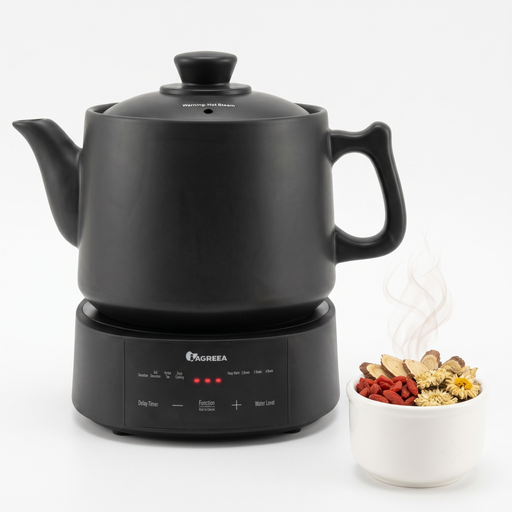
Why it's a great fit: With a 4.5-litre capacity, this automatic tonic soup pot is perfect for preparing larger quantities, such as nourishing soups for the whole family. The 24-hour timer allows you to plan meals or teas in advance, which significantly simplifies a hectic daily routine.
The intelligent heating control prevents boiling over or scorching, allowing the appliance to operate without constant supervision—a key advantage over basic models.
Large volume and full automation for time-saving preparation in a busy family life.
Why it's a great fit: The split-body design makes handling significantly easier. The heavy ceramic pot can be safely separated from the lightweight heating base for cleaning. The intuitive control panel with clear displays is easy to use, even for those without prior technical experience.
The automatic shut-off and keep-warm functions eliminate the risk of boiling dry or scorching if the appliance is forgotten—a crucial safety factor.
Split-body design for safe, effortless cleaning and high operational safety thanks to automatic features.
Why it's a great fit: The high-density, glazed ceramic pot is chemically inert, ensuring that complex decoction formulas remain pure. The heating program, which cycles between a rapid boil and a gentle simmer, mimics the traditional manual process.
Unlike porous clay pots, the smooth glaze prevents the absorption of herbal residues and aromas, which is essential for the purity of each individual batch.
Material purity and a scientific heating program for optimal and authentic nutrient extraction.
We have compiled a complete, up-to-date list of products that fully meet these strict selection criteria and rigorous safety standards.
For models with a split-body design, the ceramic pot can be removed from the heating base and cleaned like a regular cooking pot with warm water and mild washing-up liquid. Thanks to the glazed surface, residue hardly sticks. Avoid using abrasive sponges or harsh cleaning agents to prevent damaging the glaze.
Yes, these appliances are generally safer than manual preparation on a hob. Features like boil-dry protection and automatic shut-off at the end of the program prevent overheating or scorching. This allows for unattended operation, for instance, overnight.
For home use, a wattage in the 500 to 700-watt range is often optimal. This power is sufficient to bring the liquid to a boil efficiently but not so strong that it destroys delicate compounds with overly aggressive heat. An intelligent control system that reduces power after boiling is more important than the raw wattage figure.