
Lieferung heute & morgen

Qualitätsgarantie

Willkommens-Angebote freischalten: KOSTENLOSE Lieferung | Bis zu 80 % RABATT | Kostenlose 30-Tage-JoyPlus-Testphase
App herunterladen
An electric hot pot can replace several kitchen appliances in small flats, student accommodation, offices or when camping. Depending on its design, it can be used to prepare ramen, noodles, rice, soups, vegetables, stews and simple hot-pot meals. However, a high wattage is not the only deciding factor. If you focus solely on “fast heating” or “multifunctionality”, you can easily overlook important details.
A 5- or 6-litre model is suitable for several people, but it requires considerably more storage space and liquid. For a single portion of ramen, such an appliance may be unnecessarily large. Conversely, a 1-litre pot is not sufficient if two or more people regularly eat together.
That is why you should consider the amount you actually need:
The usable filling capacity may be lower than the stated nominal capacity. Leaving enough space prevents boiling liquid from spilling over the rim.
A 300 W mini electric cooker is usually slower, but it may be sufficient for porridge, soup or gentle reheating. An electric cooking pot rated at 600 W to 1,000 W will generally bring water to the boil more quickly. At 1,500 W or 2,000 W, energy consumption increases, while temperature control becomes particularly important.
At least two settings, such as low and high power, are useful. For stews, rice or delicate ingredients, a low setting is more practical than maximum heat alone. Continuously variable controls offer greater flexibility, provided that the controls are clearly labelled.
A non-stick electric cooking pot is easier to clean when used correctly. However, the coating is not a licence to use metal utensils or scouring pads. Use wooden or silicone utensils, and check before buying whether the inner pot can be removed.
Models with a stainless-steel interior, such as an electric cooking pot with a stainless-steel inner pot, are less susceptible to scratches. However, food may stick more easily if too little liquid or fat is used. With coated pots, the surface should be checked regularly for flaking or peeling.
A compact portable electric cooker must not only fit in your cupboard, but also sit safely on your worktop. Check the width, depth and height, including the lid and handles. For use in an office, motorhome or when camping, weight, cable length and a detachable cable are also important.
A multifunction cooker should be able to distinguish at least between gentle cooking and rapid boiling. For ramen and noodles, a high setting for bringing the water to the boil followed by a lower setting for cooking is often sufficient. If you also want to fry vegetables or braise meat, more precise control will be beneficial.
For appliances rated at 220–240 V and 50–60 Hz, the electrical specification for the German market is particularly relevant. Information about the plug, user manual and responsible person in the EU should be clearly available on the product page.
A cooking pot with overheat protection can switch off if the temperature becomes unusually high. Boil-dry protection, also known as dry-boil protection, responds when there is little or no liquid present. These features do not replace supervision during use.
You should also look for:
The electrical base should only be cleaned with a damp cloth. Before pouring, moving or cleaning the appliance, unplug it and allow it to cool down completely.
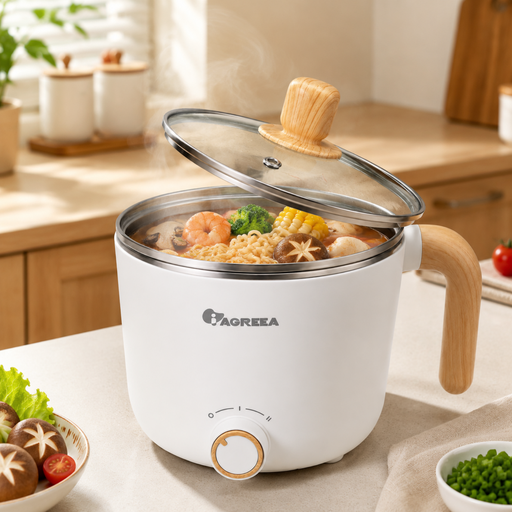
Why this product suits this profile: The 1.0-litre mini cooker is designed for individual portions or meals for two and takes up very little space in student flats, offices or small kitchens.
The stated dual-power control with 300 W and 600 W allows you to cook more slowly or bring food to the boil more quickly, rather than being limited to a single fixed power level.
Stainless-steel interior, 1.0-litre capacity and functions for soup, rice, pasta, vegetables and eggs.
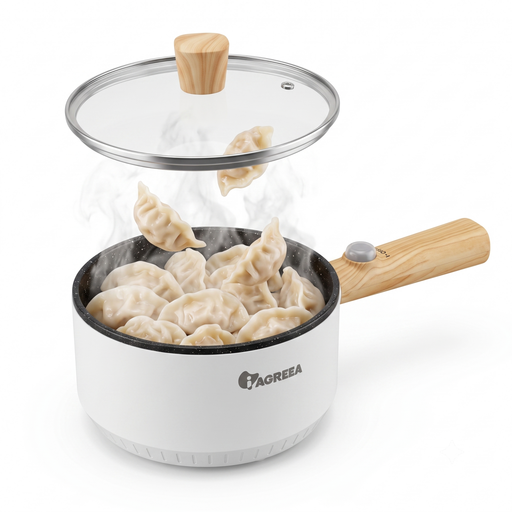
Why this product suits this profile: If you value rapid heating, visible cooking progress and a compact design, this 1.2-litre model offers a glass lid and detachable EU power cable.
The specifications list separate 500 W and 1,000 W settings, along with overheat and boil-dry protection. This makes it easier to choose between gentle and rapid heating.
Marbled non-stick coating, glass lid with steam vent and detachable cable for storage and cleaning.

Why this product suits this profile: With a 5-litre capacity and 1,500 W of power, this model is aimed at families, couples who entertain and anyone who regularly prepares shared hot-pot meals.
The larger capacity means you do not have to cook several small batches for multiple people. The power specifications and boil-dry protection are explicitly stated.
4-in-1 design for hot pot, braising, slow cooking and stews; glass lid and detachable power cable.
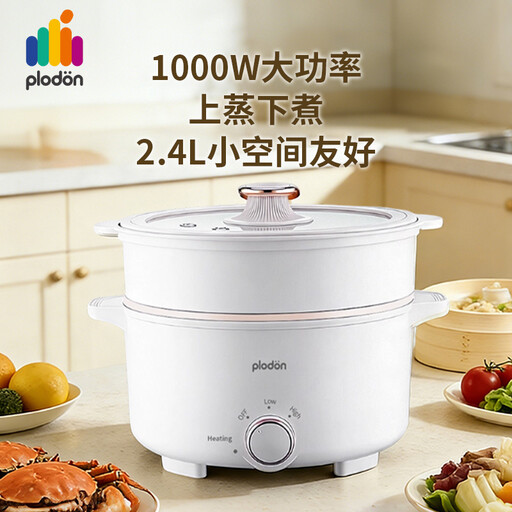
Why this product suits this profile: The 2.4-litre capacity gives you more room than a mini cooker without requiring the footprint of a family-sized model. The additional steaming insert expands your cooking options.
The 1,000 W dual-power control supports rapid boiling and gentle simmering. The detachable steaming insert can be cleaned separately.
2.4-litre capacity, non-stick interior, glass lid and steaming function for noodles, soup, vegetables or small shared meals.
We have put together a complete, regularly updated list of products that fully meet these strict selection criteria and the safety regulations applicable in the EU.
When camping, you should also check that the power supply can safely provide the stated wattage. A 2,000 W appliance places different demands on the socket and power supply than a 300 W mini cooker.
Consumption depends on the power rating and operating time. A 600 W appliance theoretically uses 0.6 kWh after one hour at full power. In practice, the heating element switches off from time to time depending on the temperature control. To calculate your personal cost, multiply the consumption in kilowatt-hours by your electricity tariff.
Yes, provided that the manufacturer specifies this use and enough liquid is added. An electric noodle cooker is particularly suitable for pasta and ramen. For rice, stews or frying, temperature settings and a suitable interior surface are important. Observe the filling limit, as starchy cooking water can foam up more vigorously.
Its lifespan depends on how it is used, how it is cleaned and the condition of the coating. Overheating, operating without liquid, dropping the appliance and using metal utensils can cause damage. A model with a detachable cable, clear instructions and readily available manufacturer information is generally easier to use and store in everyday life.